

By Ginsburg Law Group | TCPA & Robocall Rights
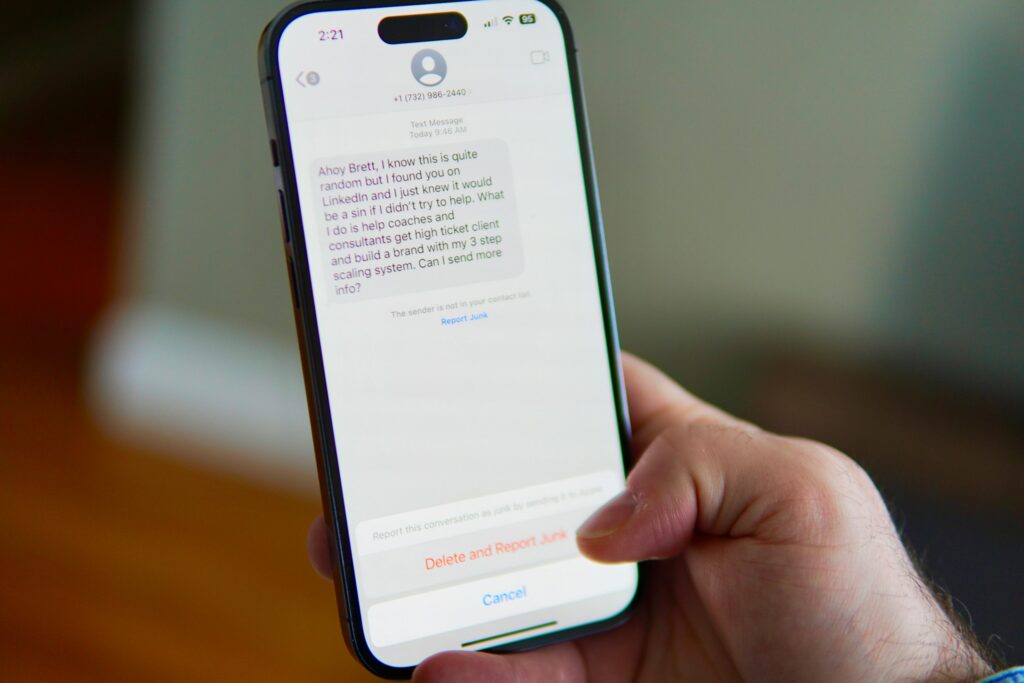
If you’ve been getting marketing texts from a five-digit “short code” for a company you never signed up with, a new federal ruling out of Dallas is worth knowing about. It shows that even in courts that have shut one door on spam-text lawsuits, another door can stay open.
What happened in the case
The case is Callier v. The Finish Line, Inc., No. 3:25-cv-02331-B, in the U.S. District Court for the Northern District of Texas (docket on CourtListener). The plaintiff, who represents himself, alleges he received 97 marketing text messages from the retailer at his personal cell number, even though his number was on the National Do Not Call Registry.
He raised two federal claims under the Telephone Consumer Protection Act (TCPA):
- A do-not-call claim under 47 U.S.C. § 227(c)(5), for telemarketing sent to a number on the Registry.
- An autodialer claim under 47 U.S.C. § 227(b)(1)(A)(iii), which bans calls to cell phones made with an “automatic telephone dialing system” (ATDS) without the person’s prior express consent.
On November 20, 2026, Senior U.S. District Judge Jane J. Boyle ruled on the company’s motion to dismiss. The ruling split the two claims:
- The do-not-call claim was dismissed. The judge applied her recent ruling in another case holding that a text message is not a “telephone call” under § 227(c)(5). She added that trying to re-plead that claim based on texts would be futile.
- The autodialer claim survived. The court found the plaintiff had alleged enough facts to make it plausible that the texts were sent with an ATDS. The case now moves forward on that claim.
Keep in mind that this is an early ruling. The court only decided that the allegations, taken as true, are enough to proceed. Nobody has proven anything yet, and the company will have a chance to fight the claim with evidence.
Why the autodialer claim survived
Since the Supreme Court’s 2021 decision in Facebook v. Duguid, an autodialer claim requires equipment that stores or produces numbers “using a random or sequential number generator” (47 U.S.C. § 227(a)(1)). That’s a hard thing for a consumer to prove before discovery, because you can’t see the sender’s software. We’ve written about how much Duguid narrowed these claims.
Courts in Texas, though, let consumers point to the details of the messages themselves. Here, the court relied on five facts in the complaint:
1. He never signed up for the company’s texts.
2. He never gave the company his phone number.
3. Every text came from the same SMS short code.
4. Every text was a sales pitch asking him to sign up or buy.
5. None of the texts were personalized, over a period of about three years.
Put together, the court said, those facts support an inference that his number wasn’t pulled from a customer list. That’s the kind of thing a random or sequential dialer would produce. The court contrasted this with cases dismissed for thin allegations, such as a single text described only vaguely.
What this means for people getting spam texts
1. The “texts aren’t calls” rulings don’t end every claim. Several Texas federal courts have now said texts can’t support a do-not-call claim under § 227(c)(5). We covered that trend, and the Texas-law options that remain, in Spam Texts in Texas: Federal Courts Say They Aren’t “Calls”. But the TCPA’s autodialer section is a different provision. In Callier, the parties didn’t dispute that a text to a cell phone counts as a “call” for § 227(b), which is consistent with how courts and the FCC have long treated that section.
2. You don’t need to be on the Do Not Call Registry for an autodialer claim. The § 227(b) claim turns on consent and the equipment used, not on the Registry. If the texts are marketing, the FCC’s rules generally require your prior express written consent (47 CFR § 64.1200(a)(2)).
3. The details in your phone are your evidence. The facts that kept this claim alive are things any consumer can document. Save them before you delete anything.
4. Damages. The TCPA allows $500 per violating call or text, and up to $1,500 per message if the court finds the violation willful or knowing (47 U.S.C. § 227(b)(3)). Across dozens of texts, that can add up. The federal TCPA does not, by itself, make the company pay your attorney’s bills, so it’s worth talking with a lawyer about how a case would be handled.
What to save if you’re getting unwanted short-code texts
- Screenshots of every text, showing the sender (the short code or number), the date and the full message.
- A note of whether the texts use your name or are generic. Generic blasts mattered in this case.
- Your history with the company. Did you ever shop there, create an account, enter a contest or type your number into a website pop-up? Be honest with yourself and your lawyer. A forgotten checkout sign-up can be consent.
- Your opt-out. Reply STOP and screenshot the reply and any confirmation. Under the FCC’s revocation rules, you can revoke consent by any reasonable means, and the sender must honor it within 10 business days (47 CFR § 64.1200(a)(10)). Messages that keep coming after STOP are strong evidence. See our guide to the FCC’s new opt-out rules.
- Your Registry status. Check or add your number at donotcall.gov. It still matters for phone calls, and in some states for texts.
The bottom line
Federal courts in Texas are narrowing the do-not-call route for spam texts. Callier shows that the autodialer route is still open when the facts point to mass, impersonal messaging sent without consent. The consumers who do best are the ones who saved the messages, kept track of the sender and opted out in writing.
Getting marketing texts you never signed up for? Contact Ginsburg Law Group. Send us your screenshots and we’ll review whether federal or state law gives you a claim.
This article is for general information only and is not legal advice. Reading it does not create an attorney-client relationship. The case description is based on the court’s November 20, 2026 opinion and the allegations it summarizes; the claims have not been proven.