Debt buyer lawsuits have become one of the most common forms of consumer litigation in America. Every day, consumers are sued by companies they have never heard of over debts they may not recognize, amounts that may be incorrect, or accounts that may not even belong to them.
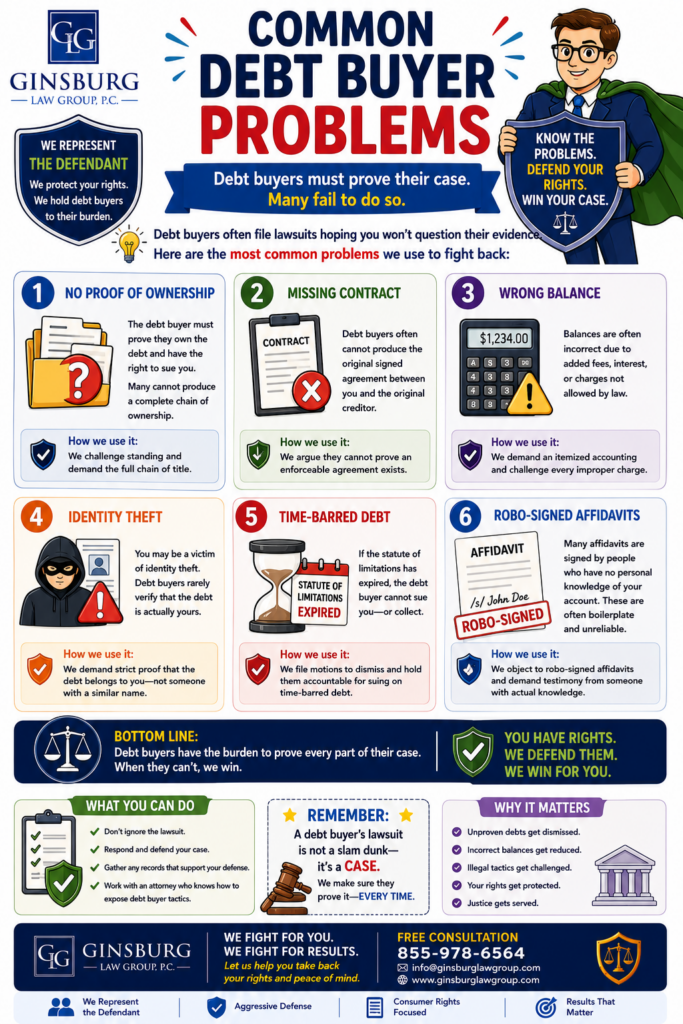
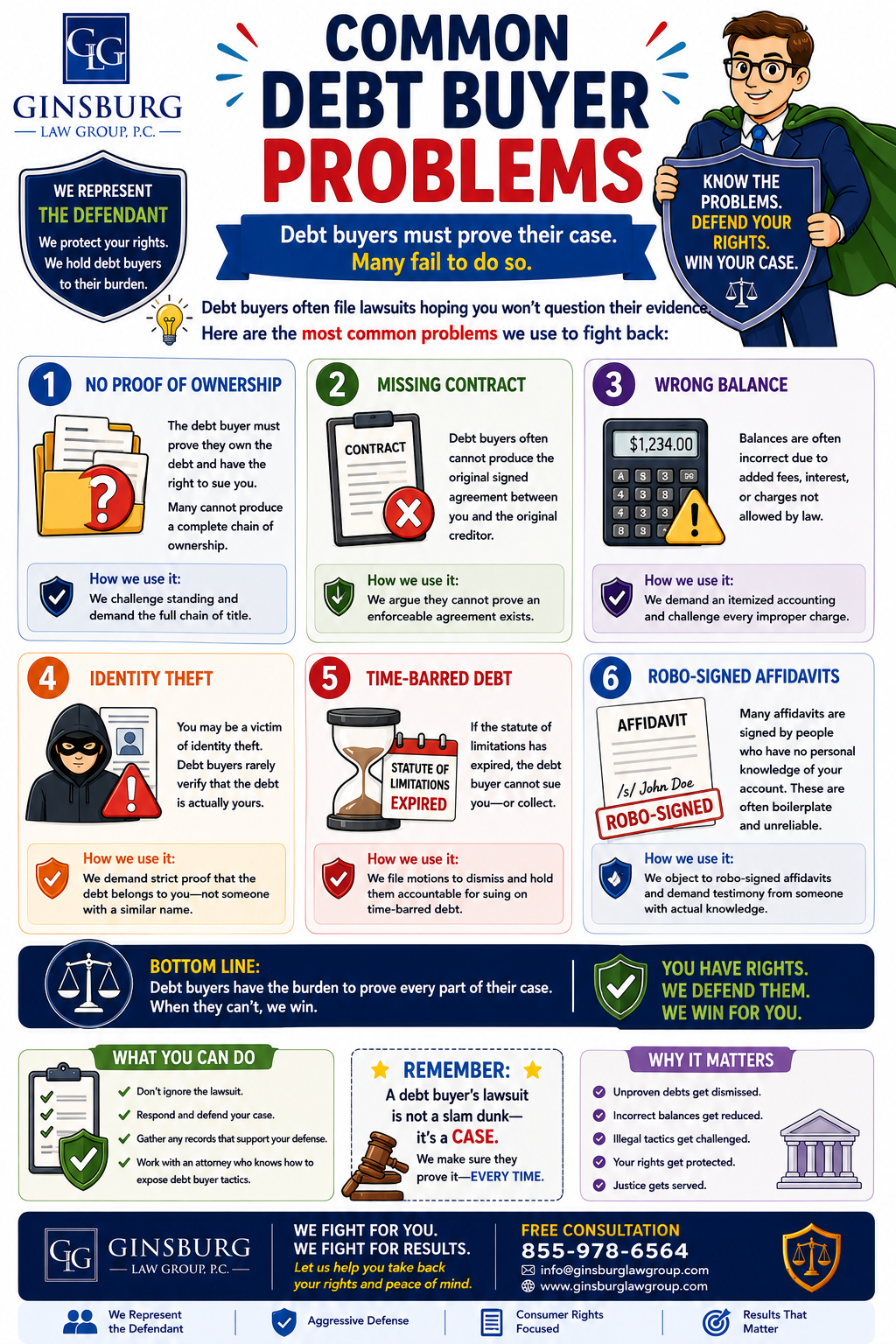
The good news is this: debt buyers must prove their case in court—and many fail to do so.
At Ginsburg Law Group, we represent consumers who are being sued by debt buyers and collection companies. We know the tactics these companies use, and we understand the weaknesses that frequently exist in their lawsuits.
Many consumers assume that if a company filed a lawsuit, the company must automatically have the evidence necessary to win. That is simply not true.
Debt buyer cases are often built on incomplete records, inaccurate balances, missing contracts, questionable affidavits, and unreliable account information. In many cases, when consumers fight back, the debt buyer cannot prove its claims.
Understanding the most common debt buyer problems can help consumers protect themselves and avoid being pressured into paying debts that may not be legally enforceable.
What Is a Debt Buyer?
A debt buyer is a company that purchases charged-off consumer debt from original creditors for pennies on the dollar.
These debts may include:
- Credit card accounts
- Personal loans
- Retail store credit accounts
- Auto deficiency balances
- Medical debt
- Telecommunications accounts
Once purchased, the debt buyer attempts to collect the debt for profit.
Common debt buyers may file thousands of lawsuits each year. These lawsuits are frequently highly automated and based on minimal documentation.
Debt buyers often hope consumers will:
- Ignore the lawsuit
- Fail to appear in court
- Assume the debt is valid
- Feel intimidated into settling quickly
But debt buyers still carry the legal burden of proof.
They must prove:
- They own the debt
- The amount claimed is accurate
- The consumer actually owes the debt
- The lawsuit was filed within the statute of limitations
- The evidence is legally admissible
In many cases, they cannot do so.
Problem #1: No Proof of Ownership
One of the most common issues in debt buyer litigation is the failure to prove ownership of the debt.
Debt buyers do not originate the accounts they sue on. Instead, they purchase portfolios containing thousands of accounts from other entities.
During these sales, records are frequently incomplete, inaccurate, or missing entirely.
Why Ownership Matters
A debt buyer cannot sue a consumer unless it can prove it legally owns the specific account at issue.
This generally requires proof of the entire chain of title from the original creditor to the current plaintiff.
For example:
Original Creditor → Intermediate Buyer → Another Buyer → Current Plaintiff
If any link in that chain is missing, the debt buyer may lack standing to sue.
Common Ownership Problems
Debt buyers often rely on:
- Generic bills of sale
- Spreadsheets with limited data
- Redacted account records
- Incomplete transfer documents
Many of these records fail to identify the specific consumer account being sued upon.
Some lawsuits involve debts sold multiple times, making documentation even more problematic.
How We Fight Back
At Ginsburg Law Group, we carefully examine whether the plaintiff can establish a complete chain of ownership.
We challenge:
- Standing
- Assignment records
- Missing transfer documents
- Incomplete account identification
- Defective evidence
Without proper proof of ownership, the lawsuit may fail.
Problem #2: Missing Contracts
Another major weakness in debt buyer cases involves missing or incomplete contracts.
Many debt buyers cannot produce the original signed agreement between the consumer and the original creditor.
Why Contracts Are Important
The contract establishes:
- The terms of the account
- Interest rates
- Fees
- Payment obligations
- Arbitration provisions
- Default terms
Without the contract, proving the legal basis of the claim becomes far more difficult.
Common Contract Problems
Debt buyers frequently rely on:
- Generic cardmember agreements
- Unsigned documents
- Agreements that do not match the account
- Terms from different years
- Incomplete account records
In some cases, there may be no signed agreement at all.
This becomes especially important when debt buyers seek:
- Interest
- Attorney’s fees
- Collection costs
- Additional penalties
Electronic Agreements Still Require Proof
Even if an account was opened online, the debt buyer must still establish:
- The consumer opened the account
- The consumer agreed to the terms
- The terms being relied upon are authentic
Assumptions are not enough.
How We Defend Consumers
We challenge whether the plaintiff can prove:
- A valid enforceable agreement existed
- The correct terms apply
- The consumer actually agreed to those terms
If the debt buyer lacks admissible contract evidence, that can significantly weaken the case.
Problem #3: Wrong Balance
Consumers are often shocked to discover that the amount claimed in a debt buyer lawsuit may be inaccurate.
Balances can become inflated due to:
- Improper fees
- Excessive interest
- Duplicate charges
- Unauthorized penalties
- Incorrect calculations
Sometimes the amount sued upon is dramatically higher than the original debt.
Why Balance Accuracy Matters
Debt buyers must prove the exact amount owed.
That requires reliable documentation showing:
- Charges
- Payments
- Credits
- Interest calculations
- Adjustments
Without accurate accounting, the claimed balance may be unreliable.
Common Balance Errors
We frequently see:
- Interest added after charge-off
- Unsupported attorney’s fees
- Collection costs not permitted by law
- Mathematical errors
- Missing payment credits
- Incorrect account histories
Some debt buyers rely solely on spreadsheets or summary records that lack sufficient detail.
Consumers Often Assume the Balance Must Be Correct
Unfortunately, many consumers assume that if a company filed suit, the amount must be accurate.
That is not always true.
Debt buyers sometimes purchase incomplete data and attempt to reconstruct balances without adequate records.
How We Challenge Incorrect Balances
We demand:
- Itemized accountings
- Original account statements
- Transaction histories
- Interest calculations
- Documentation supporting all charges
If the plaintiff cannot prove the balance, the claim may be reduced or dismissed.
Problem #4: Identity Theft and Mistaken Identity
Identity theft continues to be a growing problem in consumer debt litigation.
Some consumers are sued for accounts they never opened.
Others are targeted because they share similar names with another individual.
Debt Buyers Often Rely on Limited Information
Purchased account data may contain only:
- A name
- Partial Social Security number
- An old address
- A phone number
This can create serious errors.
Common Identity Problems
We often encounter situations where:
- The debt belongs to someone else
- The account resulted from identity theft
- The plaintiff mixed up consumers with similar names
- Address information is outdated
- The wrong person was sued
Why Verification Matters
Debt buyers must prove the defendant actually owes the debt.
That requires reliable evidence linking the consumer to the account.
Identity Theft Cases Require Aggressive Defense
Consumers dealing with identity theft are often already under enormous stress.
A debt buyer lawsuit can make matters even worse.
At Ginsburg Law Group, we demand strict proof connecting the debt to our client.
We challenge:
- Weak identifying information
- Incomplete records
- Unsupported assumptions
- Deficient account documentation
Consumers should never assume they must pay a debt simply because they were sued.
Problem #5: Time-Barred Debt
One of the most powerful defenses in debt buyer litigation involves the statute of limitations.
A debt buyer cannot legally sue on a debt after the statute of limitations has expired.
What Is the Statute of Limitations?
The statute of limitations is the legal deadline for filing a lawsuit.
The applicable time period varies depending on:
- State law
- Type of debt
- Contract terms
- Account activity
Once the limitations period expires, the debt becomes “time-barred.”
Time-Barred Does Not Always Mean the Debt Disappears
A debt may still exist morally or contractually, but the debt buyer may lose the legal ability to sue.
This distinction is critical.
Common Time-Barred Debt Problems
Debt buyers sometimes:
- Sue on expired debts
- Miscalculate the limitations period
- Rely on incorrect last-payment dates
- Attempt to revive stale debts improperly
Some consumers unknowingly restart the statute of limitations by making partial payments or acknowledging the debt.
Consumers Should Be Careful
Before making payments or entering settlement discussions, consumers should understand whether the debt may already be time-barred.
How We Fight Time-Barred Claims
We investigate:
- Payment histories
- Charge-off dates
- Account activity
- Applicable state law
- Filing dates
If the debt buyer sued after the limitations period expired, we seek dismissal of the case.
Problem #6: Robo-Signed Affidavits
Debt buyers frequently rely on affidavits to support their lawsuits.
Unfortunately, many affidavits are highly questionable.
What Is a Robo-Signed Affidavit?
A robo-signed affidavit is typically a mass-produced document signed by someone who lacks actual personal knowledge of the account.
These individuals may sign:
- Hundreds of affidavits daily
- Thousands of affidavits monthly
Without personally reviewing the records.
Why This Matters
Affidavits are supposed to contain truthful statements based on personal knowledge.
But many debt buyer affidavits rely entirely on:
- Computer-generated information
- Third-party records
- Hearsay data
- Incomplete account files
Common Affidavit Problems
We often see affidavits signed by individuals who:
- Never worked for the original creditor
- Cannot explain the account history
- Have no firsthand knowledge
- Merely review summary spreadsheets
Some affidavits are virtually identical across thousands of cases.
Courts Have Criticized Robo-Signing Practices
Numerous courts have scrutinized and criticized mass affidavit practices in debt collection litigation.
These concerns became especially prominent after widespread foreclosure robo-signing scandals.
How We Challenge Robo-Signed Affidavits
We object to:
- Lack of personal knowledge
- Hearsay
- Improper authentication
- Boilerplate testimony
- Defective business record foundations
Debt buyers must present competent evidence—not mass-produced paperwork.
Why Consumers Should Never Ignore a Debt Buyer Lawsuit
One of the biggest mistakes consumers make is ignoring the lawsuit entirely.
Debt buyers count on default judgments.
If a consumer fails to respond, the plaintiff may obtain a judgment automatically.
That judgment can lead to:
- Bank levies
- Wage garnishment (where permitted)
- Frozen accounts
- Liens
- Credit reporting damage
Even if the debt buyer’s case is weak, failing to respond can result in losing important rights.
What Consumers Should Do If Sued by a Debt Buyer
1. Do Not Ignore the Lawsuit
Deadlines matter.
Responding quickly is critical.
2. Gather Your Records
Collect:
- Account statements
- Letters
- Payment records
- Credit reports
- Identity theft reports
- Prior settlement documents
3. Avoid Admitting Liability Prematurely
Consumers should be cautious before admitting the debt is valid.
4. Consult an Experienced Consumer Defense Attorney
Debt buyer litigation involves complicated legal and evidentiary issues.
An attorney can identify defenses consumers may not recognize on their own.
Why These Defenses Matter
Debt buyer lawsuits are not automatic victories for the plaintiff.
When consumers fight back:
- Weak cases get exposed
- Invalid debts get challenged
- Improper balances get reduced
- Unproven claims get dismissed
The legal system requires debt buyers to prove their claims properly.
That burden matters.
How Ginsburg Law Group Helps Consumers
At Ginsburg Law Group, we aggressively defend consumers against debt buyer lawsuits and abusive collection practices.
We understand the tactics debt buyers use, and we know how to challenge weak documentation and defective evidence.
Our firm evaluates:
- Standing issues
- Ownership documentation
- Contract evidence
- Account balances
- Statute of limitations defenses
- Identity theft concerns
- Affidavit defects
We fight to protect consumers from improper judgments and unlawful collection tactics.
You Have Rights—Use Them
Debt buyers file lawsuits every day hoping consumers will not challenge them.
But these companies still must prove their case.
When they cannot, consumers have the right to defend themselves.
If you are being sued by a debt buyer, do not assume the company automatically has the evidence required to win.
You may have significant defenses available.
Contact Ginsburg Law Group
If you are facing a debt buyer lawsuit, contact Ginsburg Law Group for a consultation.
Ginsburg Law Group, P.C.
855-978-6564
info@ginsburglawgroup.com
www.ginsburglawgroup.com
We proudly defend consumers and hold debt buyers to their burden of proof.