Unwanted robocalls, spam texts, prerecorded messages, and relentless telemarketing calls have become part of daily life for millions of Americans. Whether it’s a fake insurance pitch, a debt relief scam, or repeated calls after you asked a company to stop, these communications are more than just annoying—they may actually be illegal.
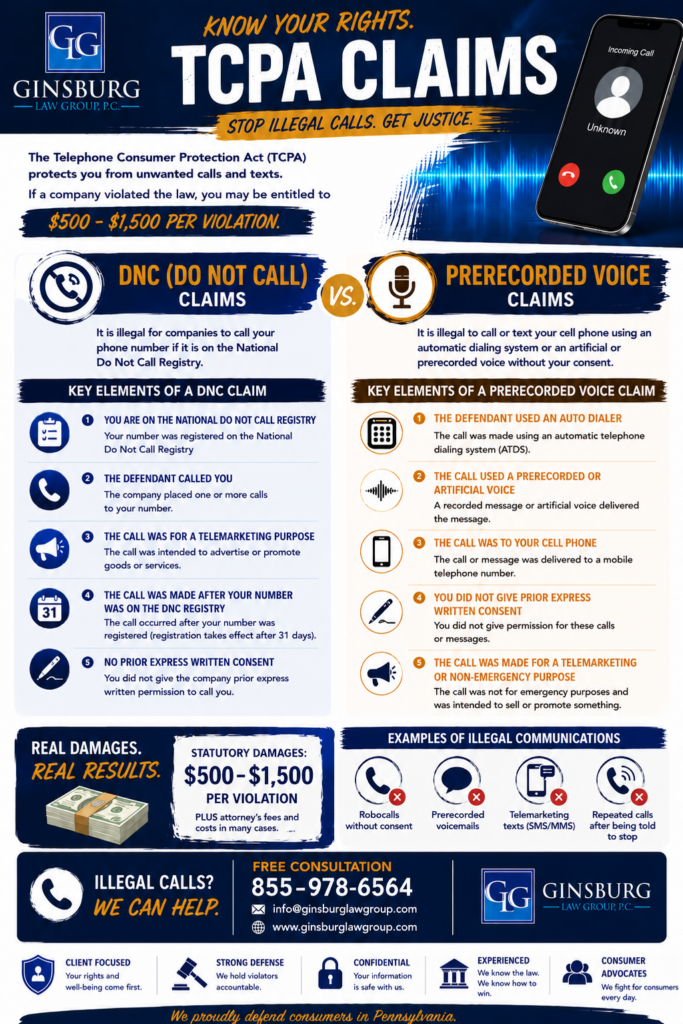
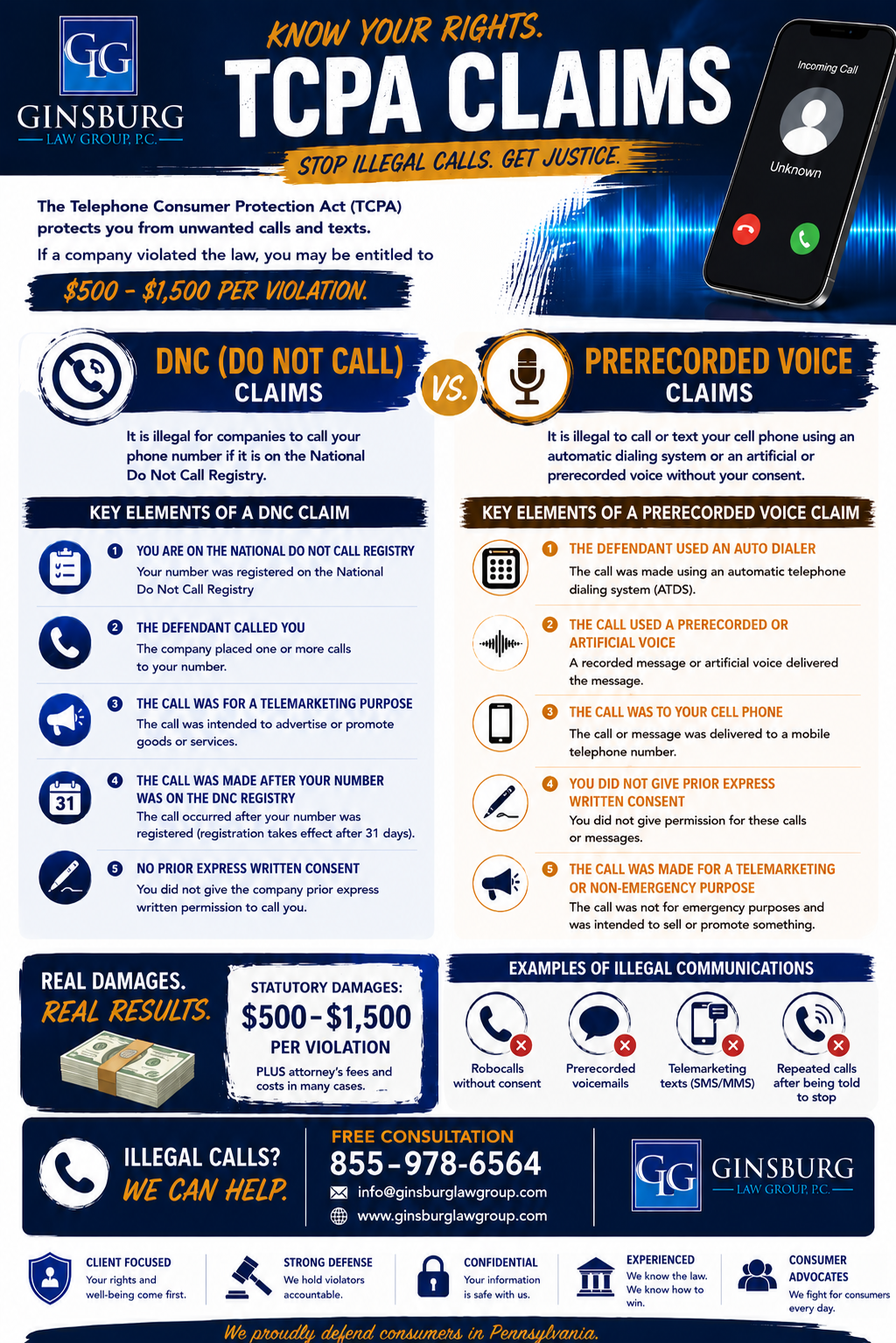
The Telephone Consumer Protection Act (“TCPA”) is a powerful federal law designed to protect consumers from intrusive and unauthorized calls and text messages. Under the TCPA, consumers may be entitled to recover between $500 and $1,500 per illegal call or text.
At Ginsburg Law Group, we help consumers fight back against companies that violate the law. If you are receiving repeated telemarketing calls, robocalls, prerecorded messages, or spam texts, you may have legal rights worth pursuing.
What Is the TCPA?
The Telephone Consumer Protection Act was enacted in 1991 to curb abusive telemarketing practices. Although the law predates smartphones and modern texting, courts and regulators have continued to apply the TCPA to modern communications technologies.
The TCPA restricts companies from:
- Calling consumers using automatic dialing systems without consent
- Sending spam text messages
- Using prerecorded or artificial voice messages without permission
- Calling numbers listed on the National Do Not Call Registry
- Continuing telemarketing communications after consumers revoke consent
- Making repeated or harassing telemarketing calls
The law applies to many types of businesses, including:
- Mortgage companies
- Debt collectors
- Auto warranty companies
- Solar companies
- Insurance marketers
- Medical marketing services
- Political robocall campaigns (in some situations)
- Retail businesses
- Lead generation companies
Importantly, the TCPA allows consumers to sue violators directly in court.
Why Illegal Calls and Texts Are a Serious Problem
Americans receive billions of robocalls every month. While some calls are merely irritating, others are part of sophisticated scams designed to steal money or personal information.
Common illegal communications include:
- Robocalls claiming your car warranty expired
- Fake IRS or government threats
- Debt settlement scams
- Mortgage refinance solicitations
- Spam political texts
- Prerecorded healthcare marketing calls
- Student loan forgiveness scams
- Calls from spoofed local numbers
- Repeated telemarketing calls after asking the company to stop
Many consumers do not realize that these calls can violate federal law—even if they answered once or previously interacted with the company.
The TCPA was created specifically to give consumers control over who can contact them and how.
DNC (Do Not Call) Claims
One of the most common TCPA claims involves violations of the National Do Not Call Registry.
What Is the National Do Not Call Registry?
The National Do Not Call Registry is maintained by the Federal Trade Commission (FTC). Consumers can register their phone numbers to indicate they do not wish to receive telemarketing calls.
Once your number has been registered for at least 31 days, telemarketers are generally prohibited from calling you unless an exception applies.
You can register your number for free at:
Registration does not expire.
Key Elements of a DNC Claim
To bring a successful Do Not Call claim, several elements usually must be present.
1. Your Number Was on the National Do Not Call Registry
The first requirement is that your number was registered on the National Do Not Call Registry before the calls occurred.
Registration generally becomes effective after 31 days.
2. The Defendant Called You
The company must have placed one or more calls to your phone number.
Even a single illegal telemarketing call may support a claim.
3. The Call Was for Telemarketing Purposes
The TCPA focuses heavily on telemarketing communications.
A telemarketing call generally includes any call encouraging:
- The purchase of goods
- The purchase of services
- Investment opportunities
- Promotional offers
Examples include:
- Solar sales calls
- Insurance solicitations
- Mortgage refinance offers
- Home improvement promotions
- Debt relief marketing
4. The Call Occurred After Your Number Was Registered
If the company called after your number had been on the registry for more than 31 days, the call may violate the TCPA.
5. You Did Not Provide Prior Express Written Consent
Many telemarketers attempt to rely on “consent” to defend against TCPA claims.
However, consent must often meet strict legal requirements.
In many telemarketing cases, companies either:
- Never obtained consent at all
- Obtained invalid consent
- Purchased questionable leads from third parties
- Continued calling after consent was revoked
Consumers frequently discover they never knowingly agreed to receive the calls.
Prerecorded Voice and Robocall Claims
Another major category of TCPA violations involves automated calls and prerecorded messages.
What Is an Autodialed or Robocall?
Robocalls typically involve automated systems that can dial large volumes of telephone numbers without human intervention.
These systems are commonly used in mass marketing campaigns because they allow businesses to contact thousands of consumers quickly and cheaply.
What Is a Prerecorded Voice Message?
A prerecorded voice message uses an artificial or recorded voice instead of a live caller.
Examples include:
- “This is an important message about your vehicle warranty…”
- “You have been selected for a special offer…”
- “Please hold for the next available representative…”
Even partial prerecorded introductions can violate the TCPA.
Key Elements of a Prerecorded Voice Claim
1. The Defendant Used an Automatic Telephone Dialing System
The company used technology capable of mass dialing or automated communications.
2. The Call Used a Prerecorded or Artificial Voice
The communication included a recorded or artificial voice message.
3. The Call Was Made to Your Cell Phone
The TCPA provides particularly strong protections for cell phones.
4. You Did Not Give Prior Express Written Consent
Telemarketing robocalls to cell phones generally require prior express written consent.
Without it, the call may be unlawful.
5. The Call Was for a Telemarketing or Non-Emergency Purpose
Emergency calls may be exempt, but sales and promotional calls are not.
Illegal Text Messages Under the TCPA
Many consumers are surprised to learn that spam text messages can also violate the TCPA.
The law applies not only to voice calls but also to SMS and MMS marketing texts.
Examples include:
- Promotional coupon texts
- Marketing blasts
- Political spam texts
- Lead generation texts
- Real estate solicitations
- “Limited time offer” messages
Companies cannot simply text consumers because they found a number online or purchased it from a marketing database.
Common Illegal Texting Practices
Failure to Obtain Consent
Businesses often rely on vague website disclosures or buried terms and conditions.
These disclosures may not satisfy TCPA requirements.
Failure to Honor Opt-Out Requests
If you reply:
- STOP
- UNSUBSCRIBE
- END
- CANCEL
The company generally must stop sending texts.
Recycled or Wrong Numbers
Businesses frequently continue texting numbers after ownership changes.
Consumers often receive messages intended for someone else.
These situations can also create TCPA liability.
Can You Revoke Consent?
Yes.
Even if you initially gave consent, you generally have the right to revoke it.
You can revoke consent by:
- Telling the caller to stop
- Replying STOP to text messages
- Sending written notice
- Emailing the company
- Verbally revoking consent during a call
Once consent is revoked, continued communications may violate the TCPA.
Many companies ignore revocation requests or fail to update their systems properly.
How Much Can You Recover Under the TCPA?
The TCPA provides for statutory damages.
Consumers may recover:
- $500 per violation
- Up to $1,500 per willful violation
This means repeated calls or texts can quickly lead to substantial claims.
For example:
- 10 illegal calls = up to $5,000
- 20 illegal texts = up to $10,000
- 50 willful violations = up to $75,000
In some cases, consumers may also recover attorney’s fees and litigation costs under related state laws.
Common Examples of Illegal Communications
Consumers often ask whether the communications they receive are illegal.
Common examples include:
Robocalls Without Consent
Automated calls attempting to sell products or services without permission.
Prerecorded Voicemails
Recorded messages left without consent.
Telemarketing Text Messages
Mass promotional texts sent without proper authorization.
Repeated Calls After Being Told to Stop
Companies continuing to contact consumers after revocation of consent.
Calls to Numbers on the Do Not Call Registry
Telemarketing calls to registered phone numbers.
Spoofed Caller ID Calls
Calls using fake local numbers to trick consumers into answering.
What Evidence Should You Keep?
If you believe you are receiving illegal calls or texts, documentation is important.
Consumers should try to preserve:
- Screenshots of text messages
- Call logs
- Voicemails
- Dates and times of calls
- Names of callers or companies
- Any opt-out requests
- Emails confirming revocation
- Copies of written communications
Do not delete evidence before speaking with an attorney.
Even partial information can help establish a TCPA claim.
Common Defenses Companies Use
Businesses accused of TCPA violations often raise defenses.
Some of the most common include:
“You Consented”
Companies frequently argue consumers agreed to receive communications.
However, consent must often be:
- Clear
- Voluntary
- Properly documented
- Legally compliant
Fine print and deceptive disclosures may not be enough.
“We Didn’t Make the Calls”
Lead generators and third-party marketers often blame each other.
Determining who is legally responsible can require investigation.
“The Calls Were Informational”
Some companies attempt to characterize sales calls as informational.
Courts examine the actual purpose of the communication.
If the goal was ultimately to sell or promote something, the TCPA may still apply.
“The Calls Were Not Automated”
Whether a system qualifies as an autodialer can become a major issue in litigation.
Phone records, vendor contracts, and dialing technology often become important evidence.
Why TCPA Cases Matter
TCPA litigation serves an important public purpose.
These lawsuits help:
- Reduce illegal robocalls
- Hold abusive marketers accountable
- Protect consumer privacy
- Discourage mass spam campaigns
- Force businesses to follow compliance rules
Without enforcement, many companies would continue violating consumer rights because automated calling systems are extremely profitable.
Consumer lawsuits help level the playing field.
Pennsylvania Consumers Have Additional Protections
Pennsylvania consumers may also have rights under state consumer protection laws in addition to federal TCPA protections.
In some cases, state law claims may involve:
- Unfair trade practices
- Deceptive conduct
- Consumer fraud
- Harassment claims
An experienced consumer protection attorney can evaluate whether multiple laws apply.
What Should You Do If You Are Receiving Illegal Calls?
If you are dealing with repeated spam calls or texts, there are several important steps you should take.
1. Register Your Number on the Do Not Call Registry
Visit:
2. Save Evidence
Keep screenshots, voicemails, and call records.
3. Revoke Consent Clearly
Tell the company to stop calling or texting.
4. Do Not Engage With Obvious Scammers
Avoid providing personal information.
5. Contact a Consumer Protection Attorney
An attorney can evaluate:
- Whether the calls violated the TCPA
- How many violations occurred
- Whether additional claims exist
- Potential compensation available
How Ginsburg Law Group Can Help
At Ginsburg Law Group, we represent consumers who have been targeted by illegal robocalls, spam texts, and telemarketing campaigns.
We understand how disruptive and invasive these communications can be.
Our firm investigates:
- Robocall practices
- Dialing systems
- Consent records
- Telemarketing campaigns
- Lead generation schemes
- Do Not Call violations
We work to hold companies accountable and pursue compensation for consumers whose rights were violated.
If you have received repeated telemarketing calls, prerecorded messages, or spam texts, you may have a valid TCPA claim.
Contact Ginsburg Law Group
If you believe your rights under the TCPA were violated, contact Ginsburg Law Group today for a free consultation.
Ginsburg Law Group, P.C.
855-978-6564
info@ginsburglawgroup.com
www.ginsburglawgroup.com
We proudly defend consumers throughout Pennsylvania and fight to stop illegal calls and texts.