If you’ve been sued over a credit card, personal loan, medical bill, or other consumer debt in Florida, you may wonder whether the creditor must actually bring a witness to court. Many consumers assume that if a creditor files account statements and other documents with the court, the judge will automatically rule in its favor.
That’s not how Florida law works.
In most cases, creditors must present admissible evidence to prove they are entitled to recover. Simply attaching documents to a lawsuit does not automatically make those documents admissible. Whether a creditor needs a live witness depends on the circumstances of the case and whether the plaintiff can satisfy Florida’s rules governing business records.
What Are Business Records?
Business records are documents created and maintained during the ordinary course of business. In debt collection lawsuits, they commonly include:
- Credit card statements
- Loan agreements
- Payment histories
- Charge-off statements
- Account ledgers
- Collection notes
- Bills of sale
- Assignment documents
These records are often the primary evidence a creditor relies upon to prove the existence and amount of an alleged debt.
Business Records Are Generally Considered Hearsay
Under the Florida Evidence Code, documents offered to prove the truth of what they contain are generally hearsay.
Unless an exception applies, hearsay is inadmissible in court.
One of the most frequently used exceptions is the business records exception, found in Section 90.803(6), Florida Statutes.
Florida’s Business Records Exception
To admit business records into evidence, the plaintiff generally must establish that:
- The records were made at or near the time of the event;
- The information came from someone with knowledge;
- The records were kept in the regular course of business;
- Making the records was a regular practice of the business; and
- The records are trustworthy.
Florida courts have repeatedly held that these foundational requirements must be established before business records may be admitted.
Does the Creditor Need a Live Witness?
Often, yes.
In many Florida debt collection cases, particularly when the defendant objects, the plaintiff must present a records custodian or another qualified witness who is familiar with the company’s recordkeeping practices.
The witness does not necessarily have to be the individual who created each record. However, the witness must be able to explain how the records are created, maintained, and relied upon in the ordinary course of business.
Simply handing documents to the judge without laying the proper foundation is generally not enough.
Debt Buyers Face Additional Evidentiary Challenges
Many debt collection lawsuits are filed by companies that purchased charged-off accounts from the original creditor rather than by the original bank itself.
Examples include:
- Midland Credit Management
- LVNV Funding
- Portfolio Recovery Associates
- Cavalry SPV
- Jefferson Capital Systems
- Crown Asset Management
These debt buyers often rely on records created by another company.
Florida appellate courts have addressed whether successor companies may rely on records originally created by someone else. Under what is commonly referred to as the adopted business records doctrine, a successor business may, in some circumstances, introduce records created by another entity if it can establish that:
- It integrated the records into its own business records;
- It routinely relies upon those records in conducting its business; and
- The records otherwise satisfy the business records exception.
Even so, the plaintiff must still establish a sufficient evidentiary foundation through competent testimony.
The Plaintiff Must Also Prove Ownership of the Debt
In addition to proving the amount allegedly owed, the creditor must establish that it actually owns the account and has the legal right to collect it.
This often requires admissible evidence such as:
- Bills of sale
- Assignment agreements
- Account transfer records
- Purchase documents
- Testimony explaining the chain of ownership
If there are gaps in the chain of assignment or insufficient evidence connecting the defendant’s specific account to the transfer documents, the plaintiff may fail to establish standing.
Common Objections in Florida Debt Collection Cases
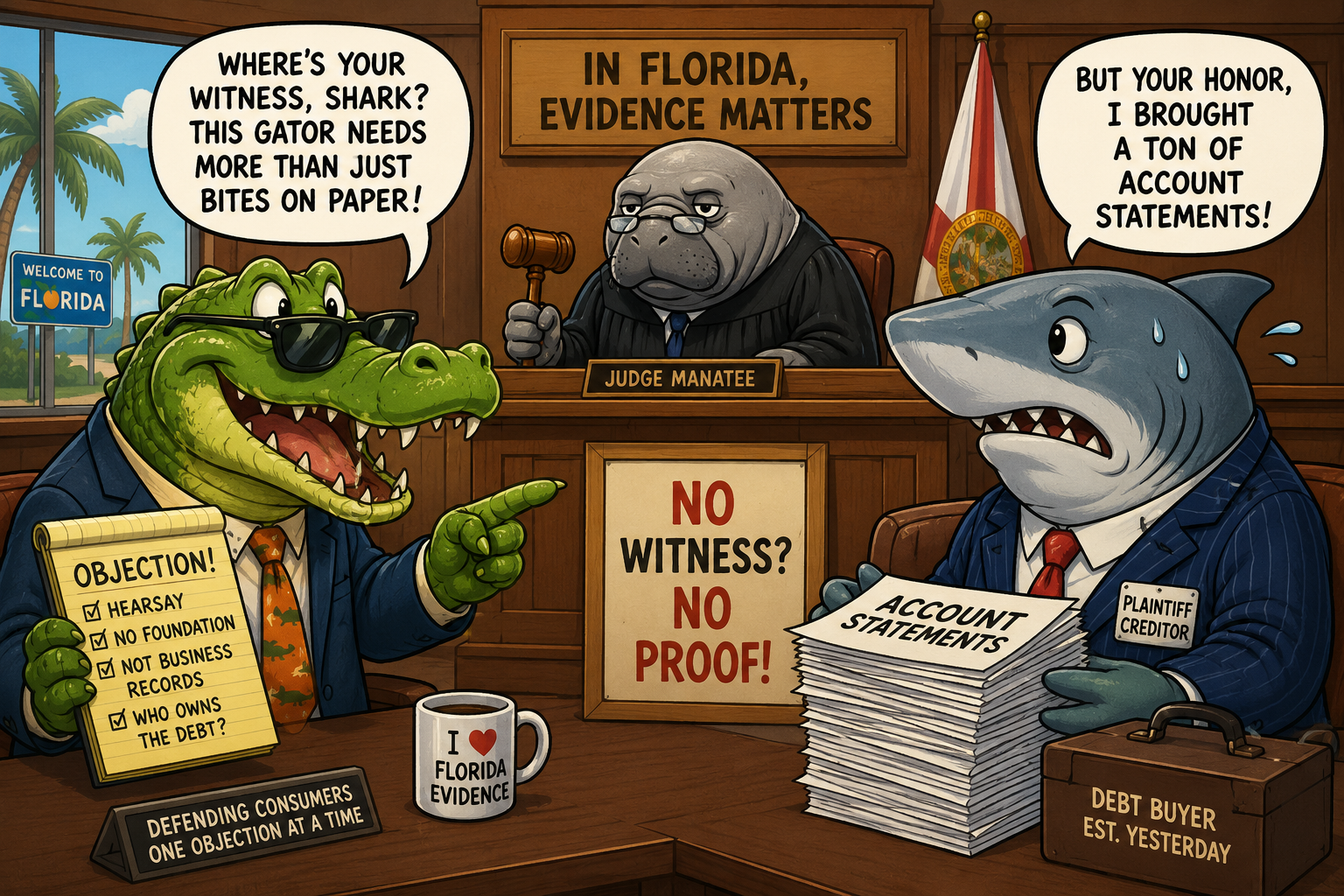
When creditors attempt to introduce business records without laying the proper foundation, defendants may object on grounds such as:
- Hearsay
- Lack of authentication
- Failure to satisfy the business records exception
- Lack of personal knowledge
- Insufficient proof of assignment
- Failure to establish standing
- Failure to prove damages
These objections can significantly affect whether critical evidence is admitted at trial.
What Happens if the Business Records Are Excluded?
Business records are frequently the plaintiff’s most important evidence.
Without admissible records, the plaintiff may be unable to establish:
- That the debt exists;
- The amount allegedly owed;
- That the defendant is responsible for the account;
- That the plaintiff owns the debt;
- That the plaintiff has standing to sue.
If the plaintiff cannot prove these essential elements through admissible evidence, the court may enter judgment in favor of the defendant.
Every Case Is Different
Whether a creditor needs a witness depends on many factors, including:
- Whether the records satisfy Florida’s business records exception;
- Whether the records were created by the plaintiff or another company;
- Whether the defendant raises evidentiary objections;
- Whether a qualified witness is available to lay the proper foundation; and
- The specific facts of the case.
Consumers should never assume that documents filed with the court are automatically admissible at trial.
Why Experienced Legal Representation Matters
Florida debt collection cases often involve complex evidentiary issues that can determine the outcome of the lawsuit. A creditor may possess extensive documentation but still fail to satisfy the Florida Evidence Code.
An experienced consumer defense attorney can evaluate the plaintiff’s evidence, identify weaknesses in the business records, examine the chain of assignment, and determine whether the creditor has met its burden of proof.
Facing a Debt Collection Lawsuit in Florida?
At Ginsburg Law Group, P.C., we represent consumers throughout Florida who have been sued by creditors and debt buyers. We carefully review the evidence, challenge inadmissible business records when appropriate, and work to protect our clients’ rights throughout the litigation process.
If you’ve been served with a debt collection lawsuit, don’t assume the creditor automatically has the evidence necessary to win. Understanding Florida’s rules governing business records may be one of the strongest tools available in your defense.
Frequently Asked Questions
Can a debt collector win in Florida without bringing a witness?
Sometimes, but in many contested cases a qualified witness is required to establish the foundation for admitting business records into evidence.
Can a debt buyer use the original creditor’s records?
Possibly. Florida law may allow a debt buyer to introduce records created by the original creditor if it establishes the necessary foundation under the adopted business records doctrine and otherwise satisfies the business records exception.
What if I object to the creditor’s records?
If the plaintiff cannot establish the proper evidentiary foundation, the court may exclude the records. Without admissible evidence, the creditor may be unable to prove its case.
Should I appear in court if I think the creditor lacks evidence?
Yes. Failing to appear can result in a default judgment, regardless of potential evidentiary issues. Even if you believe the creditor’s evidence is weak, you should respond to the lawsuit and attend all required hearings unless advised otherwise by your attorney.