(“You’re telling me I have to put a dollar amount on my cat?”)
Take a deep breath.
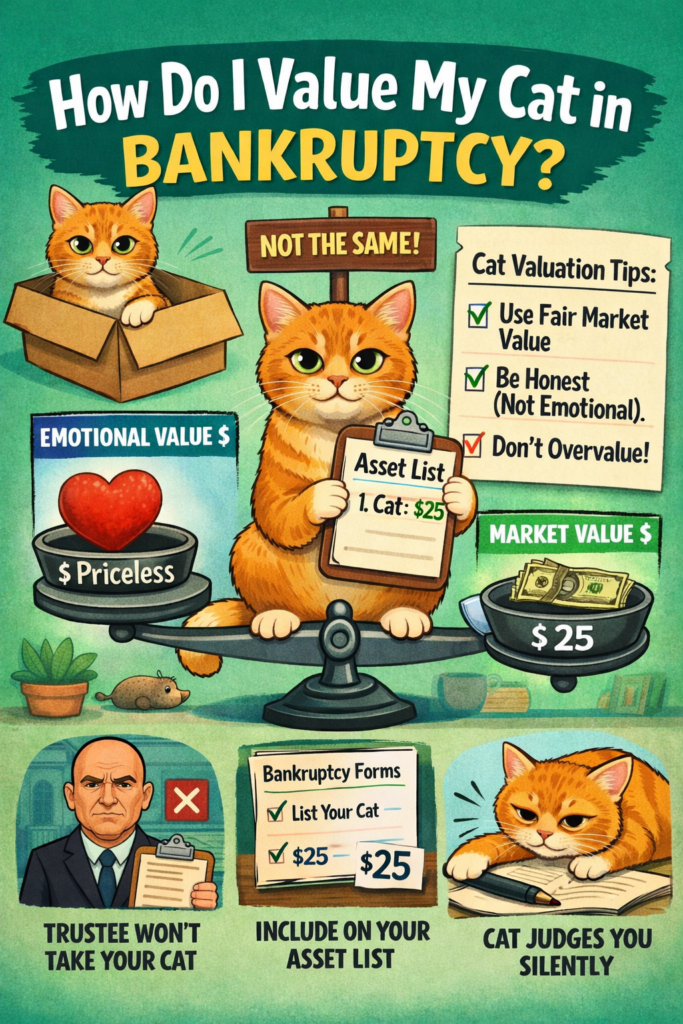
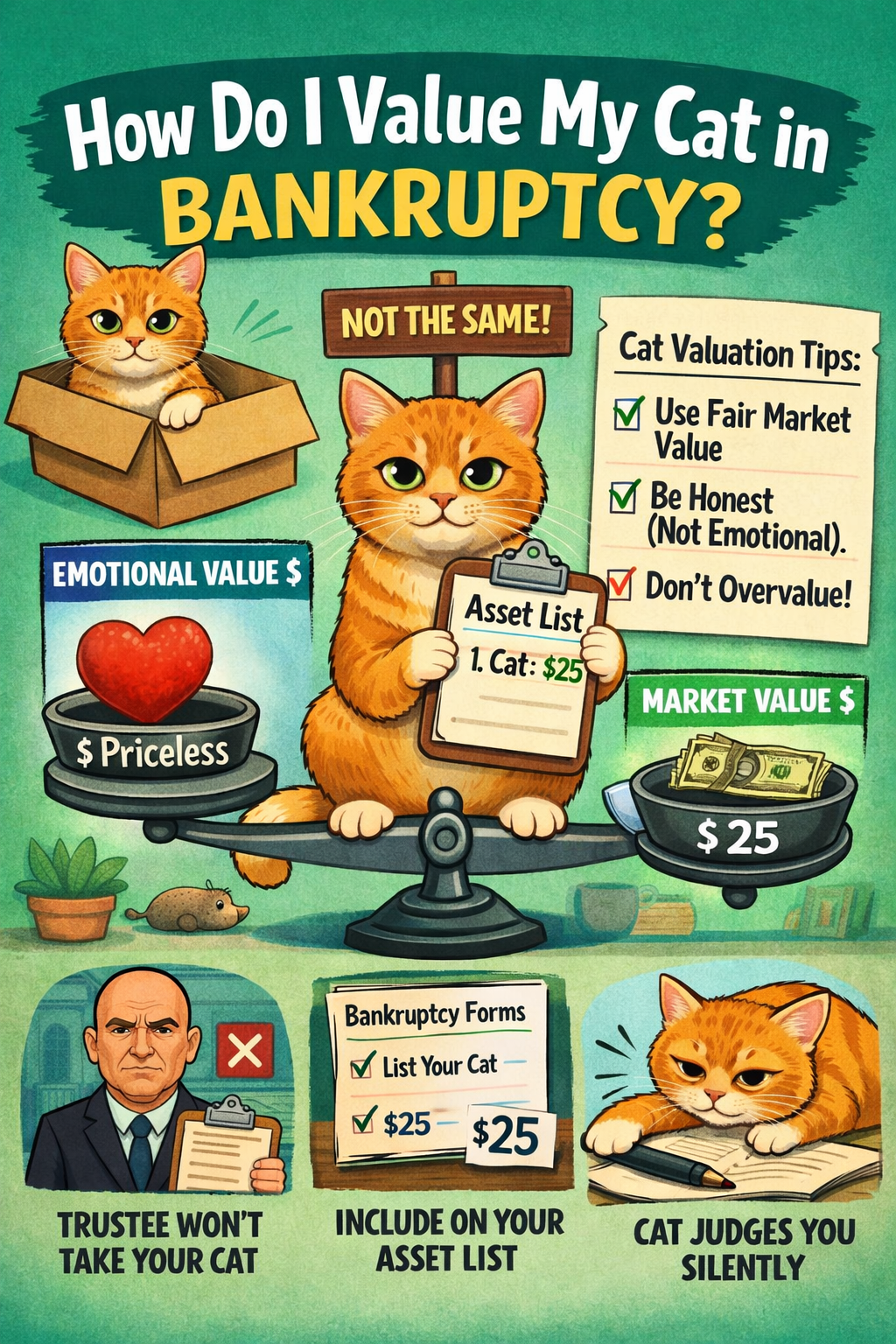
No, the court is not asking you to assign an emotional value to your cat. You don’t need to calculate the worth of 3 a.m. zoomies, head boops, or the way your cat stares at you like you owe them money.
But yes—you do have to list your cat as an asset in bankruptcy.
Let’s walk through what that actually means, how to value a pet properly, and how to avoid one of the more awkward (but common) mistakes people make when filing.
First: Are Pets Really “Assets” in Bankruptcy?
Short answer: yes.
Longer answer: Under the law, pets are considered personal property—the same category as furniture, clothing, and household goods.
Emotionally? They’re family.
Legally? They’re property.
That means your cat belongs on your bankruptcy assets list, just like your couch or your TV.
Before you panic: this does not mean the trustee is coming for your cat. In fact, that almost never happens.
But it does mean you need to assign a reasonable value.
The Big Misconception: “My Cat Is Priceless”
Every client says this.
“I can’t put a value on my cat—they’re priceless.”
Totally understandable.
Also completely unhelpful in bankruptcy.
The court isn’t asking what your cat means to you. It’s asking:
What is your cat worth on the open market today?
That’s a very different question.
So… How Do You Actually Value a Cat?
Here’s the key principle:
You value your cat at fair market value—not emotional value, not replacement cost, not what you paid.
What is “fair market value”?
It’s what someone would realistically pay for your cat today.
Not in theory. Not on Instagram. In real life.
And for most household pets?
That number is surprisingly low.
Realistic Valuation Examples
Let’s break this down:
🐱 Typical Household Cat (Adopted or Mixed Breed)
- Likely value: $0 – $50
- Why: There’s no resale market for adult mixed-breed cats
Yes—your beloved, perfect, slightly judgmental cat is likely worth less (legally) than your microwave.
🐱 Purebred Cat (Maine Coon, Bengal, Sphynx, etc.)
- Likely value: $100 – $1,000+ depending on age, pedigree, and condition
- Kittens are worth more than adult cats
- Show-quality or breeding cats may have higher value
🐱 Senior Cat
- Likely value: $0
- Age reduces market value significantly
🐱 Cat With Medical Issues
- Likely value: $0 or very low
- Ongoing care reduces resale value
True Story (Because This Comes Up A Lot)
A client once insisted their cat was worth $3,000 because:
- They paid that much for it
- It was “very special”
- It had an Instagram following (with… modest engagement)
We had to have a conversation.
What they paid is not what it’s worth now.
What it’s worth to them is not what the court cares about.
The realistic value? About $100.
What NOT to Do When Valuing Your Cat
This is where people get into trouble—usually unintentionally.
❌ Don’t Say “Priceless”
That’s not a number. The forms require an actual value.
❌ Don’t Inflate the Value
Overvaluing your cat can create unnecessary issues, like:
- Exceeding exemption limits
- Triggering unnecessary scrutiny
❌ Don’t List Purchase Price
You might have paid $2,000 for a kitten.
That does not mean it’s worth $2,000 today.
❌ Don’t Leave It Off Entirely
Yes, even your cat must be listed.
Leaving it off your bankruptcy assets list can create problems—even if the value is minimal.
Will I Lose My Cat in Bankruptcy?
Let’s address the fear directly.
No, in almost all cases, you will not lose your cat.
Here’s why:
1. Low Market Value
Most cats have minimal resale value, making them unattractive assets for liquidation.
2. Exemptions Protect You
Bankruptcy exemptions allow you to protect certain property.
Pets are often covered under:
- Household goods exemptions
- Wildcard exemptions
3. Practical Reality
Trustees are not in the business of rehoming pets.
There’s no efficient market for selling someone’s adult cat.
And frankly, no one wants to deal with that.
When Could a Pet Actually Matter?
There are rare situations where valuation becomes important:
- High-value breeding animals
- Show animals with documented worth
- Exotic or rare species
- Large-scale breeding operations
If you’re running a Bengal breeding business, that’s a different conversation.
If your cat’s main job is knocking things off counters? You’re fine.
Where Does My Cat Go on the Bankruptcy Forms?
Your cat will typically be listed under:
- Household goods and personal property
- Sometimes specifically identified as “pets” or “animals”
You’ll include:
- Description: “Domestic cat” or breed if applicable
- Estimated value: realistic fair market value
That’s it.
No need to include personality traits, favorite toys, or attitude problems.
The Emotional vs. Legal Disconnect
Let’s acknowledge something important:
This process can feel strange.
You’re being asked to assign a dollar value to something that is clearly more than property in your life.
That disconnect is real.
But bankruptcy law operates on financial value—not emotional significance.
Understanding that distinction makes the process much easier (and less frustrating).
Pro Tip: When in Doubt, Be Conservative and Honest
If you’re unsure how to value your cat:
- Use a reasonable, low market estimate
- Be consistent with reality
- Don’t overthink it
And most importantly:
Disclose it. Always disclose it.
When it comes to what to disclose in bankruptcy, transparency is your best protection.
Quick FAQ (Because You’re Probably Wondering…)
“Do I need an appraisal for my cat?”
No. Please do not hire a cat appraiser.
“What if my cat is purebred but older?”
Age significantly reduces value. Be realistic.
“What about multiple cats?”
List them collectively or individually with reasonable values.
Example:
- “2 domestic cats – $50 total”
“What if I foster cats?”
If you don’t own them, they are not your asset.
“Can I just put $0?”
Often yes—for typical household cats—but make sure it’s reasonable.
Final Thought: Your Cat Is Safe (and Still Judging You)
Filing bankruptcy requires you to take a hard look at everything you own—even the unexpected things.
Yes, that includes your cat.
But here’s the good news:
- You’re not being asked to sell your cat
- You’re not expected to assign emotional value
- You just need to provide a realistic, honest estimate
So remember:
- List your cat
- Use fair market value
- Don’t overthink it
And rest assured…
Your cat will still be there afterward—sitting on your paperwork, knocking over your pen, and silently questioning all your life choices.