The Dodge Charger Super Bee Is Back — With 600 Horsepower and No HEMI
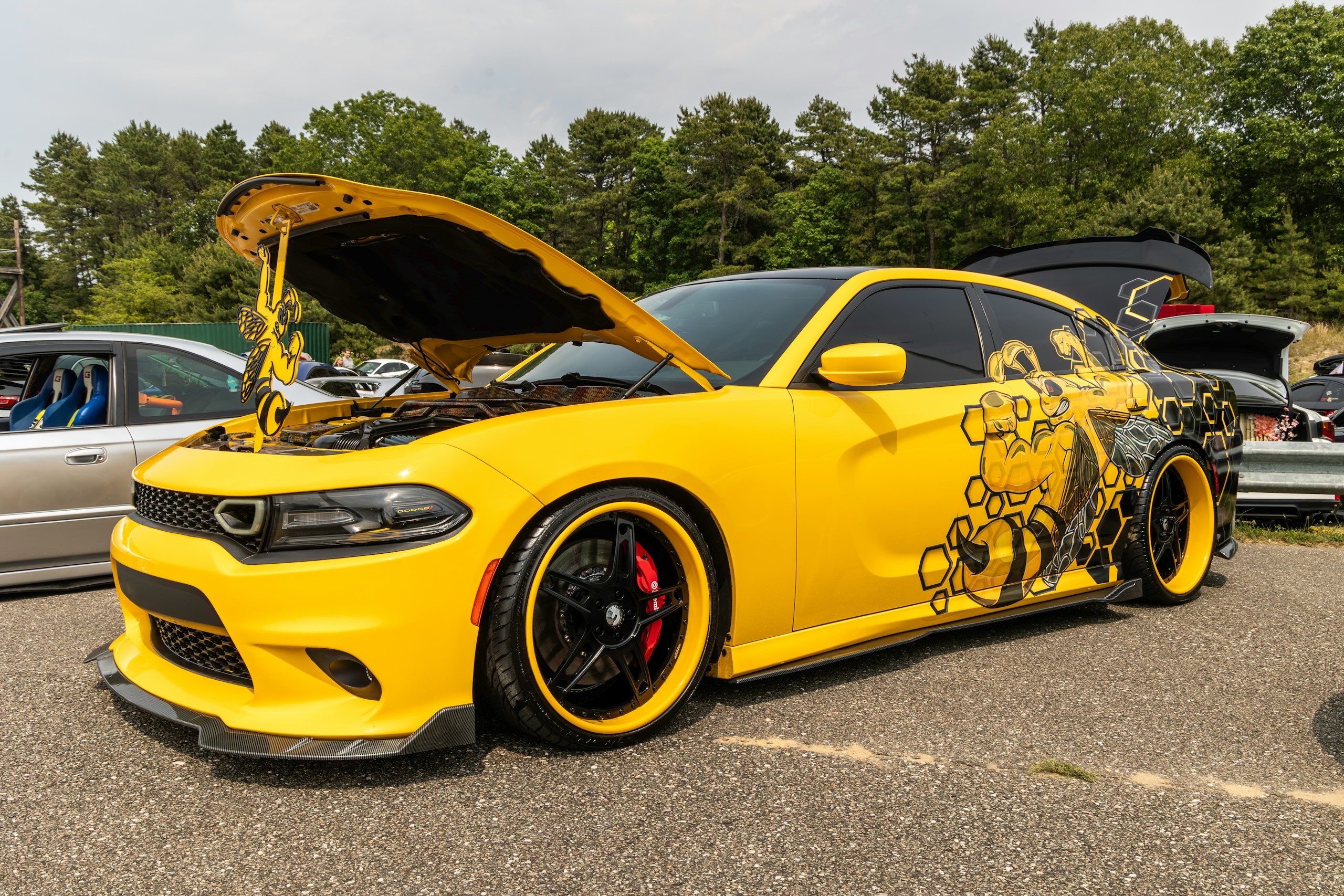
The Dodge Charger Super Bee is returning for 2027, but this isn’t simply a recreation of the V8-powered Super Bees enthusiasts remember.
Dodge has unveiled the 2027 Charger Sixpack Super Bee, a 600-horsepower performance version of the new gasoline-powered Charger. The new Super Bee uses a heavily revised version of Stellantis’ 3.0-liter twin-turbocharged Hurricane inline-six, paired with an eight-speed automatic transmission and all-wheel drive. (Road & Track)
Dodge says the new setup produces 600 horsepower and 531 lb-ft of torque, making the Super Bee the most powerful internal-combustion version of the current-generation Charger announced so far. The company claims 0–60 mph in approximately 3.6 seconds and a quarter-mile time of 11.8 seconds. (Road & Track)
It also receives substantial performance hardware, including larger turbochargers, revised cooling, adaptive dampers, huge Brembo brakes, 305-section-width Goodyear tires, Track and Drag drive modes, and a new performance data recorder. (Road & Track)
For Texas performance-car buyers, however, there’s another issue worth understanding before these cars reach owners:
What happens if a new Super Bee repeatedly breaks down or cannot deliver normal, reliable operation?
There is currently no consumer repair history establishing defects in the 2027 Super Bee—the car has just been announced and is expected to become available in 2027.
But buyers of an all-new, highly tuned performance vehicle should understand their rights under the Texas Lemon Law, Dodge’s written warranty, and the federal Magnuson-Moss Warranty Act before problems occur.
What’s Different About the 2027 Charger Super Bee?
The Super Bee isn’t simply a graphics package.
Dodge has made substantial changes to the existing high-output Hurricane engine.
The 3.0-liter twin-turbo inline-six receives larger 58-mm Garrett turbochargers, which reportedly provide approximately 7.5% greater airflow, along with changes to the intake, charge-air system, intercooler, exhaust, engine calibration, and cooling system. (Road & Track)
Those changes increase output to 600 horsepower while maintaining 531 lb-ft of torque.
Power goes through a TorqueFlite 880RE eight-speed automatic transmission and all-wheel-drive system. (Road & Track)
The chassis gets substantial attention too.
Dodge has increased spring rates and bushing stiffness, fitted a stiffer rear stabilizer bar, and added Continuous Damping Control dual-valve adaptive dampers. Twenty-inch wheels wear 305/35ZR20 Goodyear Eagle F1 Supercar 3 summer tires. (Road & Track)
Behind them are 16-inch Brembo brake rotors, with six-piston front and four-piston rear calipers. Dodge says the system provides 27% more brake-pad area and twice the fade resistance of prior SRT Charger braking systems. (Road & Track)
That is serious performance hardware.
It also means there are numerous sophisticated systems that have to operate together correctly.
An All-New Performance Car Can Create Unique Warranty Issues
There is no basis today to say the 2027 Super Bee suffers from a particular defect.
But high-performance vehicles can generate warranty disputes that differ somewhat from those involving an ordinary commuter vehicle.
Hypothetical issues could involve:
- Turbocharger failure;
- Engine overheating;
- Cooling-system problems;
- Transmission problems;
- All-wheel-drive faults;
- Loss of engine power;
- Engine warning lights;
- Misfires;
- Oil or coolant leaks;
- Adaptive suspension failures;
- Brake-system problems;
- Electrical faults;
- Repeated software issues; or
- Drive-mode malfunctions.
These are examples of potential automotive defects, not allegations that the Super Bee currently has these problems.
What matters legally is what happens if an individual Texas owner’s vehicle develops a substantial defect after delivery.
Texas Lemon Law Covers New Performance Cars Too
Texas Lemon Law isn’t limited to ordinary sedans, minivans, or family SUVs.
The Texas Department of Motor Vehicles states that the law covers qualifying new cars, trucks, vans, motorcycles and several other categories of new motor vehicles that develop defects covered by the manufacturer’s written warranty. (TxDMV)
A 600-horsepower Charger doesn’t lose Lemon Law protection simply because it is a performance vehicle.
The core requirements remain essentially the same.
TxDMV states that a qualifying vehicle generally must have:
- A substantial manufacturing defect;
- A defect covered by the manufacturer’s written warranty;
- A defect reported during the warranty term;
- A reasonable number of repair attempts;
- Written notice to the manufacturer and at least one opportunity to cure; and
- A continuing defect that substantially impairs use or market value or creates a serious safety hazard. (TxDMV)
That last requirement is important.
Not every rattle, noise, or minor imperfection makes a Super Bee a lemon.
Texas Uses Three Main Lemon Law Tests
Texas has three important presumptions for determining whether the manufacturer received a reasonable number of opportunities to repair a qualifying defect.
TxDMV calls these:
The four-times test
The serious safety-hazard test
The 30-day test (TxDMV)
A consumer does not necessarily need to satisfy all three.
The appropriate test depends on what happened with the individual vehicle.
Texas’s Four-Times Test
Under the current Texas framework, the four-times test can be satisfied when the vehicle has been presented for repair four times for the same defect within the first 24 months or 24,000 miles, whichever occurs first, and the defect remains unrepaired. (TxDMV)
Imagine a hypothetical 2027 Super Bee repair history:
Repair 1 — 2,100 miles: Check-engine light and substantial loss of engine power.
Repair 2 — 3,800 miles: Same condition. Dodge updates engine-control software.
Repair 3 — 5,900 miles: Loss of power returns. Turbocharger-related component replaced.
Repair 4 — 7,600 miles: Same engine-power condition returns again.
That type of history deserves careful review.
Four dealership visits do not automatically create a successful Lemon Law claim, however.
The same substantial defect must remain unresolved, and the other statutory requirements still matter.
Texas Has a Separate Serious Safety-Hazard Test
Some defects require fewer repair attempts because of their severity.
TxDMV defines a serious safety hazard as a life-threatening malfunction that substantially impedes the consumer’s ability to control or normally operate the vehicle or creates a substantial risk of fire or explosion. (TxDMV)
A consumer may satisfy Texas’s serious safety-hazard test when such a defect remains unrepaired after two repair attempts during the first 24 months or 24,000 miles, whichever comes first. (TxDMV)
The standard should not be exaggerated.
A check-engine light is not automatically a serious safety hazard.
Neither is a squeak, rattle, or momentary software warning.
But a defect that causes an actual loss of vehicle control, dangerous braking malfunction, significant fire risk, or another life-threatening condition could present a different situation.
Performance Does Not Excuse a Safety Defect
The Super Bee is designed to be fast.
That does not mean abnormal behavior should automatically be dismissed as:
“It’s a performance car.”
There is a difference between intentional performance characteristics and a malfunction.
For example, stiff suspension is expected in a track-oriented car.
A defective adaptive damper is different.
A loud exhaust is expected.
An engine that repeatedly misfires is different.
Aggressive transmission programming may be expected.
A transmission that unexpectedly loses drive is different.
High brake temperatures during track use may be normal.
A braking defect during ordinary street driving is another issue entirely.
Consumers should distinguish between the vehicle’s intended characteristics and actual malfunctions.
The 30-Day Texas Lemon Law Test
Texas also provides a days-out-of-service route.
TxDMV says the 30-day test can be met when a vehicle is out of service for warranty repair for a total of 30 days or more during the first 24 months or 24,000 miles, and a substantial defect remains. The 30 days do not have to occur consecutively. (TxDMV)
For example:
First repair: 8 days awaiting diagnostic work.
Second repair: 10 days awaiting a turbocharger component.
Third repair: 7 days for additional engine repairs.
Fourth repair: 6 days after the problem returns.
Total:
31 days out of service.
However, Texas has an important exception.
TxDMV states that time generally does not count toward the 30-day test when the manufacturer provides a comparable loaner vehicle while the consumer’s vehicle is being repaired. (TxDMV)
Document whether a loaner was provided.
What Counts as a “Comparable” Loaner for a Super Bee?
This could become an interesting issue for owners of specialized performance cars.
Suppose your 600-horsepower Super Bee spends weeks in the shop.
The dealer gives you an ordinary compact crossover.
Is that “comparable”?
The answer may require a fact-specific analysis rather than an assumption based solely on horsepower.
Consumers should document:
- What loaner was offered;
- Whether they accepted it;
- When they received it;
- When they returned it; and
- The dates their Super Bee remained unavailable.
Do not simply calculate dealership days yourself and assume every day automatically counts.
Written Notice to Dodge Is Important
Repeated visits to a Dodge dealer are not the end of the Texas Lemon Law process.
TxDMV requires the owner to provide the manufacturer written notice of the defect and at least one opportunity to cure it. The agency recommends certified mail. (TxDMV)
That means conversations with a dealership service adviser should not automatically be treated as satisfying every statutory notice requirement.
If a substantial problem continues, a written notice should clearly identify:
- VIN;
- Purchase date;
- Current mileage;
- Defect;
- Repair dates;
- Authorized dealerships involved;
- Number of repair attempts; and
- Fact that the condition remains unresolved.
Keep proof of delivery.
Texas’s Filing Deadline Can Arrive Quickly
This is one of the most important Texas Lemon Law rules.
TxDMV says a Lemon Law complaint must generally be filed within six months following the earlier of:
- Expiration of the express warranty;
- 24 months after purchase; or
- 24,000 miles after delivery. (TxDMV)
The key word is earlier.
For a Super Bee owner who drives frequently, 24,000 miles could arrive much sooner than two years.
Consumers should not wait until the warranty is almost over before evaluating a persistent defect.
Track Use Can Complicate a Super Bee Warranty Claim
This is particularly important with the new Super Bee.
Dodge is explicitly giving the car track-focused hardware and dedicated Track and Drag modes. (Road & Track)
That does not necessarily mean every component failure occurring after track use is covered by warranty.
Owners should carefully read Dodge’s final written warranty when the vehicle goes on sale.
Pay attention to provisions involving:
- Racing;
- Competitive events;
- Track use;
- Abuse;
- Over-revving;
- Vehicle modifications;
- Non-approved tuning;
- Aftermarket engine software;
- Alternative fuels; and
- Modified turbocharger or exhaust systems.
The fact that a vehicle has a Track mode does not necessarily mean every form of competitive use is covered.
Modifications Can Become a Major Issue
The Super Bee will almost certainly attract owners interested in modifications.
The Hurricane engine is turbocharged, making software tunes and boost modifications particularly tempting.
From a warranty standpoint, consumers should understand the risk.
Suppose an owner increases turbocharger boost with aftermarket software.
Six months later, an engine component fails.
Dodge may argue that the modification caused or contributed to the failure.
That does not mean the mere presence of an aftermarket part automatically eliminates every warranty right.
But causation can become a major factual dispute.
A stock vehicle generally presents a much cleaner warranty record.
What If the Dealer Blames the Way You Drove the Car?
Ask for the conclusion in writing.
If Dodge claims a failure resulted from:
- Track use;
- Abuse;
- Launch-control use;
- Overheating caused by driver behavior;
- Aftermarket modifications; or
- Improper maintenance,
ask the dealer to identify the basis for that conclusion on the repair order.
Do not settle for a verbal:
“You drove it too hard.”
That is especially important for a vehicle specifically marketed around high performance.
Keep Data From the Super Bee’s Performance Recorder
The 2027 Super Bee is expected to include a new Drive Experience Recorder developed with Cosworth, allowing owners to record and analyze performance data. (Road & Track)
That could become useful beyond track-day entertainment.
If the system permits owners to retain vehicle data, it may potentially help document circumstances surrounding a malfunction.
For example:
- Vehicle speed;
- Engine behavior;
- Temperatures;
- Driving mode;
- Acceleration; or
- Other available performance parameters.
Owners should not assume the recorder captures every diagnostic parameter or that its information conclusively proves the cause of a defect.
But preserving relevant data may be worthwhile when a serious malfunction occurs.
What If the Super Bee Overheats?
Cooling is particularly interesting because Dodge has reportedly revised much of the Super Bee’s cooling system to support the higher-output engine. (Road & Track)
If an owner experiences overheating during normal street use, document:
- Outside temperature;
- Vehicle speed;
- Driving mode;
- Warning messages;
- Whether air conditioning was operating;
- Whether coolant was lost;
- Whether the engine reduced power;
- Whether the vehicle had to stop; and
- Whether it required towing.
There is a significant difference between extreme temperatures during prolonged competitive track use and repeated overheating during ordinary highway driving.
The facts matter.
What If the Turbochargers Fail?
The Super Bee’s larger turbochargers are central to its increased output.
A single component failure successfully repaired under warranty does not automatically create a Lemon Law claim.
But repeated turbocharger or boost-related failures could become significant.
For example:
4,000 miles: Turbocharger fault and loss of power.
5,500 miles: Turbo-related component replaced.
7,200 miles: Same warning and power loss return.
9,000 miles: Turbocharger replaced.
10,500 miles: Same condition returns again.
Preserve every repair order.
Do not allow the dealership to write only:
“Check engine light.”
Ask that the actual symptoms—such as substantial power loss, abnormal noise, smoke, or warning messages—be accurately documented.
Texas Lemon Law Can Provide Repurchase, Replacement, or Repair
If a consumer establishes a qualifying Texas Lemon Law case, TxDMV can order relief that includes repurchase, replacement, or repair. (TxDMV)
For a repurchase, Texas generally calculates the remedy using the vehicle’s purchase price and certain taxes and fees, subject to an allowance for the consumer’s use. (TxDMV)
The specific calculation depends on the individual case.
Only qualifying new vehicles can receive refund or replacement relief through the Texas administrative Lemon Law process. (TxDMV)
What If Texas Lemon Law Does Not Apply?
Lemon Law is only one potential avenue.
A Super Bee owner may also have rights under:
- Dodge’s written warranty;
- Applicable powertrain warranties;
- Implied warranties;
- Texas warranty law;
- The federal Magnuson-Moss Warranty Act; or
- Other applicable consumer law depending on the circumstances.
This distinction can be particularly important when a defect arises outside Texas’s initial Lemon Law period but remains covered under a longer manufacturer warranty.
Breach of Dodge’s Written Warranty
Imagine a Super Bee develops an engine problem while the powertrain remains covered.
Dodge attempts multiple repairs.
The same malfunction keeps returning.
Even if Texas Lemon Law does not ultimately provide a remedy, another question remains:
Did Dodge fulfill its written warranty obligations?
Relevant facts include:
- When the defect began;
- Mileage at the first repair;
- Number of repair attempts;
- Components replaced;
- Whether Dodge denied coverage;
- Whether the vehicle was modified;
- Whether the same defect returned; and
- Whether the vehicle remained usable.
The written warranty itself becomes critical.
The Magnuson-Moss Warranty Act
The federal Magnuson-Moss Warranty Act can provide remedies when a manufacturer fails to comply with applicable written or implied warranty obligations.
Magnuson-Moss is not a nationwide Lemon Law.
There is no universal federal rule stating that four repairs automatically require Dodge to buy back a vehicle.
Instead, Magnuson-Moss generally operates alongside state warranty law and the manufacturer’s written warranty.
One important feature is that a successful consumer may potentially recover reasonable attorneys’ fees and costs in an appropriate case.
That can make legitimate warranty claims more practical to pursue.
Keep Your Super Bee Stock Repair Records From Day One
A future Texas Super Bee owner should maintain a complete vehicle file.
Keep:
- Purchase or lease agreement;
- Window sticker;
- Dodge warranty booklet;
- Powertrain warranty;
- Every repair order;
- Diagnostic trouble codes;
- Tow records;
- Loaner agreements;
- Performance-data records when relevant;
- Photographs and videos of warning messages when safely obtained;
- Dodge customer-care communications;
- Software-update records;
- Maintenance receipts; and
- Written notices to Stellantis or Dodge.
For a highly specialized performance vehicle, maintenance documentation can be especially important.
Is the 2027 Super Bee Already Known to Have Problems?
No.
That distinction is important for accurate consumer information.
Dodge only unveiled the 2027 Charger Super Bee on August 7, 2026, and the vehicle has not developed a meaningful consumer repair history. It is therefore premature to characterize the model as having any established defect pattern. (Road & Track)
The appropriate discussion today is prospective:
What rights will Texas buyers have if their individual Super Bee develops substantial warranty defects after delivery?
Could a 2027 Dodge Charger Super Bee Qualify Under Texas Lemon Law?
If problems arise after delivery, the important questions will include:
Does the Super Bee have a substantial manufacturing defect covered by Dodge’s written warranty? (TxDMV)
Was the problem reported during the warranty period? (TxDMV)
Has the same defect remained after four repair attempts within the first 24 months or 24,000 miles? (TxDMV)
If it is a genuine serious safety hazard, has it remained after two repair attempts? (TxDMV)
Has the vehicle accumulated 30 qualifying days out of service? (TxDMV)
Did Dodge receive written notice and an opportunity to cure? (TxDMV)
Was the Lemon Law complaint filed within Texas’s deadline? (TxDMV)
And if the Texas Lemon Law does not apply:
Did Dodge nevertheless breach its written warranty?
Contact Ginsburg Law Group About Dodge Charger Warranty Problems in Texas
The 2027 Dodge Charger Super Bee brings a legendary Dodge name into a new era.
Instead of a HEMI V8, the new Super Bee uses a highly tuned twin-turbocharged Hurricane inline-six producing 600 horsepower and 531 lb-ft of torque, backed by all-wheel drive and extensive performance-focused suspension, cooling, and braking upgrades. (Road & Track)
There is currently no basis to allege that the new Super Bee suffers from a known defect.
But if an individual vehicle eventually experiences repeated engine, turbocharger, transmission, cooling, braking, suspension, electrical, or other substantial warranty problems, Texas owners should begin documenting the problem immediately.
Ginsburg Law Group represents consumers in Lemon Law and breach-of-warranty matters. Texas’s Lemon Law provides specific repair-attempt, downtime, notice, and filing requirements, so early documentation can be important. (TxDMV)
Keep every repair order—even paperwork stating “could not duplicate,” “operating as designed,” “software updated,” “no codes found,” or “parts on backorder.”
Those documents may eventually help establish when the problem began, how many opportunities Dodge received to repair it, and whether Texas Lemon Law, breach-of-warranty law, or the Magnuson-Moss Warranty Act may provide a remedy.
This article is for general informational purposes only and does not constitute legal advice. The 2027 Dodge Charger Super Bee has only recently been announced, and this article does not allege that the vehicle has any known defect. Texas Lemon Law and warranty eligibility depend upon the individual vehicle, transaction, warranty terms, repair history, use, modifications, notice, mileage, filing deadlines, and other circumstances.