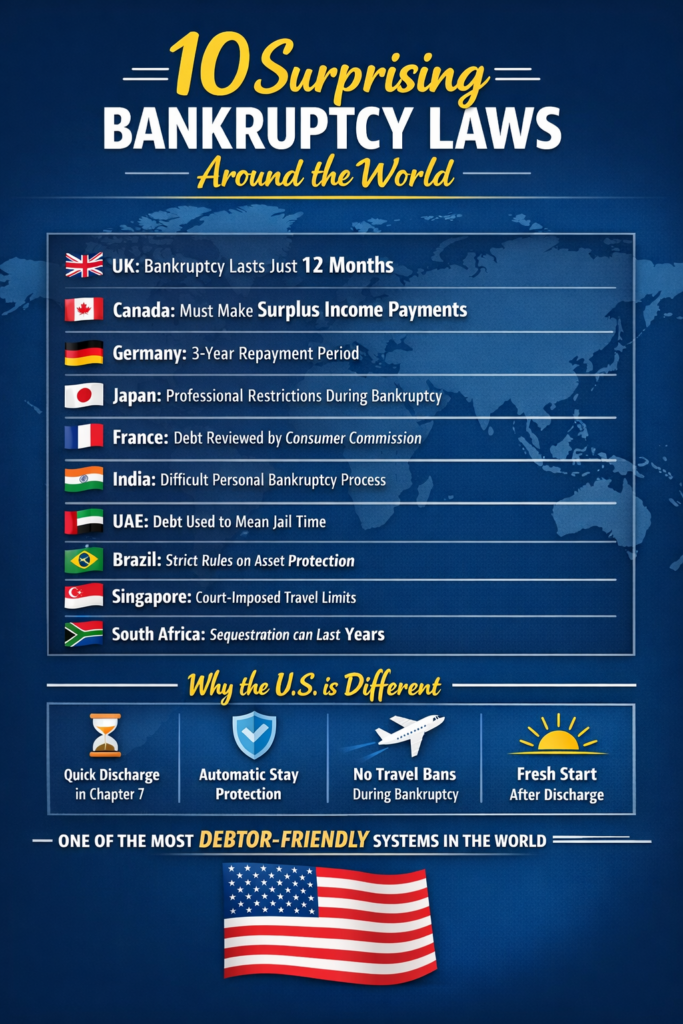
I recently came across a question online that I found fascinating — especially because it’s so different from how bankruptcy works here in the United States.
“I’m bankrupt in Australia and planning an international trip. Do I have to tell my trustee before I go? Someone mentioned I could be detained or arrested at the airport if I don’t — is there any truth to that?”
For anyone practicing or familiar with U.S. bankruptcy law, that question stops you in your tracks.
Because in the United States, there is generally no automatic restriction on international travel simply because someone files bankruptcy.
But in Australia, the rules are very different.
First — A Quick Disclaimer
I am not an Australian attorney, and this post is not legal advice. The information below is based on publicly available Australian bankruptcy law and government resources.
If you are currently bankrupt in Australia, you should always confirm your specific obligations directly with your trustee or an Australian insolvency professional.
Now, let’s talk about the issue.
Now let’s unpack why this question even exists — and what the law in Australia actually says.
Yes — Bankruptcy in Australia Restricts Overseas Travel
If you are currently bankrupt in Australia (during the standard 3-year period), you are generally required to obtain written permission from your trustee before leaving the country.
This is not optional.
Under Australian bankruptcy law, a bankrupt person cannot travel overseas without trustee consent.
So the real question isn’t whether anyone will “notice.” The real issue is that you are legally required to seek approval first.
Will You Be Arrested at the Airport?
Let’s address the dramatic version.
You are not automatically marched away in handcuffs simply because you’re bankrupt.
However:
Trustees can request a Departure Prohibition Order (DPO).
Border authorities can be notified of travel restrictions.
If restrictions are in place, you may be stopped from departing.
So while the “handcuffs” story may be exaggerated, the legal restriction itself is very real.
If a DPO exists or your trustee has taken steps to prevent travel, you can absolutely be prevented from boarding.
Why Does This Rule Exist?
Bankruptcy isn’t just about eliminating debt.
When someone becomes bankrupt:
A trustee administers their estate.
There are obligations to cooperate.
There are reporting and compliance duties.
Travel restrictions exist to ensure:
You remain contactable.
You are not leaving to avoid obligations.
Creditors’ interests are protected.
It is not designed to punish family holidays. It is designed to maintain oversight during the bankruptcy period.
“But It’s Just a Quick Family Trip…”
In practice, many trustees approve short overseas trips, particularly for:
Family holidays
Employment travel
Emergencies
Trustees typically consider:
Whether you are complying with your obligations
Whether income contributions are current (if applicable)
Whether there are outstanding issues
The duration of travel
Whether there are concerns about non-cooperation
If everything is in order, short trips are often approved.
But approval must be obtained first — and in writing.
What Happens If You Just Go and Say Nothing?
This is where online advice can get people into trouble.
If you leave without permission:
You could be stopped at departure.
Your trustee may treat it as non-compliance.
It could complicate your bankruptcy.
In serious cases, consequences could follow.
Even if you travel and return without issue, you may still have breached your legal obligations.
That is not a position you want to be in over a holiday.
The Smart Approach
If you are bankrupt in Australia and planning overseas travel:
Contact your trustee as soon as possible.
Request written permission.
Provide travel details.
Wait for confirmation before departing.
Do not rely on:
“My friend did it and nothing happened.”
Social media comments.
Assumptions that “they won’t know.”
Bankruptcy is a formal legal process. Transparency protects you.
The Bigger Picture
Bankruptcy in Australia generally lasts three years and one day.
During that time:
Certain restrictions apply.
You have compliance obligations.
Travel approval is part of that structure.
This does not mean your life is frozen.
It means you follow the rules while the process runs its course.
Final Thoughts
If you’re asking: “Should I tell my trustee?”
The safest and legally correct answer — based on the law — is yes.
Not because you will automatically be arrested. But because permission is required.
When handled properly, short holidays are often not an issue.
When handled improperly, they can become one.
Again, I am not an Australian attorney. This overview is based on research into Australian bankruptcy rules. For advice specific to your situation, speak directly with your trustee or a qualified Australian insolvency professional before traveling.
Want More Information?
Visit the Australian Government – Australian Financial Security Authority website.
Better to send one email now than face a preventable problem at the airport.
Safe travels — the compliant way.
🇺🇸 Travel During Bankruptcy in the United States
Which leads to the obvious question: does filing bankruptcy in the United States come with similar travel restrictions? The answer is generally no — there is no automatic limitation on domestic or international travel simply because you filed.
But let’s unpack that carefully.
Unlike Australia, there is no automatic travel ban simply because someone files Chapter 7 or Chapter 13 bankruptcy.
There is:
No routine airport flag
No requirement to obtain trustee permission for vacation
No standard prohibition on leaving the country
You do not lose your passport just because you filed bankruptcy.
When Travel Could Become an Issue
While there’s no automatic restriction, there are situations where travel might raise concerns:
1. Failing to Appear at Required Hearings
You must attend:
Your 341 Meeting of Creditors
Any required court hearings
If you miss mandatory appearances because you’re traveling, that can create problems — including dismissal of your case.
But that’s about compliance, not travel itself.
2. Court Orders in Rare Situations
In very unusual cases involving:
Fraud
Asset concealment
Criminal proceedings
Contempt of court
A judge could impose restrictions.
But that is not normal bankruptcy practice. That’s litigation-related misconduct.
3. Spending Concerns
Travel can also raise questions if:
You’re taking an extravagant vacation right before filing.
You’re using credit cards to fund luxury travel.
You’re claiming you can’t pay creditors but spending large sums on discretionary travel.
That doesn’t trigger a travel ban — but it could raise:
Good faith issues
Objections from creditors
Discharge challenges in extreme cases
Again, this is about financial behavior, not travel rights.
What About Chapter 13?
In Chapter 13:
You’re on a court-approved repayment plan.
You must remain compliant with payments.
You must seek court approval for certain financial transactions.
But you still do not need routine permission just to travel.
If travel interferes with plan payments or court appearances, that’s where issues arise.
Big Picture Comparison
In the United States:
Bankruptcy is a financial proceeding.
It is not a travel-restriction mechanism.
There is no standard departure prohibition system tied to bankruptcy.
That’s very different from countries like Australia, where trustee permission is required.
Bottom Line
If you’re filing bankruptcy in the U.S.:
You can generally travel domestically or internationally.
There is no automatic airport flag.
There is no requirement to get trustee approval for vacation.
Just make sure you:
Attend required hearings.
Stay current on payments (if Chapter 13).
Avoid questionable financial activity.
Bankruptcy affects your finances — not your passport.
🇦🇺 Australia vs. 🇺🇸 United States
Travel Restrictions During Bankruptcy
Issue
🇦🇺 Australia
🇺🇸 United States
Can you travel overseas while bankrupt?
Only with trustee permission
Yes, generally no restriction
Is written approval required before international travel?
Yes
No
Can you be stopped at the airport?
Yes, if a Departure Prohibition Order (DPO) is in place
No automatic airport restriction
Does bankruptcy automatically flag your passport?
Travel can be restricted through trustee action
No automatic flag or restriction
Who controls the process?
Trustee has supervisory authority
Bankruptcy court oversees financial compliance
Do you lose your right to travel?
Restricted unless approved
No, unless separate court order exists
When could travel become a problem?
Leaving without trustee consent
Missing court hearings or violating court orders
Is arrest likely just for being bankrupt?
Not automatically, but travel can be blocked
No — bankruptcy alone does not trigger arrest
Bottom Line
Australia: Travel overseas during bankruptcy requires trustee approval.
United States: Bankruptcy does not automatically limit your ability to travel.
Bankruptcy Travel Rules: Australia vs. United States
When I came across the question about being stopped at the airport during bankruptcy in Australia, it really highlighted how different bankruptcy law can be from country to country.
Here’s a straightforward comparison.
🇦🇺 Australia: Travel Permission Required
In Australia, if you are bankrupt during the standard three-year period:
You must obtain written permission from your trustee before leaving the country.
Your trustee has authority to refuse permission in certain circumstances.
A Departure Prohibition Order (DPO) can be issued.
You may be stopped from boarding an international flight if travel restrictions are in place.
The restriction exists because:
A trustee administers your bankruptcy estate.
You have statutory obligations to cooperate.
The system is designed to ensure you remain available and compliant.
International travel during bankruptcy is not automatically prohibited — but it is regulated and requires approval.
🇺🇸 United States: No Automatic Travel Restriction
In the United States, filing Chapter 7 or Chapter 13 bankruptcy:
Does not automatically restrict domestic or international travel.
Does not require trustee permission for vacation.
Does not trigger routine airport alerts.
There is no built-in departure restriction mechanism tied to bankruptcy.
However, you must:
Attend required court hearings (such as the 341 meeting).
Comply with court orders.
Continue making Chapter 13 payments if applicable.
Travel only becomes an issue if it interferes with your legal obligations or raises concerns about financial misconduct.
Why the Systems Are Different
The difference reflects two distinct approaches:
Australia’s model places stronger supervisory authority in the hands of the trustee during bankruptcy.
The U.S. system focuses primarily on financial disclosure and court compliance, without restricting physical movement unless there is fraud, contempt, or a separate court order.
In the U.S., bankruptcy is a financial proceeding — not a mobility restriction.
In Australia, bankruptcy carries statutory travel limitations unless permission is granted.
Key Takeaways: Australia vs. United States
Bankruptcy laws vary significantly by country — especially when it comes to travel.
In Australia, you generally must obtain written permission from your trustee before traveling overseas.
In Australia, a Departure Prohibition Order can prevent you from boarding an international flight.
In the United States, filing bankruptcy does not automatically restrict domestic or international travel.
In the U.S., you do not need trustee permission for vacation.
In both countries, you must comply with your legal obligations during the bankruptcy process.
Travel becomes a problem when it interferes with required appearances, cooperation, or court orders.
Bankruptcy affects your finances — but how it affects your mobility depends entirely on jurisdiction.
Many people assume bankruptcy works the same everywhere. It absolutely does not.
Here are some interesting international differences that often surprise clients.
And… like noted above, I am not an attorney in any of these countries listed below, and this post is not legal advice. The information below is based on publicly available bankruptcy law and government resources. I am admitted to practice only in the US (in PA, NJ, MD, TN, TX, FL, CA, WY, and AZ).
If you are currently bankrupt in one of the countries below, you should always confirm your specific obligations directly with your trustee or a licensed professional in your country.
🇬🇧 United Kingdom – Much Shorter Bankruptcy Period
Standard bankruptcy typically lasts 12 months.
After discharge, most debts are wiped out.
However, if misconduct is found, a Bankruptcy Restriction Order can extend restrictions up to 15 years.
Travel is not automatically restricted.
Shorter timeline than both Australia (3 years) and most U.S. Chapter 13 cases (3–5 years).
🇨🇦 Canada – Income Surplus Payments
First-time bankruptcy can last 9 to 21 months, depending on income.
If income exceeds a government threshold, you must make “surplus income” payments.
Higher earners can remain bankrupt longer.
Travel is not automatically restricted.
Canada blends time-based discharge with income-based contributions.
🇩🇪 Germany – 3-Year “Good Conduct” Period
Debtors must enter a structured repayment phase.
After reforms, discharge is possible in about 3 years.
Strict compliance requirements.
Strong cultural emphasis on repayment responsibility.
Germany historically had very long discharge periods — much longer than the U.S.
🇯🇵 Japan – Strict Court Supervision
Bankruptcy can be relatively quick.
However, during proceedings, certain professions (like company directors) may face temporary restrictions.
Trustees can have significant oversight authority.
Professional restrictions during bankruptcy are more pronounced than in the U.S.
🇫🇷 France – Consumer Commission Model
France often routes consumer over-indebtedness through an administrative commission rather than traditional court bankruptcy.
Payment plans are negotiated.
In some cases, debts can be partially or fully wiped out.
Strong government involvement in restructuring consumer debt.
More administrative than adversarial.
🇮🇳 India – Historically Difficult
Personal bankruptcy was historically rare and complex.
Modern reforms are still evolving.
Corporate insolvency has received more focus than individual bankruptcy.
In many countries, personal bankruptcy protections are still developing.
🇦🇪 United Arab Emirates – Historically Criminal Consequences
Historically, unpaid debt could carry criminal penalties.
Recent reforms have modernized insolvency law.
However, cultural and legal differences still make debt consequences more serious than in Western systems.
This highlights how uniquely protective U.S. bankruptcy law actually is.
🇺🇸 United States – One of the Most Debtor-Friendly Systems
Reminder: I am admitted here – in PA, NJ, MD, TX, TN, FL, AZ, CA, and WY.
Compared globally:
Automatic stay protection is powerful.
No automatic travel bans.
Discharge can occur in as little as 3–4 months in Chapter 7.
Strong fresh start philosophy.
The U.S. system is widely considered one of the most forgiving toward individual debtors.
Why This Matters
Bankruptcy is not just a financial tool — it reflects cultural attitudes toward:
Debt
Responsibility
Economic risk
Second chances
Some countries prioritize creditor protection. Others emphasize rehabilitation and fresh starts.
The word “bankruptcy” may be universal — but how it operates depends entirely on where you are.