The constant calls and threatening letters can feel overwhelming, but you have more power than you might realize. The truth is, you absolutely can sue debt collectors for breaking federal consumer rights laws like the Fair Debt Collection Practices Act (FDCPA)—and people win these cases all the time. This guide is designed to show you how to turn the tables on collectors who use illegal tactics, putting you back in control.
Your Guide to Suing Abusive Debt Collectors

Feeling harassed by a debt collector isn’t just stressful; it’s often a clear signal that your consumer rights are being violated. Too many people think they just have to put up with the aggressive calls and intimidating letters, but federal laws like the FDCPA, TCPA, and FCRA provide powerful protections specifically designed to stop this kind of abuse.
The first step in fighting back is understanding that this isn’t about ignoring a debt you might owe. It’s about holding collection agencies accountable when they step over the legal line. This is a core principle of debt defense: ensuring the laws that protect you are enforced.
Know Your Power Under Consumer Rights Law
The FDCPA is your primary shield. This federal law spells out exactly what collectors can and cannot do. When they break those rules, the law gives you the right to take them to court.
Winning a lawsuit against a collector can change your situation dramatically. Here’s what’s on the table:
- Statutory Damages: You can be awarded up to $1,000 just for the violation, even if you can’t prove you lost money because of it.
- Actual Damages: This covers any real harm you suffered, like emotional distress, lost wages from taking their calls at work, or even medical bills caused by the stress.
- Attorney’s Fees: This is the most important part. If you win, the collector has to pay your lawyer’s fees and court costs.
The constant contact from debt collectors isn’t just an annoyance—it’s a widespread problem. A CFPB survey revealed that about one-third of Americans were contacted by collectors in the past year. Shockingly, nearly 40% faced contact attempts four or more times a week, with 17% enduring eight or more calls weekly.
That “fee-shifting” provision is a game-changer for consumer rights. It means you can often hire a seasoned consumer rights attorney with no money out of your own pocket. It completely levels the playing field, allowing you to go up against a large collection agency without worrying about how you’ll afford a lawyer.
So, let’s dig into what actually counts as illegal behavior.
Common Debt Collector Violations You Can Sue For
It’s crucial to know what specific actions are off-limits for debt collectors. Many people are surprised to learn that common tactics they’ve experienced are actually illegal. The table below breaks down some of the most frequent violations of your consumer rights under the FDCPA. If a collector has done any of these things to you, you may have a strong case.
| Violation Category | Specific Illegal Actions | Your Legal Right |
|---|---|---|
| Harassment & Abuse | Calling repeatedly to annoy or harass you.Using obscene or profane language.Threatening violence or harm. | You have the right to be free from abusive and intimidating communication. |
| False Statements | Falsely claiming to be an attorney or government agent.Misrepresenting the amount you owe.Threatening to have you arrested if you don’t pay. | You have the right to truthful and accurate information from collectors. |
| Unfair Practices | Trying to collect extra fees or interest not allowed by law.Depositing a post-dated check early.Illegally taking or threatening to take your property. | You have the right to be treated fairly and not be subjected to deceptive collection methods. |
| Improper Communication | Calling you before 8 a.m. or after 9 p.m.Contacting you at work after you’ve told them not to.Discussing your debt with third parties like family or neighbors. | You have the right to control how, when, and where debt collectors contact you. |
Knowing these rules is the first step toward reclaiming your peace of mind. If anything on this list looks familiar, it’s time to start gathering evidence and exploring your legal options.
Recognizing When a Debt Collector Crosses the Line
It’s one thing to get a call about an old debt; it’s a whole other story when that call leaves you feeling threatened, harassed, or tricked. The key to protecting yourself—and building a solid case if you sue—is knowing exactly where that line is drawn.
Federal consumer rights laws like the Fair Debt Collection Practices Act (FDCPA) aren’t just suggestions; they draw a very clear boundary between legal collection activity and illegal abuse.
A lot of people I talk to don’t realize the unsettling tactics they’re dealing with are more than just aggressive—they’re flat-out illegal. Collectors often bank on this confusion to see what they can get away with. Pinpointing their specific violations is the first real step toward taking back control.
Unmasking Illegal Harassment
The FDCPA has a broad ban on any conduct meant to harass, oppress, or abuse you. But what does that actually look like day-to-day? It’s a lot more than just a collector having a bad attitude.
Harassment is often defined by the timing and frequency of the calls. For instance, a collector has no legal right to call you at all hours. They are prohibited from contacting you before 8:00 a.m. or after 9:00 p.m. in your local time zone, unless you’ve specifically agreed to it. That 7 a.m. wakeup call isn’t just rude; it’s a potential FDCPA violation you should be documenting.
The law also forbids collectors from using obscene or profane language. If someone is swearing at you or calling you names over a debt, they’ve jumped over a major legal line. The same goes for making endless, repetitive calls designed purely to annoy you or, worse, threatening violence. All of these are textbook violations. For an in-depth look, you can learn more about the specifics of FDCPA violations in our detailed guide.
Spotting False Statements and Deception
Deception is probably one of the most damaging tools in a rogue collector’s playbook. They’ll often say just about anything to scare you into paying, but many of their go-to threats are completely illegal.
A common tactic is misrepresenting the debt itself. A collector might try to pad the balance with unauthorized fees or jack up the interest, hoping you won’t notice. The law demands that they be truthful about the debt’s character, amount, and legal standing.
Another serious form of deception is when a collector pretends to be someone they’re not. This is a huge red flag. Keep an eye out for anyone:
- Falsely claiming to be an attorney or part of a law firm.
- Impersonating a government agent from the IRS or local law enforcement.
- Using a fake or misleading company name to hide their true identity.
A classic scare tactic is threatening to have you arrested, garnish your wages, or seize your property. Unless they have an actual court judgment against you and the legal authority for that specific action, these are just empty, illegal threats designed to intimidate you into paying. This is a cornerstone of debt defense: knowing the difference between a real legal threat and an illegal scare tactic.
Protecting Your Digital and Financial Privacy
Your consumer rights don’t stop with phone calls and letters. Two other crucial laws, the Telephone Consumer Protection Act (TCPA) and the Fair Credit Reporting Act (FCRA), offer vital protection in our modern, connected world.
Think of the TCPA as your shield against relentless robocalls and automated texts to your cell phone. Unless you gave them explicit permission beforehand, a debt collector can’t legally use an autodialer or pre-recorded messages to contact your mobile. Every single one of those illegal calls or texts can count as a separate violation, and the damages can add up fast.
Meanwhile, the FCRA is all about ensuring the information on your credit report is fair and accurate. If a debt collector knowingly reports false information to the credit bureaus—Experian, Equifax, or TransUnion—they’re breaking the law. This includes reporting a wrong amount, putting a debt on your file that isn’t yours, or refusing to update an account to show it’s “in dispute.” These errors can wreck your credit score, and the law takes that very seriously.
When you know what to look for, you can shift your mindset from being a victim to being an empowered observer, ready to document every single illegal move they make.
Building Your Case: An Evidence Checklist
When you go up against a debt collector, winning isn’t about who tells the better story. It’s about who has the better proof. Your entire case will hinge on the quality of the evidence you’ve collected, so you need to be able to show a judge or jury exactly what the collector did wrong.
Think of yourself as a detective building a case. Every letter, every voicemail, every text message is a clue. You need to start gathering this evidence the moment you suspect a collector has crossed the line. Memories get fuzzy, but a saved voicemail recording is forever.
Your Documentation Toolkit
The key is to get organized from day one. Don’t let evidence get buried in a messy pile of mail or lost in your phone’s call history. Grab a folder or create a dedicated digital one and label it clearly. This is now your case file.
Here’s how to capture and preserve every piece of communication:
- Voicemails: Don’t you dare delete them. Save every single one. Voicemails are often a goldmine, capturing the collector’s tone, threats, and any misleading statements. This is raw, unfiltered evidence.
- Text Messages: Screenshot every text. Make sure the screenshot clearly shows the sender’s number along with the date and time.
- Letters and Notices: Keep everything they mail you, including the envelopes. The postmark on an envelope can be a crucial piece of evidence all by itself.
- Phone Call Logs: This is non-negotiable. Keep a detailed log in a notebook or a simple spreadsheet. For every call, jot down the date, time, the number they called from, the name of the person you spoke with (if they give one), and a summary of the conversation.
This isn’t just about preserving a few key items; it’s about showing a pattern of harassment. A single illegal call might be dismissed as a mistake, but a log showing dozens of them is powerful.
The Power of Creating a Paper Trail
So far, we’ve talked about documenting what the collector sends to you. But you can put yourself in a position of incredible strength by creating your own paper trail. The single best way to do this is by sending a debt validation letter via certified mail, return receipt requested.
This isn’t just some angry letter; it’s a formal, legal request that is a key part of any debt defense strategy. It forces the debt collector to stop all collection activities until they prove you actually owe the debt and that they have the legal right to collect it. The certified mail receipt is your undeniable proof that they got your letter. If they call you even once after receiving it without validating the debt, they’ve just handed you another violation for your lawsuit.
Imagine getting a letter demanding payment for an old debt, and then a lawsuit shows up. This nightmare scenario is real for many; debt collection lawsuits have surged, with research showing as many as 4.7 million such cases filed in a single year in U.S. state courts. Read the full research about these trends to understand the scope of the issue.
Your Ultimate Evidence Checklist
Before you even think about filing a lawsuit, go through this checklist. Having this stuff organized and ready to go will make the entire process smoother and dramatically increase your odds of winning.
- All Communications: Every voicemail saved, every text and email screenshotted, and every physical letter kept.
- Detailed Call Log: Your written record of every single phone conversation.
- Copies of Your Letters: Especially your debt validation letter and any cease and desist letters you sent.
- Certified Mail Receipts: Those little green cards are golden. They prove the collector received your letters.
- Your Credit Reports: Pull your reports from all three bureaus (Equifax, Experian, TransUnion) to see if the collector is reporting inaccurate information—a potential FCRA violation.
- Proof of Damages: Did their harassment cause you to see a doctor for stress? Get those notes. Did you get in trouble at work because they kept calling you there? Document it. Did they take money from your bank account illegally? Get the bank statements.
I know it feels like a ton of work, but gathering this evidence is the single most important thing you can do to build an unbeatable case. For a deeper dive, check out our guide on gathering powerful FDCPA evidence.
Navigating the Legal Maze to File Your Lawsuit
Taking legal action can feel like stepping into a foreign country, but once you learn the lay of the land, it’s a lot less intimidating. With your evidence in hand, the next big step is to choose your battleground and formally launch the lawsuit against the debt collector. This is the moment your documented complaints become an official legal challenge.
The first move is deciding where to file your case. You’re typically looking at two main options, and each has its own rules, benefits, and headaches. Getting this right from the start can make a huge difference in the speed, cost, and overall complexity of your fight.
This visual breaks down the core prep work you need to do before you ever step foot in a courthouse: record, document, and organize everything.
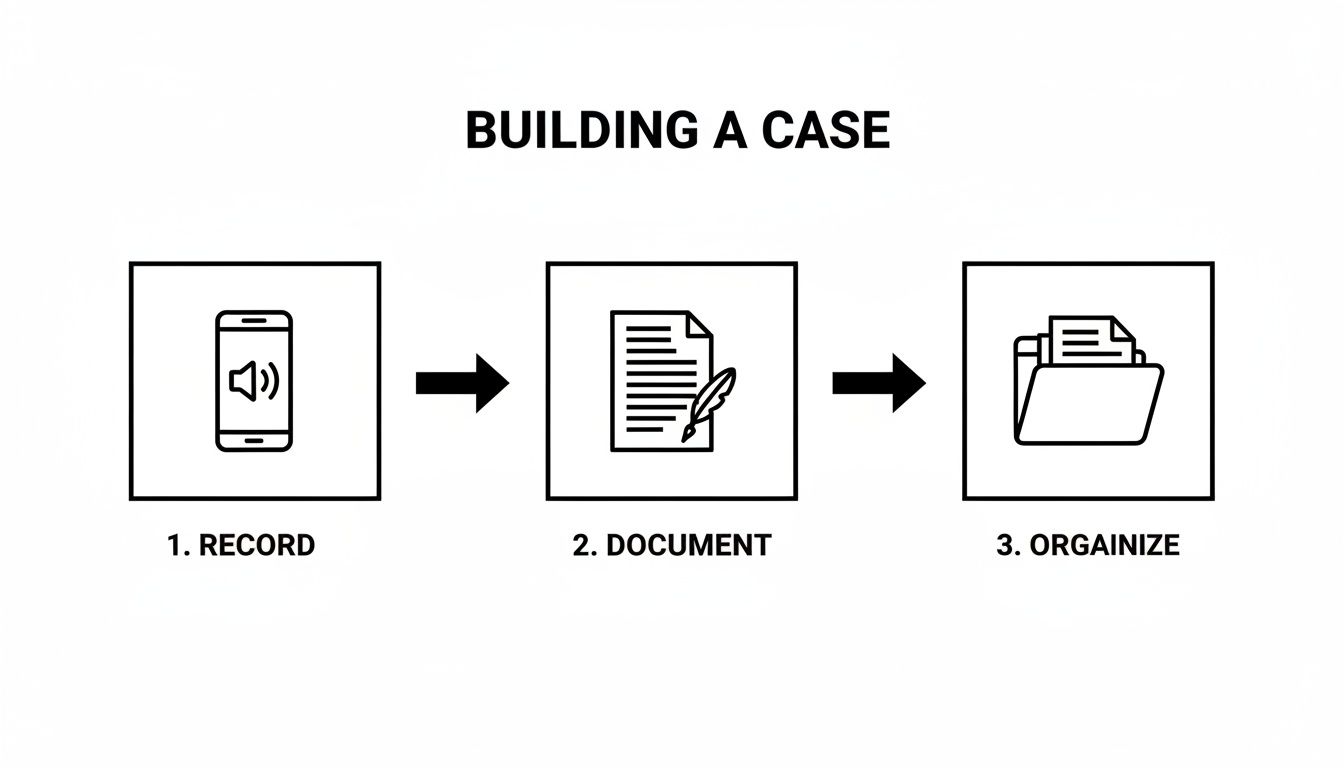
Think of this three-part process as building the foundation of your case. A solid foundation means you’re ready for anything the other side throws at you.
Choosing Your Battlefield: Small Claims vs. Federal Court
So, where do you file? A local small claims court or a larger federal court? The right answer really hinges on what you’re trying to achieve and the details of your situation.
Small Claims Court: This is often the more accessible route, and for some, it’s the right one.
- The Good: The rules are much simpler, filing fees are low, and things move quickly. You can represent yourself, but that comes with its own set of risks.
- The Bad: There are strict caps on the amount of money you can ask for, and these limits vary by state. More importantly, the judges might not be experts in complex federal consumer rights laws like the FDCPA or TCPA.
Federal Court: This is the big league, and it’s where most serious consumer rights lawsuits are filed for a few key reasons.
- The Good: Federal judges live and breathe federal law. There are no limits on the actual damages you can recover for things like emotional distress. And here’s the game-changer: the powerful fee-shifting provision in the FDCPA means the collector has to pay your attorney’s fees when you win.
- The Bad: The process is formal, complicated, and unforgiving. The rules of procedure are dense. Trying to go it alone in federal court without a seasoned consumer rights lawyer is a recipe for disaster.
For most people looking to hold a debt collector accountable for harassment, federal court is the clear winner. The ability to hire an attorney who gets paid by the collector when you win is the single most powerful advantage you have in consumer rights law.
The First Moves: Filing a Complaint and Serving the Collector
After you’ve picked the court, the lawsuit officially kicks off with two critical actions: filing a “complaint” and then “serving” that complaint on the debt collector.
The complaint is the document that gets the ball rolling. It’s not just a letter airing your grievances; it’s a structured legal document that spells out:
- Who you are (the Plaintiff) and who you’re suing (the Defendant).
- Why this specific court can hear your case (i.e., it involves a federal law).
- Your story, told as facts, in numbered paragraphs detailing exactly what the collector did wrong.
- The specific laws you believe they broke (like the FDCPA, TCPA, or FCRA).
- What you want the court to do—like award you damages and make the collector pay your lawyer.
Drafting a solid complaint is a real skill. It has to hit all the right legal notes to be considered valid. Once it’s written, you file it with the court clerk, who will stamp it and assign your case a number.
Next up is service of process. You can’t just email the lawsuit to the collector. The law demands a formal “service,” which means a neutral third party—like a professional process server or a sheriff’s deputy—must personally deliver the complaint and a court summons to them. This serves as their official notice that they’re being sued and gives them a deadline to respond. If you get this step wrong, your whole case could be thrown out.
Ironically, many consumers get sued by debt collectors and simply ignore the paperwork, which results in a default judgment against them. But now, you get to turn the tables. You file a strong complaint, and the collector is the one who has to respond or risk a default judgment in your favor.
Getting a handle on these first steps is key. Even with a lawyer handling the mechanics, knowing the playbook helps you stay involved and confident as your case moves forward. Once the complaint is served, the case moves into the “discovery” phase, where both sides start exchanging evidence. To get a better idea of what to expect next, check out our guide on understanding the discovery process.
What Happens After You Sue a Debt Collector
Filing the lawsuit is a huge step, but it’s really just the opening move. Once the debt collector gets officially served with your complaint, the case moves into a structured legal process where both sides prepare for a potential trial. Knowing what’s coming next demystifies the whole thing and shows you just how much leverage your evidence provides.
Most people imagine a dramatic courtroom battle, but that’s not how it usually plays out. The truth is, the vast majority of consumer lawsuits against debt collectors never actually go to trial.
The entire process is designed to encourage a resolution long before a judge gets involved. The collector knows they’re on the hook for your attorney’s fees if they lose, and that fact completely changes the power dynamic in your favor.
The Discovery Phase: Uncovering the Truth
After your lawsuit is filed, we enter a critical stage known as discovery. This is where the real work of building your case happens. During discovery, both you and the debt collector have the legal right to request and exchange evidence.
This isn’t just a casual chat; it’s a formal process governed by strict rules. Your attorney will use specific legal tools to dig up information the collection agency would never volunteer on its own.
Some of the most common discovery tools include:
- Interrogatories: These are basically written questions the debt collector is legally required to answer under oath. For example, your attorney might ask for the names of every employee who called you or demand details about their internal compliance policies.
- Requests for Production of Documents: This is a formal demand for specific paperwork. It’s how your lawyer gets their hands on things like call logs, internal notes about your account, and any training manuals they use for FDCPA compliance.
- Depositions: This is a formal, out-of-court testimony where your attorney questions the collector (or their employees) under oath with a court reporter transcribing everything. It’s a powerful opportunity to lock in their story and find inconsistencies.
Of course, discovery is a two-way street. The collector’s lawyers will also ask for information from you. This is precisely why all that evidence you gathered—the call logs, voicemails, and letters—becomes absolutely essential to winning your case.
Navigating Settlement Negotiations
Armed with solid evidence, debt collectors often realize that going to trial is a terrible business decision. A public trial airs their dirty laundry and carries the huge risk of a jury siding with an individual over a big company. Even more importantly, a loss means they have to pay a judgment plus your attorney’s fees.
This is exactly why the vast majority of FDCPA cases settle out of court. Once discovery shines a light on how strong your evidence is, the collector’s attorneys almost always start talking about a settlement.
A settlement is a formal agreement where the debt collector pays you money in exchange for you dropping the lawsuit. It’s a strategic move for them—they’d much rather pay a predictable amount now than risk an unpredictable, and potentially much larger, loss later on.
Your attorney handles all these negotiations, fighting to get you the best possible outcome based on the specific violations and the damages you suffered. A strong case doesn’t just mean getting a settlement; it means getting a fair settlement that actually compensates you for everything you went through.
Understanding Your Potential Compensation
When you sue a debt collector and win, the law allows you to recover money in a few different ways. This isn’t just about getting an apology; it’s about receiving real compensation for the harm they caused and holding them accountable for breaking the law.
The table below breaks down the different types of damages you can recover when you successfully sue a debt collector under federal consumer rights law.
Potential Compensation in a Debt Collector Lawsuit
| Type of Damage | What It Covers | Potential Value |
|---|---|---|
| Statutory Damages | A penalty for the collector’s violation of the law. You can get this even if you can’t prove you lost any money. | Up to $1,000 per lawsuit under the FDCPA. TCPA violations can be $500-$1,500 per call/text. |
| Actual Damages | Compensation for the real harm you suffered from the collector’s actions. | This is uncapped. It can include medical bills, lost wages, and money for emotional distress like anxiety or sleepless nights. |
| Attorney’s Fees & Costs | The “fee-shifting” rule requires the collector to pay your reasonable attorney’s fees and court costs if you win. | This is often the largest part of the financial recovery and allows you to hire a lawyer with no upfront cost. |
This fee-shifting provision is the real game-changer in consumer protection law. It ensures that your ability to get justice isn’t limited by how much money you have. This powerful tool levels the playing field, empowering you to hold abusive collectors accountable without taking on a huge financial risk. It’s the ultimate leverage in your fight for fair treatment.
Common Questions About Suing Debt Collectors
Thinking about taking on a debt collector in court can feel intimidating. It’s only natural to have a lot of questions running through your mind. Let’s tackle some of the most common concerns head-on. Getting straight answers will give you the confidence you need to stand up for your rights.
Uncertainty about the cost, the timeline, or even the strength of your case stops too many people from taking action. We’re here to clear away that confusion.
How Much Does It Cost to Hire a Lawyer to Sue a Debt Collector?
This is, without a doubt, the number one question on everyone’s mind. The answer, however, is often a welcome surprise. Consumer rights laws like the FDCPA have a powerful feature built right into them called a fee-shifting provision, and it’s there to make sure justice isn’t only for those who can afford it.
Here’s how it works: if you win your case, the law forces the debt collector to pay your attorney’s reasonable legal fees and court costs. Because this tool is so effective, almost every consumer protection lawyer worth their salt takes these cases on a contingency fee basis.
What does that mean for you? You pay absolutely nothing upfront. Your lawyer only gets paid when they win, and that payment comes from the debt collector, not out of your pocket. This setup completely removes the financial risk from your shoulders.
How Long Do I Have to Sue a Debt Collector for Harassment?
When it comes to filing a lawsuit, the clock is ticking. The law sets a firm deadline, known as the statute of limitations, and for consumer rights violations, it can be strict.
For FDCPA violations, you have exactly one year from the date the violation occurred to file your lawsuit. The timeline for TCPA and FCRA claims can be different, often two years, so it’s critical to act fast.
Let’s say a collector screamed profanities at you during a phone call on August 10, 2024. Your deadline to file an FDCPA lawsuit would be August 9, 2025. If you miss that date by even a single day, your right to sue for that illegal act is gone for good.
This is precisely why documenting everything—especially dates and times—is so critical. Don’t put it off. Speaking with an attorney as soon as you think your rights have been violated is the best way to protect your claim before time runs out.
What if the Debt Is Actually Mine? Can I Still Sue?
Yes. Absolutely. This is a huge point of confusion for many people, so let’s be crystal clear: your consumer rights have nothing to do with whether you owe the money.
The FDCPA protects all consumers—regardless of their debt status—from abusive, deceptive, and unfair collection practices. The law does not give collectors a green light to harass you just because the debt is valid. A key part of debt defense is asserting these rights.
Think of it this way: a driver who speeds and causes a crash is still at fault, no matter how legitimate their reason for being on the road was. In the same way, a debt collector who breaks the law is liable for their illegal behavior. If they harassed you, lied to you, or used any other illegal tactic, you have a case.
Can I Handle a Lawsuit Against a Debt Collector Myself?
Legally, you have the right to represent yourself in court (this is called appearing “pro se”). Practically speaking, it’s almost always a terrible idea in these situations. Debt collection agencies and their insurers have armies of experienced lawyers who do nothing but defend these lawsuits all day long.
Bringing in an expert consumer protection attorney gives you an immediate advantage:
- Deep Legal Knowledge: They live and breathe the nuances of the FDCPA, TCPA, and FCRA and are up-to-date on all the recent court decisions that could affect your case.
- Strategic Advantage: They know the court procedures inside and out, how to corner the defense in discovery, and how to shut down their common tactics.
- Maximizing Your Outcome: A good lawyer is skilled at proving all your damages—including the emotional distress that’s hard to put a price on—and knows how to negotiate the best possible settlement.
Most importantly, remember that fee-shifting provision? Since the collector has to pay your attorney’s fees when you win, you gain very little financially by going it alone while taking on a massive amount of risk. Partnering with an expert gives you the best shot at winning.
Facing down an abusive debt collector can be incredibly stressful, but you don’t have to go through it alone. Knowing your rights is the first step, and taking decisive action is the next. If you’ve been the target of illegal collection tactics, remember that the law is on your side.
The team at Ginsburg Law Group PC is dedicated to defending consumer rights. We know the laws that protect you—from the FDCPA and TCPA to the FCRA and debt defense strategies—and have the experience to hold abusive collectors accountable. Contact us for a consultation to discuss your case and learn how we can help you fight back.