(“Wait… New Jersey doesn’t really have its own exemptions?”)
Correct—and that surprises a lot of people.
If you’re filing bankruptcy in New Jersey, the exemption landscape looks very different from states like Pennsylvania or Florida. And understanding that difference can have a huge impact on what property you keep.
Let’s break this down in a way that actually makes sense—no legal jargon overload, just clear, practical guidance on how New Jersey bankruptcy exemptions work and how they affect you.
First: What Are Bankruptcy Exemptions?
At the most basic level:
Bankruptcy exemptions are laws that allow you to keep certain property when you file bankruptcy.
Without exemptions, the bankruptcy system would allow creditors to take everything you own.
With exemptions, the law protects what you need to live and rebuild.
Think of exemptions as a legal shield around your essential assets.
The Unique Thing About New Jersey
Here’s the headline:
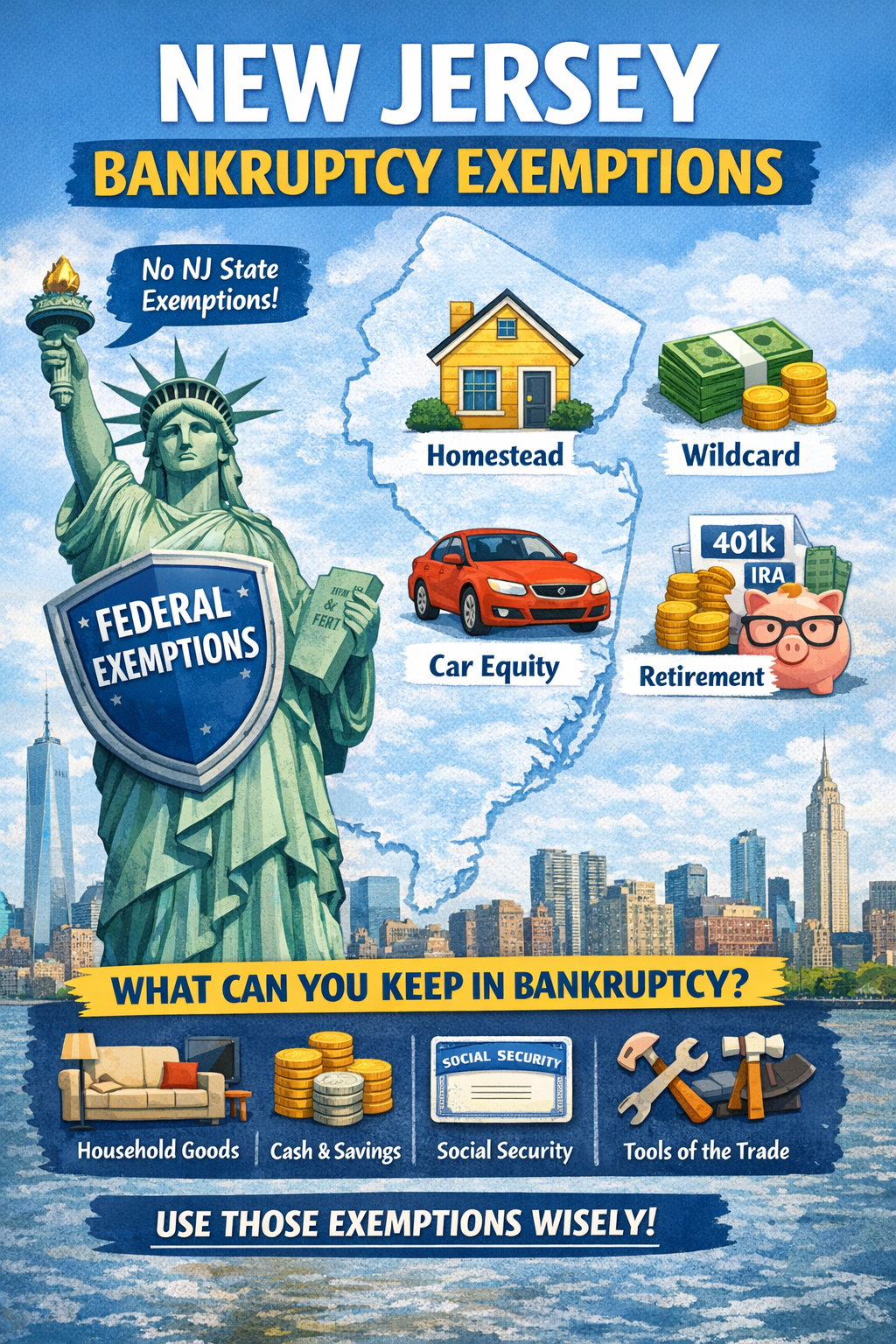
New Jersey does NOT have a comprehensive state exemption system.
Instead, if you file bankruptcy in New Jersey, you will almost always use:
👉 Federal bankruptcy exemptions
This is very different from states like Pennsylvania, where you can choose between state and federal systems.
In New Jersey, the federal exemptions are typically the primary (and best) option.
Why This Matters
The exemption system you use determines:
- What property you keep
- What property could be at risk
- How your case is structured
- Whether Chapter 7 or Chapter 13 makes more sense
So understanding exemptions isn’t just technical—it’s strategic.
How Federal Exemptions Work (For NJ Filers)
When you file bankruptcy in New Jersey using federal exemptions, you’re working with a structured list of categories, each with specific dollar limits.
These limits adjust periodically, but the framework stays the same.
Let’s go through the most important ones.
1. The Homestead Exemption (Your Home)
This is one of the biggest—and most important—protections.
What it does:
Protects equity in your primary residence.
Why it matters:
If you have equity in your home, this exemption can determine whether you keep it.
How it works:
- Protects up to a certain dollar amount of equity
- Applies to your primary residence only
Example:
- Home value: $300,000
- Mortgage: $250,000
- Equity: $50,000
If your exemption covers that equity, your home is protected.
2. The Wildcard Exemption (The MVP)
If there’s one exemption people love, it’s this one.
What it does:
Lets you protect anything you want
Why it matters:
It gives you flexibility.
You can apply it to:
- Cash
- Bank accounts
- Extra vehicle equity
- Personal property
Think of it as:
A “fill in the blank” protection.
3. Motor Vehicle Exemption
What it does:
Protects equity in your car.
Example:
- Car value: $10,000
- Loan: $6,000
- Equity: $4,000
If your exemption covers that equity, you keep the car.
If not, you may still protect it using the wildcard.
4. Personal Property (Household Goods)
This includes everyday items like:
- Furniture
- Appliances
- Clothing
- Electronics
Most people are surprised by this:
These items usually have very low resale value
So even modest exemptions often fully protect them.
5. Retirement Accounts
Good news:
Most retirement accounts are fully protected.
This includes:
- 401(k)s
- IRAs
- Pensions
This is one of the strongest protections in bankruptcy law.
6. Wages and Income
Certain wages and earned income are protected, especially:
- Recent earnings
- Necessary income for living expenses
7. Public Benefits
Fully protected in most cases:
- Social Security
- Disability benefits
- Unemployment
- Veterans benefits
These are considered essential and off-limits to creditors.
8. Tools of the Trade
If you rely on tools for your job (think mechanics, contractors, etc.), these can be protected up to a certain value.
9. Jewelry and Miscellaneous Assets
There are specific limits for items like:
- Jewelry
- Small valuables
Again, the wildcard exemption often helps here.
The Role of the Wildcard (Why It Changes Everything)
Let’s pause here, because this is where strategy comes in.
The wildcard exemption allows you to:
- Cover gaps
- Protect assets that don’t fit neatly into categories
- Maximize what you keep
Example:
You have:
- $3,000 in a bank account
- $2,000 in extra car equity
You can use the wildcard to protect both.
This flexibility is why federal exemptions are so powerful for NJ filers.
What Happens If an Asset Isn’t Fully Exempt?
This is where people get nervous—but it’s not always as bad as it sounds.
If something exceeds exemption limits:
In Chapter 7:
- The trustee may try to recover the non-exempt portion
- But often, there are options (like buybacks)
In Chapter 13:
- You keep the asset
- You may pay creditors the non-exempt value over time
Chapter 7 vs. Chapter 13 in NJ
Chapter 7 (Liquidation)
- Exemptions determine what you keep
- Non-exempt assets may be at risk
Chapter 13 (Repayment Plan)
- You keep everything
- Exemptions affect how much you repay
Common Misconceptions About NJ Exemptions
❌ “I’ll lose everything.”
Reality:
Most people keep all or most of their property.
❌ “I can’t file if I own a house.”
Reality:
Many homeowners file successfully and keep their homes.
❌ “Cash is safe.”
Not necessarily.
Cash and bank accounts are often less protected unless you use exemptions strategically.
❌ “I don’t need to think about exemptions.”
This is a big mistake.
Exemption planning can completely change your outcome.
Real-World Example
Let’s say you live in New Jersey and have:
- $5,000 in savings
- A car with $4,000 equity
- Household goods
- Retirement account
Using federal exemptions:
- Retirement = protected
- Household goods = protected
- Car = protected
- Savings = protected using wildcard
Result?
You keep everything.
Strategic Planning: Timing and Asset Positioning
This is where things get more advanced—but also more powerful.
Before filing, people sometimes:
- Adjust timing of filing
- Pay necessary expenses
- Allocate exemptions strategically
Important note:
This must be done legally and carefully—never try to “hide” assets.
A good attorney will guide this process.
The Emotional Reality of Exemptions
Let’s be honest:
Filing bankruptcy is stressful enough without worrying about losing everything you own.
Understanding exemptions changes that.
It shifts the mindset from:
“What am I going to lose?”
to:
“What can I protect?”
And in many cases, the answer is: a lot more than you think.
Why New Jersey Filers Often Have Strong Outcomes
Because federal exemptions are:
- Flexible
- Generous (especially with wildcard)
- Well-structured
New Jersey filers often end up in a better position than they expected.
Practical Tips for NJ Filers
1. Take Inventory of Everything
List:
- Bank accounts
- Vehicles
- Property
- Digital assets
2. Don’t Forget Cash
Cash is one of the most commonly overlooked assets.
3. Be Honest
Full disclosure is critical.
4. Work With an Experienced Attorney
This is not DIY territory.
Exemption strategy matters.
Final Thoughts: It’s About Protection, Not Punishment
New Jersey bankruptcy exemptions—primarily through the federal system—are designed to:
- Protect your essentials
- Give you a fresh start
- Balance fairness to creditors
So if you’re considering filing, remember:
- You are not expected to lose everything
- Exemptions are your protection
- Strategy matters
And most importantly:
Bankruptcy is not about starting over from nothing—it’s about starting over with what you need.