Getting served with a court summons for a debt is a scary moment, but how you respond is your most powerful tool. The key is to file a formal “Answer” with the court, where you’ll need to admit, deny, or state you lack knowledge about each specific claim made against you. The absolute worst thing you can do is ignore it—that almost always guarantees the debt collector wins by default because you gave up your consumer rights.
Your First Moves After Receiving a Debt Collection Summons
Seeing that official envelope can make your heart pound. But this is a time for strategy, not panic. A summons isn’t a final judgment; it’s just the starting bell for a legal process. What you do in the next few days can make all the difference in defending your rights.
Think of this initial phase as reconnaissance. You’re gathering intel, not fighting a battle just yet.
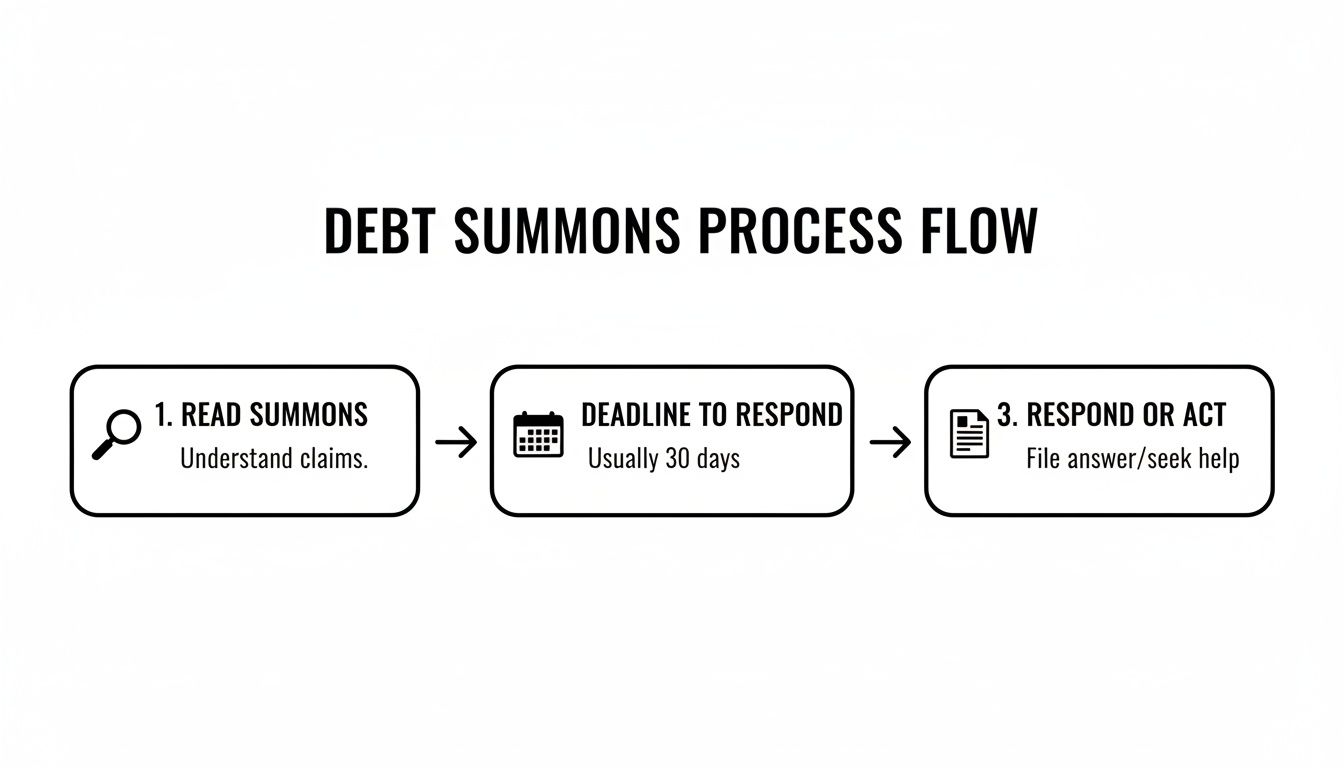
This process turns a moment of high stress into a clear, manageable plan of action: read the documents, find your deadline, and get ready to respond.
Never, Ever Ignore a Summons
Ignoring a summons is like handing the other side a victory before the game even starts. If you don’t file a response, the debt collector (the “plaintiff”) will simply ask the court for a default judgment. If the judge grants it, they win automatically. They don’t have to prove a single thing about the debt, and your rights under laws like the FDCPA become much harder to enforce.
This isn’t just a possibility; it’s the most common outcome. Courts award a default judgment in over 70% of debt collection lawsuits. The collector wins because the person being sued never showed up to fight.
That statistic reveals a tough truth: doing nothing is exactly what the debt collector is hoping for. With 2 to 4.7 million of these lawsuits filed every year in the U.S., countless people lose by default. A judgment gives the collector powerful legal tools to take your money, including:
- Wage Garnishment: The court can order your employer to send a portion of your paycheck directly to the collector.
- Bank Levies: They can freeze your bank account and seize the funds inside.
- Property Liens: A legal claim can be placed on your property, like your house or car, complicating your ability to sell or refinance.
Decoding the Documents
The stack of papers you were served with usually has two main parts: the Summons and the Complaint.
The Summons is the official court paper telling you that you’ve been sued. It’s a direct order to respond. Most importantly, it contains your deadline—this is non-negotiable. Deadlines are strict and typically range from 20 to 30 days from the day you were served. Find this date first.
The Complaint is where the debt collector lays out their case. It will be a series of numbered paragraphs, each making a specific “allegation.” Go through it paragraph by paragraph, looking for these key details:
- Who is the Plaintiff? Is it the original company you owed money to, or is it a third-party debt buyer you’ve never heard of?
- What is the Alleged Debt? Do you recognize the account number or the original creditor mentioned?
- How Much Do They Claim You Owe? Does the amount look right? Is it broken down into principal, interest, and fees?
Filing an Answer is your first real move to defend yourself. It forces the plaintiff to actually prove their claims and opens the door for you to present defenses. To get a better handle on what you can and can’t be subjected to, it’s worth reviewing your rights against debt collectors. Responding puts the ball back in your court.
The table below summarizes the absolute first things you need to do. Don’t put these off—your deadline is already ticking.
Your Immediate Action Checklist After Receiving a Summons
| Action Item | Why It’s Critical |
|---|---|
| 1. Don’t Panic | Your emotional state affects your decisions. Take a deep breath and treat this as a business matter to be handled methodically. |
| 2. Identify the Deadline | This is the most important date. Missing it means an automatic loss. Circle it on the summons and put it on your calendar immediately. |
| 3. Read Every Document | The Summons and Complaint contain all the information you need to start building your defense. Understand who is suing you and for what. |
| 4. Preserve the Envelope | The postmark or service date on the envelope can be crucial evidence for when your response timeline officially began. Don’t throw it away. |
| 5. Do Not Call the Collector | Anything you say can be used against you. Don’t make promises or admit to anything. Your communication should now be in writing through the court. |
Tackling these five steps right away will set you up for a much stronger defense and prevent the simple mistakes that lead to a default judgment.
Picking Apart Their Lawsuit: How to Find the Weak Spots
Once you know your deadline, it’s time to put on your detective hat. The document you need to dissect is called the Complaint. This is where the debt collector lays out their entire case against you, and frankly, it’s often full of holes. Don’t let the dense legal jargon throw you off. Your mission is to break it down, piece by piece, and look for anything that doesn’t add up.
Every numbered paragraph in that Complaint is an “allegation”—a specific claim the plaintiff is making. Your job is to challenge every single one. You’re not just questioning the total amount they say you owe; you’re scrutinizing every single detail they present as part of your debt defense strategy.
Scrutinizing Every Claim
The best way to start is to get organized. Grab a notepad or open a document and make a simple list. Go through the Complaint one numbered paragraph at a time and write down what each one claims.
You’re hunting for very specific pieces of information:
- Original Creditor: Who do they say the original debt was with? Is it a bank or company you actually did business with?
- Account Number: Does the account number they list look familiar? It’s incredibly common for debt buyers to have partial or totally wrong account information.
- Date of Last Payment: This is a huge one. This date is directly tied to the statute of limitations, which is a powerful consumer rights defense.
- Total Amount Claimed: How did they get to this number? Is it broken down into principal, interest, and fees? A legitimate claim should be able to justify every single penny.
Debt collection lawsuits have absolutely exploded, now making up about a quarter of all civil cases in America. This is a massive jump, and it puts millions of people in a tough spot if they don’t know their rights. After the pandemic, collectors went into overdrive filing suits on old credit card and medical debts. Your real power comes from demanding proof. Many states don’t require collectors to prove the debt is valid before they sue, but a well-crafted Answer can force their hand, making them produce contracts and statements that are often riddled with errors. You can dig into more data on how often debt collectors go to court to see just how widespread this is.
Finding the Flaws in Their Story
As you go through their allegations, you’re looking for the cracks in their foundation. These weak spots will form the backbone of your official Answer and your affirmative defenses. The truth is, many of these lawsuits are churned out by mills, and they’re often full of mistakes you can use to your advantage.
For example, what if the Complaint names a credit card company you’ve never even had an account with? That’s a major red flag. Or maybe the amount they claim you owe is way higher than you remember, bloated with mysterious fees and interest charges they can’t explain—a potential FDCPA violation.
The burden of proof is 100% on them. It’s the plaintiff’s job to prove you owe the debt, that they have the legal right to collect it, and that the amount is correct. Your job is simply to make them prove it.
The case gets even shakier if the plaintiff is a third-party debt buyer—a company like Midland Funding or Portfolio Recovery Associates. These companies have an extra hurdle to clear. They have to prove they legally purchased your specific account and have the standing to sue you. This requires a paper trail called the “chain of title,” showing the debt’s journey from the original creditor to them. More often than not, they can’t produce it.
Common Weak Points to Target
While you’re reviewing the Complaint, be on the lookout for these classic red flags. Spotting even one can give you serious leverage in your debt defense.
- Incorrect Personal Information: Is your name misspelled? Is your address wrong? Even small errors can show how sloppy their records are.
- Vague Allegations: Does the lawsuit just say you “owe a debt” without naming the original creditor or the account number? That’s often too vague to hold up in court.
- Missing Paperwork: The Complaint itself might be the only thing they have. They are supposed to attach key documents, like the original credit agreement. If those are missing, it’s a huge weakness.
- Statute of Limitations: Check the “date of last payment” or “date of default” they list against your state’s statute of limitations for debt. If they’re suing you over an old, expired debt, the case could be thrown out entirely.
By doing this careful analysis, you stop being a victim of the lawsuit and become an active force in your own defense. This is the critical groundwork that will allow you to build a powerful Answer that puts the pressure right back on them.
How to Draft Your Formal Answer and Affirmative Defenses
This is where you officially push back. Your “Answer” is the formal legal document you’ll create to tell the court—and the plaintiff suing you—that you’re not just rolling over. It might sound intimidating, but it’s more straightforward than you think.
Your Answer has two main jobs: respond directly to every claim they made in their Complaint and then raise your own defenses to their lawsuit.
First, Respond to Every Single Allegation
Your initial task is to go through the plaintiff’s Complaint, paragraph by paragraph. You need to provide one of three specific responses to each numbered statement they’ve made. This isn’t the time to tell your whole story; it’s a very precise, formal reply to their claims.
For every single numbered paragraph, you must choose one of these responses. Be deliberate here—it matters.
- Admit: Only use this if you are 100% certain the statement is completely true, without a doubt. For instance, if a paragraph correctly states your legal name and current address, you’d admit it. Use this one very, very carefully.
- Deny: This will likely be your most common response. If any part of a statement is untrue, or if you aren’t absolutely sure it’s true, you should deny it. When in doubt, deny. This is a powerful move because it forces the plaintiff to prove that specific point is true.
- State Lack of Sufficient Information: If you genuinely have no way of knowing whether something is true or false, this is the correct choice. A classic example is a claim that the plaintiff bought your debt on a specific date. You weren’t part of that deal, so you have no firsthand knowledge. Stating you lack sufficient information is the honest and legally correct response.
Think of it like a true/false quiz where “deny” is your default setting. Admitting to something incorrectly can weaken your case significantly later on.
Second, Introduce Your Affirmative Defenses
After you’ve responded to each allegation one by one, you get to the most strategic part of your Answer: your Affirmative Defenses.
These are powerful legal arguments that can get the case thrown out, even if the debt they’re claiming is technically valid. You’re essentially saying, “Even if what you claim is true, you still can’t win, and here’s why.”
It is absolutely critical to list every possible affirmative defense in your initial Answer. If you fail to raise a defense now, you almost always lose the right to bring it up later.
State laws on debt collection can be a minefield for consumers. While 41 states and Washington, D.C., have rules on the books, most offer surprisingly few real protections. This is why collectors often get away with suing on old debts—they bet you won’t know to raise the statute of limitations as a defense.
In fact, research shows that few states actually require collectors to provide proof that a debt is valid, which is how just 10 firms can dominate the lawsuit filings in some states. You can read more about these policy gaps in a detailed Pew analysis of state debt collection laws.
Common Affirmative Defenses That Win Cases
Here are some of the most common and effective defenses used in debt collection lawsuits. See which ones might fit your situation.
- Statute of Limitations Has Expired: Every state sets a time limit (usually 3 to 10 years) on how long a creditor has to sue you over a debt. The clock generally starts ticking from your last payment. If they sued you after that window closed, the debt is “time-barred,” and you can ask the court to dismiss the case.
- Lack of Standing: This is a big one. The company suing you must prove it has the legal right to do so. If it’s a debt buyer, it has to prove it legally owns your specific account. You can argue they lack standing if they can’t produce the “chain of title”—the paper trail showing they bought the debt from the original creditor.
- Improper Service of the Summons: The law has very strict rules about how a summons must be delivered. If the process server just left it with a neighbor, mailed it to the wrong address, or didn’t follow the rules to the letter, the service is invalid. This can be grounds for dismissal.
- The Amount Claimed is Incorrect: Check the math. If the total they’re suing for is inflated with improper interest calculations, unauthorized fees, or other mistakes, you absolutely should raise this as a defense. This can also be a violation of the FDCPA.
- Failure to State a Claim: This is a more technical, catch-all defense. You’re arguing that the plaintiff’s Complaint is too vague or is missing essential information (like a copy of the original contract) required to even bring a valid lawsuit.
Your Answer is not the place for long, emotional stories. Keep it concise and formal. It’s a legal document designed to address their claims head-on and lay out your defenses in a clear, structured way.
By carefully crafting your responses and asserting your affirmative defenses, you shift the legal pressure right back onto the debt collector. Your Answer forces them to actually prove their case—a task many are surprisingly unprepared for.
For a deeper dive into these strategies, you can learn more about how to challenge a debt collector lawsuit in our guide. This is your first real opportunity to take control and build a strong foundation for your defense.
Making It Official: Filing and Serving Your Answer
You’ve done the hard work of writing your Answer, but it’s just a piece of paper until you get it into the right hands. This next part is all about the administrative legwork—filing your document with the court and formally delivering it to the plaintiff. These steps are absolutely critical. Messing them up is like writing a brilliant exam but forgetting to hand it in. You can lose by default just by fumbling the paperwork.
Think of it this way: you have to officially get your Answer on the court’s record and prove you gave a copy to the other side. Let’s walk through exactly how to do that.
How to File Your Answer at the Courthouse
Your first destination is the clerk of the court. This is the office that handles all the paperwork for the courthouse listed on your summons.
Don’t just show up with a single document. Here’s the play-by-play for getting it done right:
- Make copies. Lots of them. You’ll need the original for the court, one copy for the plaintiff’s lawyer, and at least one for yourself. I always tell people to make an extra “just in case” copy. You can never have too many.
- Head to the clerk’s office. Bring your original Answer and all the copies. You’ll hand them over, and the clerk will stamp the original with the date, making it an official court document.
- Get your copies stamped. This is a pro tip, and it’s non-negotiable. Ask the clerk to stamp all of your copies with that same official date stamp. This “file-stamped” or “conformed” copy is your golden ticket—it’s irrefutable proof that you filed on time.
A quick note on cost: some courts charge a filing fee. If you can’t afford it, don’t panic. Ask the clerk for a “fee waiver” application. It’s a standard procedure, so don’t be shy about asking.
Serving the Plaintiff’s Attorney
Once your Answer is filed, you have to let the plaintiff know you’ve responded. In legal terms, this is called service of process, or simply “serving” them. You won’t be dealing with the debt collector directly; you’ll serve their lawyer, whose name and address are right there on the summons.
You can’t just drop it in a mailbox and hope for the best. You need a method that gives you proof of delivery.
The gold standard for this is Certified Mail with a Return Receipt. You can get this at any U.S. Post Office. When your document is delivered, the lawyer’s office has to sign a little green postcard, which is then mailed back to you. That signed green card is your definitive proof they got it.
Why Proof Is Everything: You have to operate as if the other side might claim they never received your Answer. They might not, but if they do, the court won’t just take your word for it. Your file-stamped copy and that signed green return receipt are the evidence that shuts down that argument cold.
Your Final Checklist Before You Rest
It’s easy to miss a small step when you’re stressed. Run through this checklist one last time to make sure you’ve covered all your bases.
- Final Proofread: Read your Answer one more time. No typos.
- Sign and Date It: An unsigned Answer is worthless. Don’t forget this.
- Make at Least 3 Copies: The original for the court, one for the plaintiff, one for you.
- File at the Right Courthouse: Double-check the address on the summons.
- Get ALL Copies Stamped: This is your proof of filing.
- Serve the Attorney: Use Certified Mail with Return Receipt.
- Safeguard Your Proof: Keep your stamped Answer copy and the signed green mail receipt somewhere safe.
Once you’ve checked off every item on this list, you can take a deep breath. You’ve officially joined the lawsuit, prevented a default judgment, and put the ball back in the plaintiff’s court. Now, they have to actually prove their case.
So You’ve Filed Your Answer. Now What?
First off, congratulations. By filing your Answer, you’ve accomplished something huge: you’ve avoided a default judgment and told the debt collector you’re not an easy target. This simple act forces them to actually prove their case. But this isn’t the finish line; it’s just the start of the race. Knowing what to expect next is key.
After your Answer is on the record, things usually go one of three ways. In the best-case scenario, the debt collector just gives up and dismisses the lawsuit. This happens more than you might think. Many collectors file lawsuits hoping for a quick default judgment, and when they realize you plan to fight—and that they might not have the paperwork to back up their claim—they cut their losses and move on.
The other common outcome is a settlement offer. Suddenly, that aggressive collector might sound a lot more reasonable. Filing an Answer gives you real leverage. They know that going to court costs them time and money, so they’re often willing to settle for a fraction of the original amount.
Entering the “Discovery” Phase
If the collector is determined to push forward, the lawsuit officially enters the discovery phase. This is where things get serious. It’s a formal process where both sides can demand evidence and information from each other.
Discovery is often where the DIY approach gets incredibly challenging. You’ll start receiving formal legal documents with intimidating names.
Here’s a look at what you can expect to land in your mailbox:
- Interrogatories: These are basically a list of written questions you are required to answer in writing, under oath.
- Requests for Production of Documents: This is a formal demand for you to hand over specific documents, like old bank statements, emails, or any other paperwork related to the debt.
- Requests for Admission: These are a series of “admit or deny” statements. The goal here is to get you to agree to certain facts so they don’t have to prove them in court.
But remember, discovery is a two-way street. This is your chance to demand that the plaintiff show their cards. You can send them your own requests, demanding they produce the original signed contract, a complete history of the account, and proof that they legally own the debt. More often than not, this is where their case completely crumbles.
Red Flags: When to Call in a Professional
While filing the initial Answer can be manageable on your own, some developments are a blaring siren that you need an experienced attorney in your corner. The rules of court procedure are a minefield for non-lawyers, and one misstep can easily cost you the case.
If you see any of these red flags, it’s time to stop what you’re doing and find a consumer protection lawyer immediately.
- You Receive Discovery Requests: Answering Interrogatories or producing documents isn’t as simple as it sounds. An attorney knows how to frame your answers truthfully without accidentally giving away your entire defense strategy. They can also spot and object to improper or harassing requests.
- A “Motion for Summary Judgment” Shows Up: This is a make-or-break moment. The plaintiff is asking the judge to just hand them the win without a trial, arguing that there are no real facts in dispute. You absolutely cannot ignore this. It requires a very specific, evidence-based legal response, and failing to file one properly almost guarantees you will lose.
- You Get a Notice for a Deposition or a Trial Date: A deposition is a formal interview where you have to answer questions under oath in front of a court reporter. If you’re headed to trial, you’ll need to understand the rules of evidence and how to question witnesses. This is not the time for on-the-job training.
A good consumer protection attorney doesn’t just play defense—they go on offense. They’re trained to spot violations of powerful federal laws like the Fair Debt Collection Practices Act (FDCPA) or the Fair Credit Reporting Act (FCRA) that most people would never notice.
Think about it: Did the collector call you at work after you told them to stop? Did they threaten you or misrepresent how much you owe? Those are classic FDCPA violations. If the violations are strong enough, your attorney can file a counterclaim, which means you’re now suing them in the same case. A successful counterclaim could get their lawsuit against you thrown out and might even result in the debt collector paying you damages.
You can learn more about what to expect from debt defense attorneys and see how they can turn the tables on debt collectors by using these consumer protection laws.
Common Questions About Answering a Debt Collection Summons
Getting served with a debt collection lawsuit kicks up a lot of questions, and fast. The legal jargon and tight deadlines are designed to be intimidating, but understanding the process is how you start to take back control. Let’s walk through the most pressing concerns people have when they find a summons in their hand.
What Happens If I Miss the Deadline to Answer?
This is the single biggest mistake you can make, and collectors count on it. If you don’t file your Answer on time, the plaintiff’s attorney will immediately ask the court for a “default judgment.”
Think of it as an automatic win for them. They don’t have to prove the debt is yours, that they own it, or even that the amount is accurate. The judge grants their request simply because you never showed up to defend yourself. Once they have that judgment, they can legally start garnishing your wages or freezing money in your bank accounts. It’s a game-changer, and not in a good way.
Now, if you’re just a day or two late, don’t panic—but you need to act immediately. It’s sometimes possible to file a “motion to set aside the default,” but you’ll need a very good reason for why you missed the deadline. Procrastination isn’t one of them. The clock is your enemy here.
Can I Settle the Debt Instead of Answering the Summons?
Yes, settling is always an option. But here’s the crucial part: you should still file your Answer with the court on time.
Never, ever stop the legal process because a collector promises you they’ll “work something out.” That’s a classic trap. Filing your Answer is your insurance policy against a default judgment while you negotiate. It keeps the pressure on them and gives you leverage to get a better deal.
Any settlement you agree to absolutely must be in writing. A phone call or a verbal promise is worthless. The written agreement needs to say the lawsuit will be dismissed “with prejudice,” which is legal-speak for “they can never sue you for this debt again.”
Before you sign anything, it’s a smart move to have a consumer rights lawyer look it over. They know what to look for and can make sure the agreement truly protects you.
Do I Need a Lawyer to Answer a Summons?
Legally, no. You have the right to represent yourself (this is called appearing “pro se”). And filing your own Answer is a thousand times better than doing nothing.
However, debt collection law is a minefield of technical rules and deadlines. A lawyer who lives and breathes this stuff can make a world of difference.
Here’s what an experienced debt defense attorney brings to the table:
- Spotting Defenses: They know how to spot powerful legal arguments you’d likely miss, like an expired statute of limitations or a violation of the Fair Debt Collection Practices Act (FDCPA).
- Navigating the System: They handle all the paperwork, deadlines, and communication with the other side’s lawyers. This alone can lift a huge weight off your shoulders and prevent a costly mistake.
- Going on Offense: If the collector broke the law (and many do), an attorney can flip the script and sue them back. A strong counterclaim doesn’t just get your case dismissed; it can result in the collector paying you damages.
So, while you can do it yourself, hiring a lawyer is often the difference between just getting by and getting a great outcome. They’re there to make sure your rights are protected every step of the way.
Facing a lawsuit is tough, but you don’t have to figure it all out alone. The legal team at Ginsburg Law Group PC is here to protect consumers from unfair debt collection practices and help them find a way forward. If you’ve been served with a summons or are dealing with harassing collectors, contact us to understand your rights and explore your options. You can learn more at https://www.ginsburglawgroup.com/.