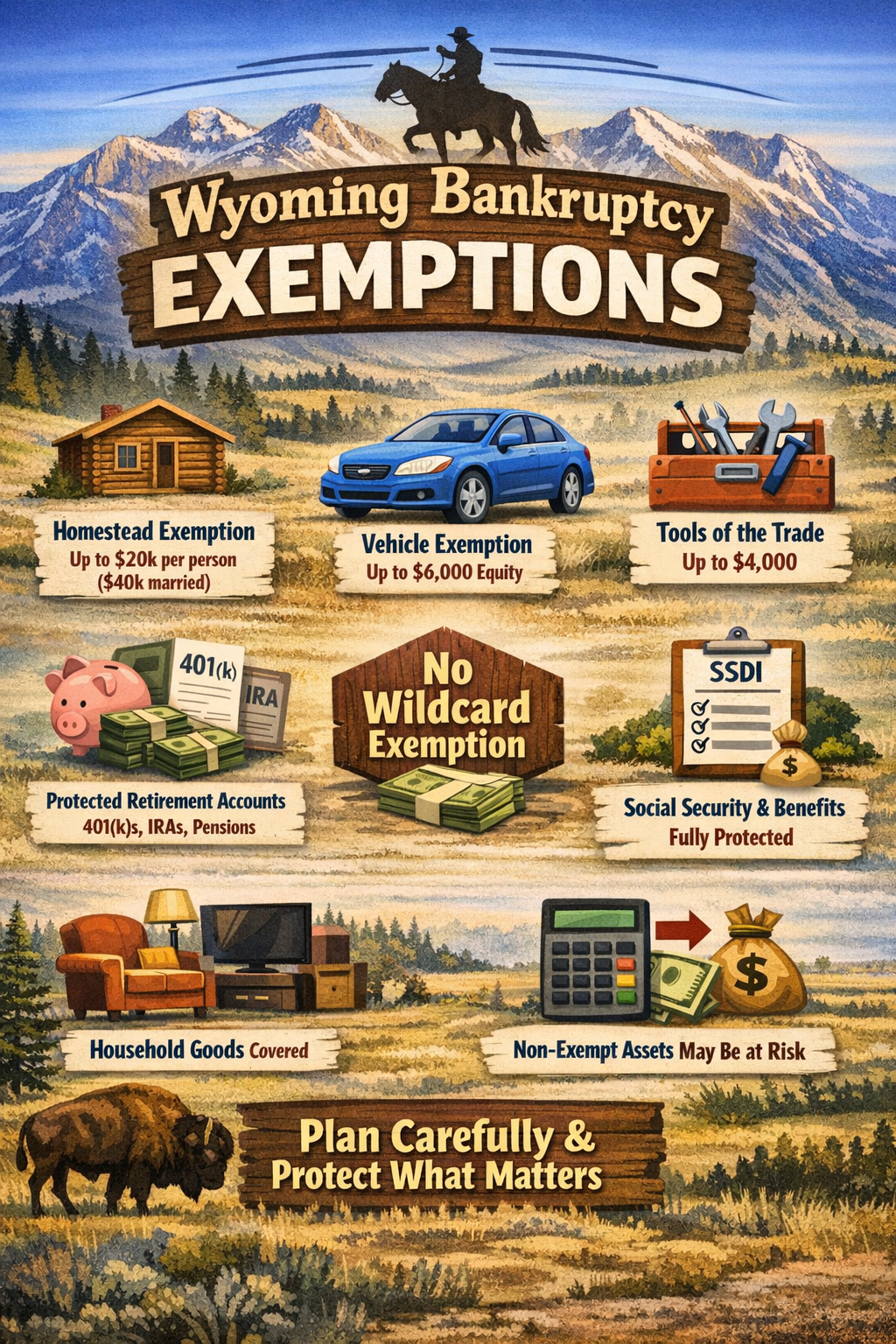
(“Wyoming… that’s a pretty debtor-friendly state, right?”)
Yes—and in some ways, it’s better than people expect.
Wyoming doesn’t get talked about as much as Florida or Texas when it comes to bankruptcy exemptions, but it offers a solid, practical exemption system that can protect a wide range of assets—especially if you understand how to use it.
If you’re filing bankruptcy in Wyoming (or just researching your options), this guide will walk you through what Wyoming exemptions are, how they work, and what you can realistically expect to keep.
First: What Are Bankruptcy Exemptions?
At the most basic level:
Exemptions are laws that protect your property when you file bankruptcy.
Without exemptions, creditors could potentially take everything you own.
With exemptions, you get to keep:
- Essential assets
- Basic necessities
- The foundation for a financial reset
Think of exemptions as a legal shield—they define what stays with you after your case is complete.
Wyoming Is an “Opt-Out” State
Here’s a key rule:
Wyoming requires you to use Wyoming exemptions—you cannot use federal exemptions.
This means:
- You don’t get to choose between systems
- Strategy comes from how you apply Wyoming’s rules
How Exemptions Work (Simple Example)
Let’s say:
- You own a car worth $10,000
- You owe $4,000
- Your equity is $6,000
If Wyoming’s vehicle exemption covers that amount, your car is protected.
If it doesn’t, the difference may need to be addressed—but that doesn’t automatically mean you lose the car.
Wyoming Exemptions: The Key Categories
Let’s walk through the most important protections available under Wyoming law.
1. Homestead Exemption (Your Home)
Wyoming provides a solid homestead exemption.
Protection:
- Up to $20,000 per person
- Up to $40,000 for married couples filing jointly
What it covers:
- Your primary residence
- Houses, mobile homes, and some other residential property
Example:
- Home value: $250,000
- Mortgage: $220,000
- Equity: $30,000
If filing jointly:
Fully protected.
Reality Check:
Wyoming’s homestead exemption is modest compared to states like Florida or California, but it can still protect many homeowners—especially those with limited equity.
2. Motor Vehicle Exemption
Protection:
- Up to $6,000 in vehicle equity
Example:
- Car value: $12,000
- Loan: $7,000
- Equity: $5,000
Fully protected.
For many filers, this is enough to cover a primary vehicle.
3. Personal Property (Household Goods)
Wyoming protects everyday household items, including:
- Furniture
- Appliances
- Clothing
- Electronics
Limits:
- Typically capped per item and overall value
But in practice:
Most household goods are fully protected because resale value is low.
4. Tools of the Trade
If you rely on tools for your job:
Protection:
- Up to $4,000 in tools, equipment, or books
Who this helps:
- Contractors
- Mechanics
- Skilled workers
5. Retirement Accounts (Strong Protection)
Good news:
Most retirement accounts are fully protected.
This includes:
- 401(k)s
- IRAs
- Pensions
Your long-term financial future is protected.
6. Wages
Wyoming protects a portion of your wages, typically:
- A percentage of disposable income
- Income necessary for support
These protections often align with federal garnishment limits.
7. Public Benefits
Fully protected:
- Social Security
- Disability benefits
- Unemployment
- Veterans benefits
These are considered essential income streams.
8. Life Insurance and Annuities
Certain life insurance policies and proceeds may be exempt, depending on:
- Beneficiary
- Structure of the policy
Does Wyoming Have a Wildcard Exemption?
Here’s where things get important:
Wyoming does NOT have a traditional wildcard exemption.
Why this matters:
Without a wildcard:
- You cannot freely protect cash or miscellaneous assets
- You must fit assets into specific categories
Translation:
Cash, bank accounts, and “extra” assets are often the most vulnerable.
What Happens If an Asset Exceeds the Exemption?
This is where people get nervous—but let’s simplify it.
In Chapter 7:
- The trustee may look at the non-exempt portion
- You may be able to pay that value to keep the asset
In Chapter 13:
- You keep everything
- You repay creditors based on the non-exempt value
Chapter 7 vs. Chapter 13 in Wyoming
Chapter 7
- Exemptions determine what you keep
- Non-exempt assets may be at risk
Chapter 13
- You keep all property
- Exemptions determine repayment amount
Real-World Example
Let’s say you have:
- $25,000 home equity
- $5,000 car equity
- $4,000 in savings
- Household goods
Using Wyoming exemptions:
- Home = protected (if within limits)
- Car = protected
- Household goods = protected
- Savings = potentially exposed
Why?
Because there’s no wildcard exemption to protect cash.
Common Misconceptions About Wyoming Exemptions
❌ “I’ll lose everything.”
Reality:
Most people keep most—or all—of their property.
❌ “Wyoming exemptions are weak.”
Not necessarily.
They are practical and effective, especially for:
- Homes with modest equity
- Vehicles
- Essential property
❌ “Cash is safe.”
Cash is often the most vulnerable asset.
❌ “I don’t need to think about exemptions.”
This is a big mistake.
Exemption planning can significantly affect your outcome.
Strategic Planning Matters
Because Wyoming lacks a wildcard, planning becomes especially important.
Before filing, people sometimes:
- Use funds for necessary expenses
- Time their filing
- Allocate assets strategically
Important:
This must always be done legally and transparently.
Never hide assets.
The Emotional Reality
Let’s be honest:
The biggest fear people have when considering bankruptcy is:
“Am I going to lose everything?”
In Wyoming, the answer is usually:
“No—but we need to plan carefully.”
Understanding exemptions replaces fear with clarity.
Why Wyoming Still Works Well for Filers
Even without a wildcard, Wyoming offers:
- Solid homestead protection
- Reasonable vehicle protection
- Full retirement protection
- Protection for essential property
With proper planning, many filers keep everything they need.
A Simple Way to Think About It
If bankruptcy is the reset button…
Wyoming exemptions determine what stays with you when you start over.
Practical Tips for Wyoming Filers
1. Know Your Equity
Especially in your home and car.
2. Don’t Ignore Cash
Cash is often the most exposed asset.
3. Categorize Everything
Wyoming exemptions are category-based—organization matters.
4. Be Honest
Full disclosure is required.
5. Work With an Experienced Attorney
Wyoming exemption strategy is not something you want to guess on.
Final Thoughts: Practical Protection with the Right Strategy
Wyoming bankruptcy exemptions may not be flashy—but they are effective.
They’re designed to:
- Protect what you need
- Provide a fresh start
- Balance fairness to creditors
So if you’re considering filing, remember:
- You must use Wyoming exemptions
- Your home and car are often protected
- Retirement accounts are safe
- Cash requires careful planning
And most importantly:
Bankruptcy in Wyoming isn’t about losing everything—it’s about protecting what matters and building a path forward.