Rebuilding your credit after bankruptcy isn’t about some secret formula; it’s a patient, deliberate process of proving you’ve turned a corner with your financial habits. It all starts with one simple action: keeping a close eye on your credit reports to make sure they’re accurate. From there, you’ll strategically add new, manageable credit—like a secured credit card—and focus on the one thing that matters most: consistent, on-time payments.
Your New Financial Start After Bankruptcy
Let’s get one thing straight: filing for bankruptcy is a legal tool for a fresh financial start, not a financial life sentence. The moment the court grants your discharge, the slate is wiped clean. This gives you a stable foundation to build a new, positive credit history. You’re not erasing the past, you’re building a better future on solid ground.
It’s completely normal to feel a bit lost about what to do next. But understanding the road ahead is the first step to taking back control. Yes, the bankruptcy is a public record and will show up on your credit report. The key thing to remember is that its impact fades over time, especially as you start adding new, positive information.
Here’s how long it will stick around:
- A Chapter 7 bankruptcy can stay on your credit report for up to 10 years from the day you filed.
- A Chapter 13 bankruptcy typically remains for seven years from your filing date.
These timelines aren’t arbitrary; they’re set by the Fair Credit Reporting Act (FCRA). This federal law is your most powerful ally in this journey. It ensures the information on your reports is fair and accurate, and it gives you the right to dispute and correct any errors—which, unfortunately, are all too common after a bankruptcy discharge.
Understanding The Recovery Timeline
Think of rebuilding your credit as a marathon, not a sprint. The great news is you can start taking positive steps almost as soon as your debts are discharged. I’ve seen it time and again: lenders are often far more interested in what you’ve done in the last 12 months than what happened years ago.
You’re also not alone. Total consumer bankruptcy filings jumped by 12% recently, with nearly 500,000 Americans a year using this process to get back on their feet. This isn’t a sign of personal failure; it’s proof that bankruptcy is a practical, widely-used tool for financial recovery.
This timeline breaks down the first few crucial phases of your journey:
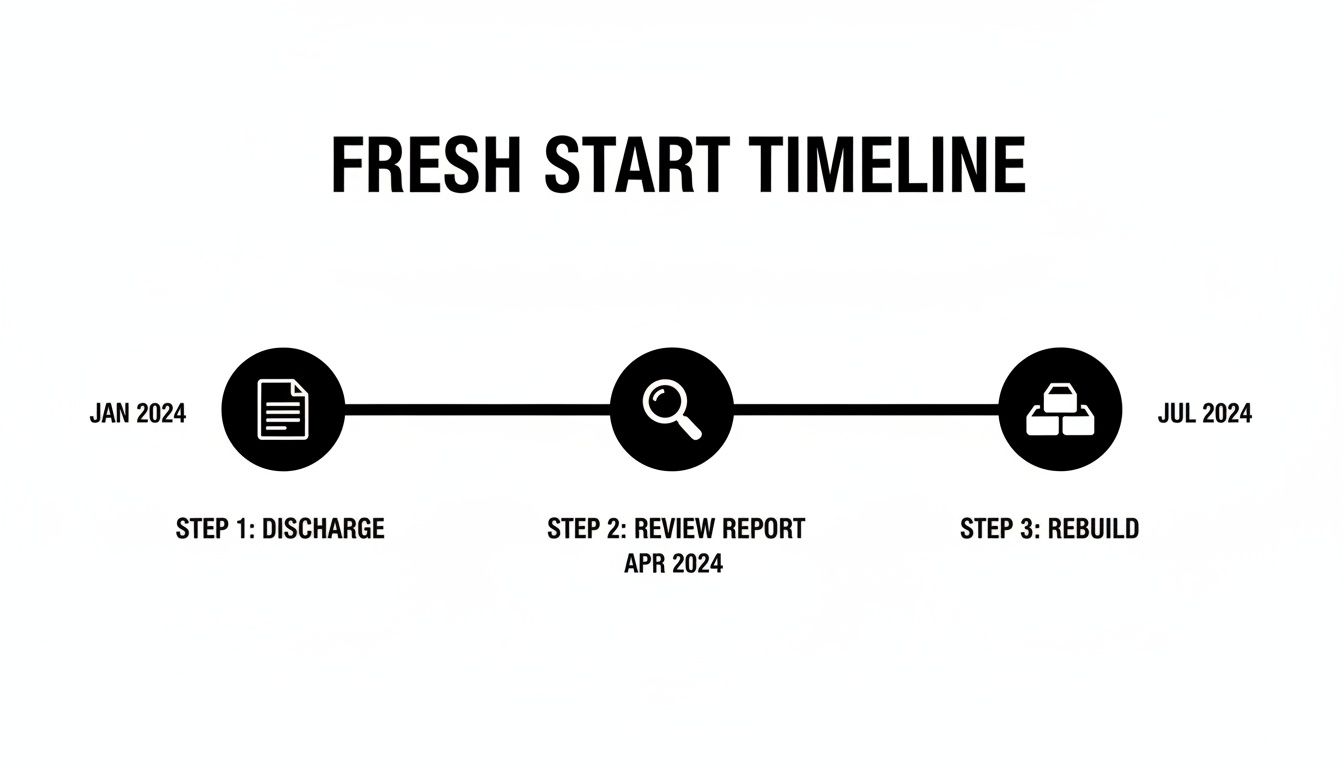
As you can see, the path forward is a series of manageable stages. It starts with the legal finality of the discharge and moves directly into proactive steps you can take to manage your credit.
Your First 90 Days After Bankruptcy A Recovery Checklist
The actions you take in the first three months after your discharge are critical. They set the stage for everything that follows. This checklist breaks down the immediate priorities to get your recovery started on the right foot.
| Action Item | Why It’s Important | Key Consumer Right |
|---|---|---|
| Pull All 3 Credit Reports | You need to see exactly what lenders see. Each bureau may have different information, and you need a complete picture. | Under federal law, you’re entitled to free weekly reports from all three bureaus at AnnualCreditReport.com. |
| Verify Account Status | Ensure every debt included in the bankruptcy is marked as “Discharged in Bankruptcy” or “Included in Bankruptcy” with a $0 balance. | The FCRA mandates that information on your credit report must be accurate. |
| Dispute Any Errors | Immediately file a dispute with the credit bureaus for any accounts that are still showing a balance or an incorrect status. | The FCRA gives you the legal right to dispute inaccurate information and requires the bureaus to investigate. |
This initial cleanup is non-negotiable. An accurate credit report is the foundation of your entire rebuilding effort.
The Role Of Consumer Protection Laws
Your rights under the FCRA are what empower you to ensure your credit report accurately reflects your fresh start. As soon as you can, pull your reports from all three major bureaus—Equifax, Experian, and TransUnion—and go through them with a fine-tooth comb.
Your credit report is the blueprint for your financial recovery. An inaccurate report is like building a house on a faulty foundation. The FCRA gives you the legal tools to demand that foundation be fixed, ensuring every creditor and credit bureau respects your bankruptcy discharge.
Look for accounts that were part of your bankruptcy but are still showing an outstanding balance. Check that every single one is clearly marked as “discharged in bankruptcy.” If you find an error, it’s a violation of the FCRA.
Disputing these mistakes isn’t just financial housekeeping; it’s you actively exercising your legal right to a fair and accurate credit history. This is the absolute cornerstone of rebuilding your credit score.
Getting Your Credit Reports in Order After Bankruptcy
Think of your credit reports as the official story of your financial life. After a bankruptcy, you get to write a new chapter, but first, you have to make sure the old one is closed out correctly. Your reports from Equifax, Experian, and TransUnion are the blueprint for your entire rebuilding strategy, and it’s shocking how often they’re riddled with errors after a bankruptcy discharge.
These aren’t just tiny typos. We’re talking about serious mistakes that can keep your score artificially low and make it harder to get that fresh start you’re entitled to. The good news is, the law is on your side. The Fair Credit Reporting Act (FCRA) is a powerful federal law that guarantees your right to an accurate credit history and gives you the tools to fix any mistakes you find.

How to Get Your Free Credit Reports
First things first, you need to pull your reports. Don’t pay for them. Federal law allows you to get free weekly reports from all three major bureaus through one central, secure website.
Key Takeaway: You can access all three of your reports for free at AnnualCreditReport.com. This is the only website officially authorized by the U.S. government for this service.
Once you’ve downloaded your reports, it’s time to put on your detective hat. It can look like a lot of information, but you’re hunting for very specific inaccuracies that commonly pop up after a bankruptcy case is closed.
Spotting the Most Common Post-Bankruptcy Errors
Your mission is to make sure every single account that was part of your bankruptcy is reported accurately. Anything less is an error and a potential violation of your rights under the FCRA.
Here’s a checklist of what to look for on each report:
- Wrong Account Status: Every debt discharged in your bankruptcy should be clearly labeled with a phrase like “Discharged in Bankruptcy” or “Included in Bankruptcy.” If an old credit card is still showing as “past due” or “charged off” without that bankruptcy note, that’s a problem.
- Lingering Balances: This is a big one. All discharged accounts must show a $0 balance. It’s illegal for a creditor to report you still owe them money on a debt the court has already eliminated.
- Zombie Accounts: Sometimes a single debt shows up twice—once from the original bank and again from a collection agency they sold it to. If the debt was discharged, both entries need to reflect that.
- “Re-Aged” Debts: Watch out for the “Date of Last Activity.” Some collectors might improperly update this date to make an old debt look new again, which can seriously drag your score down.
Finding these errors is crucial. The next step is using your legal rights to get them wiped clean.
Using the FCRA to Formally Dispute Errors
The FCRA provides a clear path for correcting mistakes. When you file a formal dispute, the credit bureau is legally required to investigate your claim, usually within 30 days.
While you can submit disputes online, sending a formal letter via certified mail (with return receipt) is the smarter move. It creates an undeniable paper trail, proving you sent the dispute and they received it. This can be invaluable if you need to take legal action later.
Your dispute letter doesn’t need to be complicated. Just make sure it includes these key pieces of information:
- Your Info: State your full name, address, and date of birth.
- The Error Details: Name the credit bureau and list each inaccurate item. Be sure to include the account number and creditor name.
- The Reason: Explain clearly and simply why it’s wrong. For example: “This Citibank account (Acct # ending in 1234) was included in my Chapter 7 bankruptcy (Case #56789) discharged on June 15, 2023. It should be reported with a zero balance.”
- Your Request: Politely but firmly request that the incorrect information be corrected or removed entirely.
- Proof: Attach copies (never send your originals!) of your supporting documents. The most powerful proof is usually the relevant pages from your bankruptcy discharge order.
Once the investigation is over, the bureau has to let you know the outcome. If they made a change, they must also send you a copy of your newly updated credit report, free of charge. Actively enforcing your rights is one of the most important first steps you can take to properly rebuild your credit after bankruptcy.
Strategically Add New, Positive Credit
Now that your credit reports are clean and accurate, it’s time to start building again. This isn’t a race. The goal is to be incredibly deliberate about adding new, positive payment history to your file. Think of it as carefully laying a new, solid foundation, one brick at a time, to prove to future lenders that you’re a responsible borrower.
It’s tough out there right now, which makes this step more critical than ever. With interest rates up and the cost of everyday life climbing, a good credit score is a financial shield. Many people are stretched thin, so having access to fair credit can make a huge difference. You can find more details on these economic pressures from recent financial analysis.
Start With a Secured Credit Card
For most people coming out of bankruptcy, a secured credit card is the smartest first move. It’s the most accessible and effective tool to get started.
Here’s how it works: you make a small, refundable cash deposit—usually around $300—and that amount becomes your credit limit. This deposit takes the risk away from the lender, which is why they are much easier to get approved for. Use the card for a small, recurring purchase, pay the bill in full every month, and the lender reports that positive activity to the credit bureaus.
When you’re shopping for a secured card, keep an eye out for these must-haves:
- Reports to all three bureaus: This is non-negotiable. Your hard work needs to show up on your Experian, Equifax, and TransUnion reports.
- Low (or no) annual fees: Don’t let high fees drain your budget. Plenty of great secured cards have minimal or no annual fees.
- A path to “graduate”: The best secured cards will automatically review your account after 6-12 months of on-time payments. If you qualify, they’ll convert your card to a regular unsecured one and refund your deposit.
Consider a Credit-Builder Loan
Another fantastic tool is the credit-builder loan. These are a bit unique—they work backward from a normal loan.
Instead of getting cash upfront, the loan amount is placed into a locked savings account. You then make small, fixed monthly payments over a set term. Once you’ve paid off the loan, the money is released to you. All those on-time payments get reported to the credit bureaus, proving you can handle an installment loan.
A healthy credit mix, which includes both revolving credit (like cards) and installment credit (like loans), shows lenders you can manage different types of debt responsibly. This is a huge plus for your score.
Leverage Payments You Already Make
You don’t always have to take on new debt to build credit. Some of the most powerful methods use bills you’re already paying.
Services for rent and utility reporting are a game-changer. You can sign up with a platform that verifies your on-time rent or utility payments and adds them to your credit report. Since payment history is the biggest piece of your credit score, this can give you a real boost without you having to borrow a single dime.
Comparing Credit Rebuilding Tools
Deciding which tool to start with really comes down to your budget and goals. Each option works a little differently, so it’s smart to compare them side-by-side. This table breaks down the most common choices to help you figure out the best fit for your post-bankruptcy journey.
| Tool | How It Works | Best For | Potential Cost |
|---|---|---|---|
| Secured Credit Card | You provide a cash deposit that becomes your credit limit. Your payments are reported to credit bureaus. | Establishing a new revolving credit line and demonstrating responsible card use. | A refundable security deposit (typically $200-$500) and a possible annual fee. |
| Credit-Builder Loan | You make fixed monthly payments into a locked savings account. The funds are released to you after the final payment. | Adding an installment loan to your credit mix and building a savings habit simultaneously. | Interest on the loan amount and potential administrative fees. |
| Rent/Utility Reporting | A third-party service verifies and reports your on-time rent or utility payments to the credit bureaus. | Adding positive payment history without taking on new debt. | A monthly or annual subscription fee for the reporting service. |
The key here isn’t to do everything at once. Pick one or two of these tools, use them perfectly, and stay patient. Making those small payments on time, every single month, is the most reliable way to build a strong credit score from the ground up.
Protecting Your Fresh Start From Creditors
Your bankruptcy discharge is more than just a piece of paper—it’s a federal court order. This injunction legally prohibits your old creditors from trying to collect on any debts that were wiped out. But here’s the thing: sometimes, collectors don’t get the memo. Or worse, they choose to ignore it. This is where knowing your rights is crucial to defending the fresh start you worked so hard to get.
Part of rebuilding your credit is knowing how to protect it from day one. When a collector tries to chase a debt that the court has officially discharged, they aren’t just being annoying—they’re likely breaking federal law. The Fair Debt Collection Practices Act (FDCPA) sets firm rules for collectors, and trying to collect a discharged debt is a serious violation.

What Illegal Collection Activity Looks Like
Once your bankruptcy is final, almost any attempt to collect on a discharged debt is off-limits. You need to be able to spot these illegal tactics immediately so you can shut them down.
Keep an eye out for these specific red flags:
- Persistent Phone Calls: You keep getting calls about an old debt that was included in your bankruptcy. This could also violate the Telephone Consumer Protection Act (TCPA) if they are using autodialers.
- Demand Letters: You receive letters demanding payment for an account that was discharged.
- Incorrect Credit Reporting: A creditor reports a discharged account as “past due” or “charged off” on your credit report without also noting it was “included in bankruptcy.” This violates the FCRA.
- Empty Threats: You’re threatened with a lawsuit or wage garnishment over a debt that no longer legally exists.
Any contact from a collector about a discharged debt is a big deal. The FDCPA gives you the power to sue collectors for these violations. You could be entitled to statutory damages, compensation for actual damages, and even have your attorney’s fees covered.
The key is to document everything. Keep every letter, save every voicemail, and log every phone call. Note the date, time, the collector’s name, and exactly what they said. This paper trail is your best weapon if you need to take legal action.
Taking Action When Collectors Cross The Line
If a collector contacts you about a discharged debt, don’t just ignore them. But you also don’t need to get into a long argument or make any promises. There’s a clear, professional way to handle it.
First, calmly tell them the debt was discharged in bankruptcy. You can use a simple script like this:
“The debt you’re calling about, account number [Provide the account number], was discharged in my bankruptcy, case number [Your Case #], on [Date of Discharge]. Your attempt to collect is a violation of the FDCPA and the federal discharge injunction. Do not contact me again.”
After that call, your next step is to send a formal cease-and-desist letter. Send it via certified mail with a return receipt requested. This creates a legal paper trail proving they were notified. Keep the letter short and direct, stating the facts and demanding they stop all communication immediately.
Managing Debts That Weren’t Discharged
It’s also critical to remember that bankruptcy doesn’t wipe the slate entirely clean. Certain debts, known as non-dischargeable debts, will stick around.
These typically include:
- Most student loans
- Recent tax debts
- Alimony and child support
You must continue making on-time payments for these accounts. Missing payments here will quickly sabotage your credit rebuilding efforts and can lead to major financial trouble. I always recommend setting up automatic payments for these obligations to ensure you never miss one. It’s a simple way to demonstrate financial responsibility and build a positive payment history.
For a deeper dive into how these rules work even before a case is discharged, you can learn more about what happens when debt collectors ignore the automatic stay in our related guide.
Building Long-Term Financial Resilience
Getting your credit back on track after bankruptcy is a marathon, not a sprint. The first year is all about cleaning up your credit report and carefully adding a few new accounts. But real, lasting success comes from the daily habits you build for the long haul.
This is your chance to turn that bankruptcy discharge into a tool for genuine stability, not a life sentence. It’s a mindset shift. You’re moving past the quick fixes and focusing on building a rock-solid financial foundation, and that all starts with a realistic budget you can actually live with.
Mastering Credit Habits for the Long Haul
If you want to maintain a great credit score, two rules are absolutely non-negotiable: make 100% of your payments on time, every time, and keep your credit card balances low. Your payment history is the single biggest piece of your credit score, and just one late payment can undo months of hard work.
Just as crucial is your credit utilization ratio—that’s the percentage of your available credit that you’re currently using. The standard advice is to keep it below 30%, but honestly, under 10% is where you’ll see the best results. On a secured card with a $500 limit, that means keeping your statement balance under $50.
Think of your bankruptcy as a clean slate, not a final verdict. The skills you’re learning now aren’t just about boosting a number; they’re about creating a financial future where you’re the one in control.
When to Graduate to Unsecured Credit
After a solid year of perfect payments on a secured card or credit-builder loan, you can start thinking about applying for a regular, unsecured credit card. But don’t rush it. Wait until your score is climbing steadily and you feel completely on top of your budget.
When the time is right, be strategic.
- Look for pre-qualification offers: Many card issuers have tools that let you check your approval odds without a “hard” credit inquiry that dings your score.
- Start small: Your first unsecured card will likely have a low credit limit, and that’s perfectly fine. The goal is simply to keep proving you’re a reliable borrower.
This disciplined, patient approach signals to lenders that your past financial troubles are firmly in the rearview mirror. It’s what paves the way for better rates on a car loan or mortgage down the road.
You Are Not Alone in This Journey
It’s easy to feel like you’re the only one going through this, but that couldn’t be further from the truth. You’re part of a huge community of people taking the exact same steps.
In fact, as of September 30, bankruptcy filings had jumped by 10.6 percent compared to the same period the previous year. This isn’t some rare event; it’s a financial tool used by thousands of Americans to get a fresh start. If you’re interested, you can find more bankruptcy filing trends on bakerassociates.net.
Answering Your Top Post-Bankruptcy Questions
Once the bankruptcy process is over, a whole new set of questions usually pops up. This is completely normal. Let’s tackle some of the most common concerns I hear from people who are ready to start their next chapter, making sure you know your rights and can move forward with confidence.
Can Creditors Still Contact Me After My Discharge?
Absolutely not. Once your debts are discharged, a powerful federal injunction under 11 U.S.C. § 524 kicks in. Think of it as a legal restraining order that legally forbids creditors from trying to collect on any debt that was wiped out in your bankruptcy.
If a collector calls or sends a letter about a discharged debt, they are likely breaking the law, potentially violating both the bankruptcy injunction and the Fair Debt Collection Practices Act (FDCPA). Don’t just ignore it. Start a log, document every single contact, and then talk to a consumer rights attorney. You have the right to sue them for these violations, stop the harassment for good, and even recover damages.
How Soon Can I Get a Car Loan After Bankruptcy?
You might be surprised by the answer. It’s often possible to get a car loan within just a few months of your discharge. From a lender’s perspective, you’ve just eliminated most of your other debts, which ironically can make you look like less of a risk than someone juggling multiple high-interest payments.
The trick is to prove you have a stable income and to be very careful about who you borrow from. The market is full of predatory lenders targeting post-bankruptcy consumers. Be prepared to shop around, compare rates, and read the fine print before you sign anything. This is a core part of effective debt defense.
Will I Ever Be Able to Qualify for a Mortgage?
Yes, without a doubt. It’s not an overnight process, but owning a home is a completely realistic goal after bankruptcy. There are standard waiting periods you’ll have to get through, but what you do during that time is what really counts.
- FHA Loans: Typically, you’ll need to wait two years after a Chapter 7 discharge.
- Conventional Loans: The waiting period is often longer, usually up to four years.
Mortgage lenders will put your financial habits under a microscope during this waiting period. They’re looking for a perfect record of on-time payments, steady employment, and proof that you can manage credit responsibly now. This is why using your FCRA rights to keep your credit reports squeaky clean is so vital.
A mortgage underwriter will care more about your post-bankruptcy payment history than almost anything else. Consistency is the name of the game.
Should I Reaffirm Any of My Debts During Bankruptcy?
This is a big one. Reaffirming a debt, like a car loan, is a serious legal move. It pulls that specific debt out of the bankruptcy protection and makes you personally liable for it again, as if the bankruptcy never happened. In my experience, it’s rarely a good idea.
This is a decision you should never make without a deep conversation with your bankruptcy attorney. They will walk you through the long-term consequences and help you figure out if it truly aligns with the “fresh start” you’re trying to achieve.
What Is the Fastest Way to See My Credit Score Improve?
The quickest path to a better score involves a two-part strategy grounded in your consumer rights. It’s not about gimmicks; it’s about accuracy and new habits.
First, you have to go on the offensive with your credit reports. Use the FCRA to dispute every single inaccuracy, especially old discharged debts that shouldn’t be reporting a balance. Your goal is a report that is 100% accurate. Errors are like an anchor holding your score down.
At the same time, open a secured credit card. Don’t go crazy with it. Just use it for one small, predictable purchase each month—like your Netflix subscription or a tank of gas—and pay the bill in full and on time. This creates the exact kind of positive, consistent payment history that credit scoring models are designed to reward.
If you’re dealing with creditor harassment or discovering errors on your credit report after bankruptcy, you don’t have to handle it on your own. The consumer protection attorneys at Ginsburg Law Group PC are here to defend your rights and make sure your fresh start stays protected. Contact us for a consultation to see how we can help.