Why Robocallers Keep Calling (Even Though They Can Be Sued)
2/18/26- There’s a moment in The Office where Jim questions DeAnge/lo’s fake juggling routine:
“What could he stand to gain from a fake juggling routine?”
Pam responds:
“What could he stand to gain from a real juggling routine?”
It’s a joke about motive. But it’s also the right question to ask when it comes to robocalls and spam texts.
Because if companies can get sued for illegal robocalls under the TCPA…
Why do they keep calling?
Why do they keep texting?
What is the purpose?
What do they stand to gain?
By the way… I’m a huge Office fan… but if you don’t remember DeAngelo Vickers was Michael Scott’s replacement when he moved to Colorado with Holly. 🙂
Yes — They Can Get Sued
Under the Telephone Consumer Protection Act (TCPA):
- $500 per illegal call or text
- Up to $1,500 per call if willful
That sounds serious.
So why would a company risk sending 10,000 texts?
Why risk 100,000 robocalls?
Why keep texting after someone replies STOP?
They can get sued.
So again: What do they stand to gain?
The Answer: Volume
Because only a fraction of people sue.
That’s the math.
Let’s be honest.
How many people reading this article are getting robocalls or spam texts right now… and doing nothing about it?
Actually — this author included. I get multiple per day.
We ignore them.
We block the number.
We delete the text.
We move on.
And they know that.

The Business Model
Robocall campaigns work on scale.
If a company sends:
- 100,000 texts
- 1% respond
- 0.1% convert
- A single converted customer generates $500–$2,000 in profit
That campaign may still be profitable — even if a few people sue.
They calculate that:
- Most people won’t know their rights.
- Most people won’t preserve evidence.
- Most people won’t contact a lawyer.
- Most people will just ignore it.
So what do they stand to gain? Revenue.

Why Do They Keep Texting After “STOP”?
This is where the motive question becomes even sharper.
If someone replies STOP and the messages continue, that’s riskier.
So why do it? Because:
- Opt-out systems fail.
- Vendors don’t sync databases.
- Marketing departments push volume.
- Compliance isn’t prioritized.
- They assume enforcement is rare.
And often, they’re right.
Only a small percentage of recipients ever assert their TCPA rights.

“They Know They Can Get Away With It”
That sounds cynical — but from a business risk perspective, it’s often true. If:
- 10,000 people receive a message,
- 50 complain,
- 5 hire attorneys,
- 1 files a lawsuit,
The campaign might still turn a profit.
That’s the calculation.
Not because it’s right.
But because it’s profitable.
Let’s Look at the Numbers…
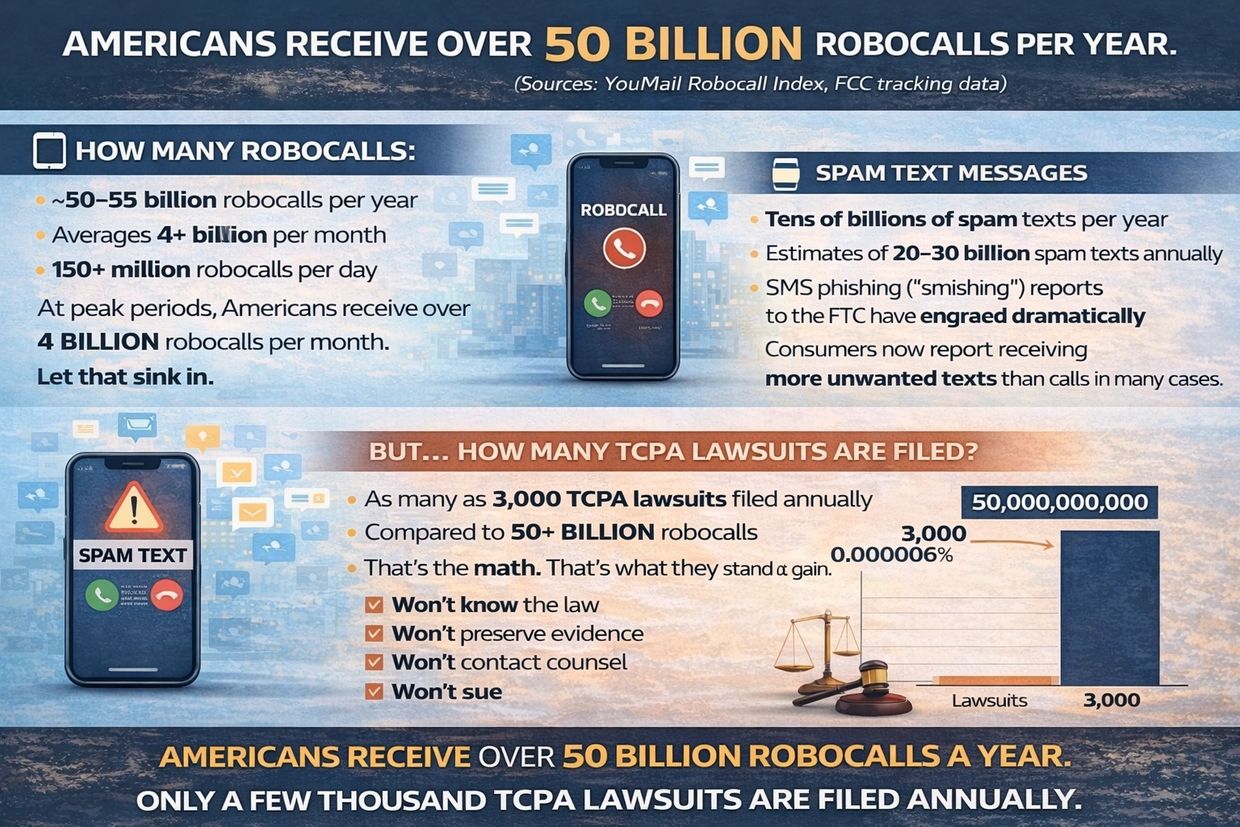
📞 How Many Robocalls Are Made Each Year? In the United States –
- ~50–55 billion robocalls per year in recent years
- That averages 4+ billion per month
- Roughly 150+ million robocalls per day
At peak periods, Americans receive over 4 billion robocalls per month. Let that sink in.
📱 Spam Text Messages – Spam texts are exploding –
- Americans receive tens of billions of spam texts per year
- In some estimates, over 20–30 billion spam texts annually
- SMS phishing (“smishing”) reports to the FTC have increased dramatically over the past few years
Consumers now report receiving more unwanted texts than calls in many cases.
But…. ⚖️ How Many TCPA Lawsuits Are Filed?
Despite tens of billions of calls and texts… Only a few thousand TCPA lawsuits are filed per year.
Typical annual filings:
- Roughly 1,500–3,000 federal TCPA cases per year
- Additional cases filed in state courts
Even if we assume 3,000 lawsuits in a year… Compared to 50+ billion robocalls.
That’s a microscopic enforcement rate.
📊 The Math… If:
- 50,000,000,000 robocalls are made
- 3,000 lawsuits are filed
That’s: 0.000006% enforcement
That’s why they keep calling.
They’re betting most people:
- Won’t know the law
- Won’t preserve evidence
- Won’t contact counsel
- Won’t sue
💰 FTC Complaint Data – Each year:
- The FTC receives millions of complaints about unwanted calls
- Robocalls consistently rank among the top consumer complaints nationwide
But complaints ≠ lawsuits.
That gap is where the business model survives.
Americans receive over 50 billion robocalls a year.
Only a few thousand TCPA lawsuits are filed annually.
That’s the math.
That’s what they stand to gain.
If even 1% of recipients enforced their rights, the robocall industry would collapse overnight.
That’s not hyperbole. It’s economics.
(Sources: YouMail Robocall Index, FCC tracking data)
Why the TCPA Still Matters
The TCPA exists precisely because volume marketing creates incentives to overreach.
The law shifts the equation.
$500 per call or text.
$1,500 if willful.
Suddenly, scale becomes dangerous.
One person with 20 unlawful texts could mean:
- $10,000 minimum
- Up to $30,000 if willful
And when companies realize consumers enforce their rights, the math changes.

The Real Question
So when your phone lights up again…
Ask the same question:
What do they stand to gain?
And then ask:
What do you stand to gain by doing nothing?
Most people delete the message.
Most people block the number.
Most people never assert their rights.
That’s the gap the business model relies on.

The Bottom Line
Robocalls and spam texts continue not because they’re legal — but because they’re profitable. They stand to gain:
- Volume conversions
- Easy revenue
- Minimal enforcement
But when consumers understand their rights under the TCPA, that equation changes. And that’s why the question matters. What do they stand to gain?
And more importantly —
What are you going to do about it?