If you’re fed up with the endless barrage of robocalls and spam texts, you’re not just annoyed—you might have a legal case. A telephone consumer protection act lawsuit is how you fight back against companies that use illegal robocalls, autodialers, and unsolicited text messages. Under this powerful federal law, you can sue for significant financial compensation, typically between $500 and $1,500 per violation. It’s a way to stop the harassment and make companies pay for breaking the law.
Tired of Robocalls? Understanding Your TCPA Rights
That constant buzzing in your pocket from an unknown number isn’t just a modern-day nuisance. In many cases, it’s a direct violation of federal law. If you feel helpless against the daily flood of automated sales calls and spammy texts, you should know that you have real legal power thanks to the Telephone Consumer Protection Act (TCPA).
This law was created specifically to protect people from invasive and aggressive telemarketing. It lays out clear, strict rules that companies have to follow when using automated technology to contact you. When they ignore those rules, the TCPA gives you the green light to take them to court.
What Is a TCPA Lawsuit?
Simply put, a telephone consumer protection act lawsuit is your legal tool for holding a company accountable—financially—for every single illegal call or text they send your way. It’s more than just a complaint. It’s about seeking tangible justice in the form of monetary damages, which can turn a company’s illegal marketing campaign into a very expensive mistake for them.
The principle behind it is straightforward: your phone is your private space. Companies need your express permission before they can invade it with automated marketing, and the TCPA is the law that enforces that boundary.
The TCPA essentially draws a legal line in the sand. It tells businesses, “You cannot bombard consumers with automated calls and texts without their explicit permission.” A lawsuit is how you enforce that line when it’s crossed.
Why Your Rights Matter More Than Ever
You are definitely not alone in this battle. Consumer lawsuits are surging as more people realize they don’t have to put up with relentless robocalls and aggressive debt collectors. The latest numbers show TCPA filings are up 0.8% year-over-year. This is part of a much bigger trend, with related consumer protection cases also seeing massive spikes.
Consider this: lawsuits under the Fair Credit Reporting Act (FCRA) jumped by 37.4%, Fair Debt Collection Practices Act (FDCPA) cases rose by 7.8%, and complaints filed with the Consumer Financial Protection Bureau (CFPB) skyrocketed by an astonishing 89.1%. You can explore more data about these consumer litigation trends to see just how widespread these issues are.
This wave of legal action shows a growing public awareness that these practices are unacceptable. By understanding your consumer rights, you can join the thousands of others who are successfully standing up to these companies. Want to learn more about the rules they have to follow? Check out our detailed guide on the Telephone Consumer Protection Act (TCPA) for a complete breakdown.
Do You Have Grounds for a Lawsuit?

So, when does a barrage of annoying calls and texts cross the line into illegal harassment? That’s the core question behind a telephone consumer protection act lawsuit. The TCPA isn’t just about feeling bothered; it lays down very specific rules for how companies can use automated tech to contact you.
A lot of people think that if they ever gave a company their number, even once, they’ve signed away their rights forever. That’s just not true. The law is crystal clear about what kind of contact is allowed and, more importantly, what’s not. Let’s dig into the most common violations that give you solid grounds to fight back.
Receiving Unsolicited Robocalls or Texts
The heart of most TCPA cases is the use of an autodialer. Just think of it as a robotic dialing machine that can blast out calls or texts to thousands of numbers at once without a human being involved in dialing each one. If you get a call or text from one of these systems and you never gave the company your prior express written consent, they’re almost certainly breaking the law.
This is especially true for robocalls—those calls that play a prerecorded message. That familiar, disembodied voice trying to sell you a car warranty? That’s a classic TCPA violation if you never signed off on it.
How can you tell it’s an autodialer? Look for these tell-tale signs:
- You answer, and there’s that weird click and a long pause before a live person finally comes on the line.
- A prerecorded message starts playing the second you say “hello.”
- You get a generic-sounding text that’s obviously been sent to a huge list of people.
Getting Marketing Texts Without Consent
The rules for text messages are just as tough as they are for calls. A business needs your clear, written permission before it can legally start sending you promotional texts using an autodialer. This consent has to be obvious and upfront—not buried in the fine print of a 50-page “Terms and Conditions” document nobody reads.
For instance, say you give an online store your number to get a shipping update on your order. If that company then starts hitting you with weekly marketing texts about their latest sales, they’ve likely stepped over the line. Your permission for a one-time update doesn’t give them a free pass to spam your phone forever. If you want to see what other shady tactics are illegal, check out this helpful overview of Telephone Consumer Protection Act violations we put together.
Being Contacted on the Do-Not-Call Registry
Don’t forget about the National Do-Not-Call (DNC) Registry. It’s a powerful shield. If your number is on that list, most telemarketers are legally forbidden from calling you. While there are a handful of exceptions—like charities, political campaigns, and companies you already do business with—the protection is incredibly broad.
A violation happens when a company calls your DNC-listed number more than once in a 12-month period for marketing. Every single call after that first one can count as a separate, new violation.
Revoking Consent and Still Getting Calls
This one is crucial. Even if you did give a company permission to contact you in the past, you have the absolute right to change your mind. This is called revoking consent, and you can do it at any time.
All it takes is a clear statement. Simply saying “stop calling me” over the phone or replying “STOP” to a text message is legally binding.
Once you’ve revoked consent, that company is required by law to stop immediately. Any marketing calls or texts they send you after that are blatant violations of the TCPA. Companies that make it hard to opt-out or simply ignore your request are practically begging for a lawsuit.
What’s a TCPA Lawsuit Actually Worth?
When you file a Telephone Consumer Protection Act (TCPA) lawsuit, you’re doing more than just trying to make the annoying calls stop. You’re demanding financial justice. The TCPA isn’t some toothless regulation; it was written with serious penalties to compensate you for the harassment and to punish companies that knowingly break the law.
Unlike personal injury cases where you have to prove abstract damages like “emotional distress,” the TCPA cuts right to the chase. It establishes what are known as statutory damages—a specific, fixed dollar amount for every single violation.
How Statutory Damages Work
Think of it like a penalty box in hockey. For every illegal call, robocall, or spam text that hits your phone, the company has to pay a set price. This makes things very straightforward and sends a clear message to companies that their illegal marketing campaigns have real, predictable costs.
The TCPA breaks down compensation into two simple tiers:
- Standard Violations: For any illegal robocall or autodialed text sent without your consent, you can recover $500 per violation.
- Willful Violations: If you can prove the company acted “knowingly or willfully,” that amount triples to a whopping $1,500 for each violation.
That jump to $1,500 is a big deal. It’s designed to hammer companies that knew they were breaking the rules (or were told to stop and didn’t) but chose to keep pestering people anyway. It’s the law’s way of saying, “You knew better.”
Seeing How the Numbers Add Up
It’s amazing how quickly these penalties can stack up. What might feel like a minor nuisance at first can balloon into a significant legal claim. The real power of a TCPA lawsuit is in the numbers—every single call and text counts.
Let’s run through a quick example to see what this looks like in the real world.
Say a single company blasted your phone with 20 illegal robocalls over a couple of months. Even if we can’t prove they did it maliciously, the math is simple:
20 calls x $500 per call = $10,000
Just like that, twenty annoying interruptions become a $10,000 claim. This is exactly why the TCPA has been so effective; it gives you a powerful financial reason to hold bad actors accountable.
When Damages Triple for Ignoring You
Now, let’s tweak that scenario a bit. Imagine that after the fifth call, you finally got a person on the line and told them, “Take me off your list and stop calling.” But they didn’t. They kept calling you 15 more times.
Those next 15 calls are a different story. They could now be considered “willful” violations because you put the company on notice, and they blew you off. The potential payout would look dramatically different:
- First 5 Standard Violations: 5 calls x $500 = $2,500
- Next 15 Willful Violations: 15 calls x $1,500 = $22,500
- Your Total Potential Damages: $25,000
See the difference? Proving a company knew what it was doing and did it anyway massively raises the stakes. This is the TCPA’s sledgehammer, ensuring that companies face severe consequences for intentionally trampling on your rights. It’s also why documenting everything is so crucial to building a rock-solid case.
How to Build a Strong TCPA Case
Winning a telephone consumer protection act lawsuit isn’t something that just happens. A successful case is built on a foundation of solid, undeniable proof. You need to think like a detective assembling a case file—the more detailed and organized your evidence, the stronger your position will be.
Your main job here is to create an airtight record of the harassment you’ve been dealing with. It might feel a little tedious, but trust me, every piece of evidence you gather is another brick in your wall, making it that much harder for the company to wiggle out of responsibility.
Start Gathering Your Evidence Immediately
The very first thing you need to do is become a diligent record-keeper. Don’t just rely on your memory; details get fuzzy over time. Instead, start putting together a log of every single unwanted call and text. This is, without a doubt, the most important step you can take to support your claim.
Here’s a breakdown of exactly what you need to be collecting:
- Call Logs: Screenshot your phone’s call history. Make sure the screenshot clearly shows the incoming number, the date, and the time of each call.
- Text Messages: Whatever you do, don’t delete those illegal texts. Screenshot the entire conversation, making sure the sender’s number and the date are easy to see.
- Voicemails: If they leave prerecorded “robot” messages on your voicemail, save them. These are golden pieces of evidence.
- Your Own Notes: Keep a simple log or a journal. For every call or text, jot down the date, time, and a quick note about it. If you actually talked to someone, write down what was said and, crucially, if you told them to stop calling you.
This chart shows how quickly those individual violations can translate into serious money under the TCPA.
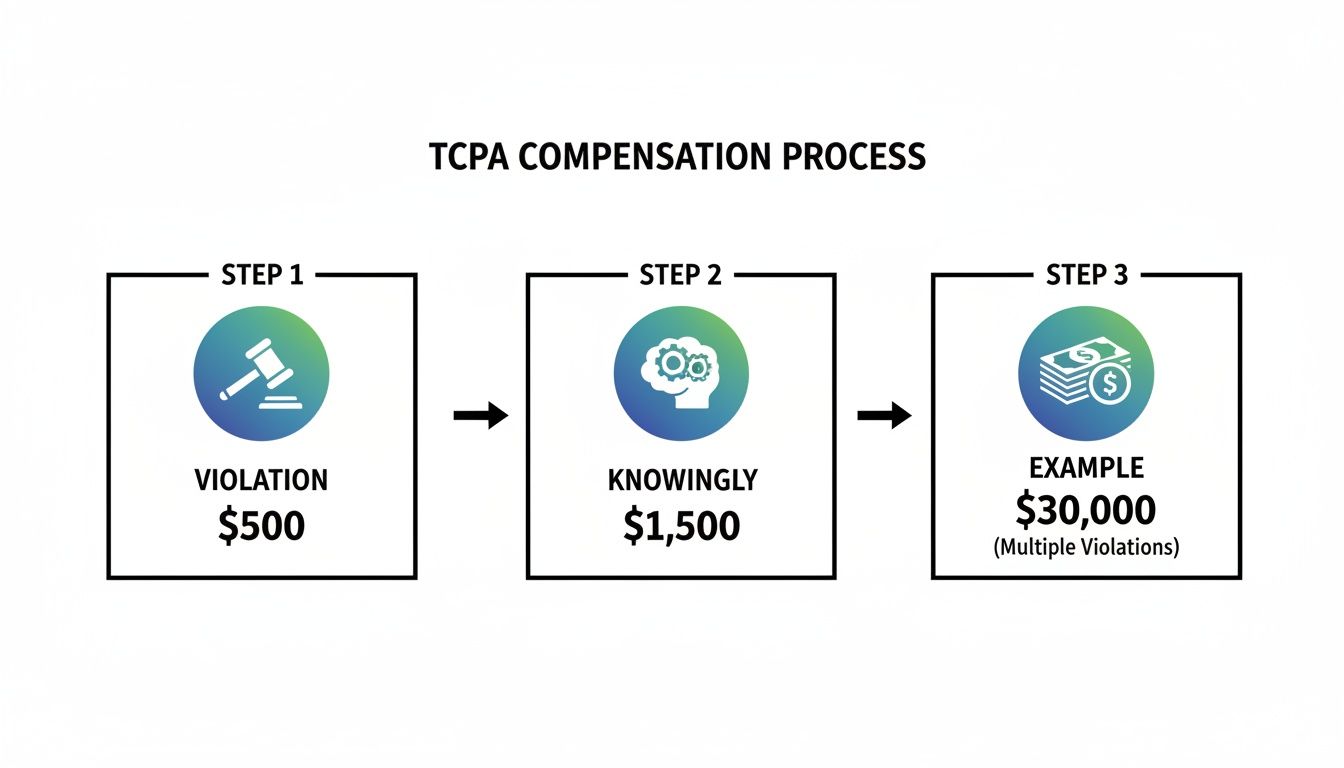
As you can see, the penalties jump significantly when a company knowingly breaks the law. A string of illegal calls can quickly become a massive financial headache for the business responsible.
Your TCPA Evidence Checklist
Follow this checklist to gather the essential information needed before you speak with an attorney.
| Evidence to Collect | How to Document It | Why It’s Crucial for Your Case |
|---|---|---|
| Dates and Times | Screenshot call/text logs. Keep a written journal. | Establishes a clear pattern of harassment. |
| Phone Numbers | List the numbers that called or texted you. | Identifies the source of the unwanted contact. |
| Screenshots of Texts | Capture the full message, sender, and timestamp. | Provides undeniable proof of the communication. |
| Saved Voicemails | Save any prerecorded messages. Don’t delete them. | Shows the use of an autodialer or artificial voice. |
| Revocation of Consent | Note the date/time you said “stop calling.” | Proves the company ignored your request. |
| Do Not Call Registry | Note the date you registered your number. | Shows you proactively opted out of telemarketing. |
Having this information organized and ready will give your attorney a huge head start in evaluating and building your case.
Don’t Miss the Deadline: Understanding the Statute of Limitations
In any legal matter, time is of the essence. The TCPA has what’s called a statute of limitations, which is basically a legal deadline for filing your lawsuit. For TCPA violations, you generally have four years from the date the violation occurred to file your case in court.
Four years might sound like a long time, but you really don’t want to wait. Evidence gets lost, memories fade, and phone records can become a pain to track down later on. Acting fast ensures that everything you need to build a powerful case is still fresh and easy to get your hands on.
If you wait too long, your case could be dead on arrival. File a lawsuit after that four-year window closes, and the court will almost certainly throw it out. You’ll lose your right to get any compensation for good.
The Power in Numbers: Joining a Class Action Lawsuit
Sometimes, an illegal robocall campaign isn’t just hitting your phone—it’s hitting thousands of others, too. When a company is responsible for such widespread violations, consumers can band together to file a class action lawsuit. Think of it as teamwork for justice.
Instead of one person trying to take on a massive corporation, a whole group of victims joins forces. This approach gives you much more power and makes it financially possible to challenge a company with deep pockets. If you’ve gotten an unwanted robocall or text, there’s a good chance you’re not alone, which might make you a perfect fit for a larger case.
The scale of this problem is huge. TCPA class action filings recently skyrocketed by 67% in just one year, reaching a record 2,788 cases. What’s really telling is that over 80% of these were class actions, not individual lawsuits. You can learn more about the explosion in TCPA class action lawsuits to see how people are fighting back in record numbers.
Common Defenses Companies Use and How to Beat Them
When you file a Telephone Consumer Protection Act lawsuit, don’t expect the company to just roll over and write you a check. They have a whole playbook of legal arguments ready to go, all designed to get your case thrown out.
Knowing what you’re up against is half the battle. Let’s break down the most common defenses companies use and, more importantly, how a skilled consumer rights attorney can take them apart.
The “You Gave Us Consent” Defense
This is the big one. The company will almost always claim you gave them prior express consent to call or text. They’ll argue you checked a box, agreed to some fine-print terms of service, or entered your number on their website for a contest.
Often, this supposed “consent” is buried in pages of legal jargon you’d never read or hidden in a pre-checked box you didn’t even see. The trick to dismantling this defense is proving the consent wasn’t truly “express” or “knowing.” Just because you gave your number for a shipping notification doesn’t mean you signed up for a lifetime of marketing messages. Your attorney will dig in and challenge exactly what you agreed to—and what you didn’t.
The “Wrong Number” or Reassigned Number Defense
This one sounds reasonable on the surface. A company might argue they were actually trying to call the previous owner of your phone number, who they claim did give them consent. This is what lawyers call the reassigned number defense.
But it’s not a get-out-of-jail-free card. Courts have become much tougher on this excuse, especially if the calls keep coming after you’ve told them they have the wrong person.
A single conversation where you state, “You have the wrong number,” can be enough to make every single call after that a willful, and much more expensive, violation. This is why documenting every interaction is so critical.
The “Our Machine Isn’t an Autodialer” Defense
This is where things get technical. To have a strong TCPA claim, you usually need to prove the company used an Automatic Telephone Dialing System (ATDS), or “autodialer.” The legal definition of an ATDS has been a major battleground in the courts, and companies love to play in that gray area.
They’ll bring in their own experts to argue that their dialing equipment doesn’t fit the strict legal definition because it requires some minor human involvement. They’ll say, “See? A person clicked a button, so it’s not really automatic.”
This is where a lawyer who lives and breathes consumer protection law really earns their keep. They know the technology, they follow the latest court decisions, and they can use the legal discovery process to demand records on the company’s dialing system. By cross-examining the company’s witnesses and bringing in their own experts, they can prove to the court that the system is, in fact, an illegal autodialer. Punching holes in these technical defenses is what turns a potential loss into a win.
Taking Action with a Consumer Law Attorney
By now, you’ve seen how the TCPA protects your privacy, what a violation looks like, and the steep penalties companies face for ignoring the law. If any of this sounds familiar, you’re probably wondering, “What now?” The great news is that the first step toward filing a telephone consumer protection act lawsuit is simple and, more importantly, costs you nothing.
So, how do you know if you have a strong case? It’s usually pretty clear. If you’ve been on the receiving end of relentless, unwanted contact, you likely have a solid foundation for taking legal action.
Here are some tell-tale signs of a TCPA violation:
- You answer a call and hear a distinct pause, click, or delay before a live person comes on the line.
- You get those annoying prerecorded “robocalls” on your cell or home phone without ever giving permission.
- Your phone is buzzing with marketing text messages from businesses you never signed up for.
- You’ve told a company to stop calling or texting, but they just keep coming.
If you’re nodding along to any of these, it’s probably time to talk to a professional.
How You Can Afford a Great Lawyer
One of the biggest worries that stops people from fighting back is the fear of lawyer bills. This is where consumer protection law is different. Attorneys who specialize in TCPA cases and other consumer rights issues almost always work on a contingency fee basis.
A contingency fee arrangement means you pay absolutely nothing out of your own pocket. The law firm covers all the upfront costs of the lawsuit, and they only get paid if they win a settlement or a court award for you.
This system levels the playing field, making sure anyone can get justice, not just those who can afford to write a big check. It takes all the financial risk off your shoulders and puts it squarely on the law firm. It also gives your attorney a powerful incentive to get the best possible result, because their paycheck depends entirely on your success. You can focus on your case without ever seeing an hourly bill.
Your Next Step Is a Free Consultation
If you suspect a company has trampled on your consumer rights, your next move is to schedule a free, no-strings-attached consultation with an experienced attorney. This is your chance to lay out what’s been happening, present the evidence you’ve gathered, and get a professional opinion on your claim.
This initial chat is completely free and incredibly valuable. You’ll find out if you have a case and what you could potentially recover in damages. It’s the perfect opportunity to get straight answers and understand your options. For more on what to look for in a legal expert, check out our guide to a Telephone Consumer Protection Act attorney. Don’t put up with illegal harassment for another day—take the first step toward holding these companies accountable.
Frequently Asked Questions About TCPA Lawsuits
If you’re thinking about your rights under the Telephone Consumer Protection Act, you probably have a lot of questions. Let’s walk through some of the most common ones people ask when they’re getting inundated with unwanted calls and texts.
Can I Really Sue for a Single Unwanted Call or Text?
Yes, you absolutely can. The TCPA was written with the individual in mind, meaning a single illegal robocall or spam text is enough to give you standing to sue. It’s a common misconception that you need a pattern of harassment to have a case.
The law is clear: each violation carries its own penalty, with statutory damages ranging from $500 to $1,500 per call or text. And since consumer attorneys almost always take these cases on a contingency basis, you won’t pay anything upfront to get started. That one annoying call could be the very thing that holds a company accountable.
It’s also worth remembering that the one illegal call you got might be one of thousands a company made. Your individual claim could uncover a massive illegal campaign, potentially making you the lead plaintiff in a powerful class action lawsuit.
What if I Gave a Company My Number in the Past?
This is a big one. Just because you gave a company your number once—say, for a delivery notification—doesn’t give them a free pass to market to you forever. Consent is specific.
More importantly, you always have the right to revoke your consent. All it takes is a clear statement. Saying “stop calling me” over the phone or replying “STOP” to a text message is legally binding. If they contact you again for marketing after that, they’ve likely just broken the law.
How Long Does a TCPA Lawsuit Take to Resolve?
There’s no single answer here, as the timeline really depends on the specifics of your case. A straightforward individual claim with clear evidence might settle in just a few months, especially if the company knows it’s caught red-handed and wants to avoid a bigger fight.
On the other hand, more complex cases can take longer. Class actions, which involve sorting through evidence for potentially thousands of people, can easily stretch out for a year or more. A good consumer rights lawyer can look at your situation and give you a much better feel for what to expect.
Do I Have to Pay an Attorney to Start a Lawsuit?
No, you shouldn’t have to pay a dime out of your own pocket. Reputable law firms specializing in consumer rights handle TCPA cases on a contingency fee agreement. This model is what gives everyday people a fighting chance against large corporations.
Here’s how it works: you pay no upfront fees or hourly rates. The law firm covers all the costs of building your case and taking it to court. They only get paid if they win money for you, taking a percentage of the settlement or award. If for some reason you don’t win, you owe them nothing for their time.
If you believe a company has violated your rights under the TCPA, you don’t have to tolerate the harassment. The team at Ginsburg Law Group PC is here to help you fight back. We offer free consultations to evaluate your case and explain your options. Contact us today to take the first step toward justice.