Summary
The Telephone Consumer Protection Act (TCPA) of 1991 serves as a vital federal shield against intrusive business communications, specifically targeting unwanted robocalls, text messages, and faxes. This law mandates that companies obtain prior express written consent before contacting consumers with marketing messages using automated dialing systems or prerecorded voices. Cell phones receive particularly robust protections because users often pay for incoming communication. Identifying a violation involves recognizing unauthorized automated contact or the failure of a business to honor a revocation of consent. When companies breach these regulations, they face significant statutory damages ranging from $500 to $1,500 per individual violation, which can escalate into millions for mass marketing campaigns. To combat harassment, individuals should meticulously document every unauthorized contact, issue formal cease and desist demands, and consider legal action through consumer protection attorneys. By enforcing these rights, consumers not only seek personal compensation but also hold businesses accountable, fostering a marketplace that respects privacy. Ultimately, the TCPA empowers citizens to reclaim control over their personal devices from the constant barrage of aggressive telemarketing and illegal spam campaigns that have plagued American households for decades.
The Telephone Consumer Protection Act (TCPA) is a federal law passed in 1991 that restricts how businesses contact you by phone, text, or fax. The law gives you specific rights against unwanted calls and messages, particularly those made using automated dialing systems, prerecorded voices, or artificial intelligence. Companies must get your prior express written consent before contacting you with marketing messages, and they face serious penalties when they ignore these rules.
This guide breaks down everything you need to know about TCPA protections. You’ll learn how to recognize violations of your privacy rights, what penalties companies face when they break the law, and the specific steps you can take to stop harassment and potentially receive compensation. Whether you’re drowning in robocalls or getting bombarded with unwanted texts, understanding your TCPA rights puts you in control of who gets to contact you and when.
Why the TCPA exists and protects you
Congress created the TCPA after American households received billions of unwanted telemarketing calls throughout the 1980s. You couldn’t eat dinner without interruptions, and businesses used automated dialers to flood phone lines with sales pitches at all hours. The technology outpaced privacy protections, leaving consumers with no legal recourse against companies that refused to stop calling.
The harassment problem before 1991
Before the TCPA, telemarketers faced zero federal restrictions on when or how often they could contact you. Companies programmed automated systems to dial every possible number combination, meaning you paid for incoming calls (on some phone plans) while strangers pitched you products. Fax machines ran out of paper from spam advertisements, and businesses couldn’t opt out of the constant barrage. The Federal Communications Commission received thousands of complaints monthly, but existing law provided no framework to stop the abuse.

Understanding what is the telephone consumer protection act means recognizing your right to control who reaches your personal devices and when they can do it.
Your specific protections under the law
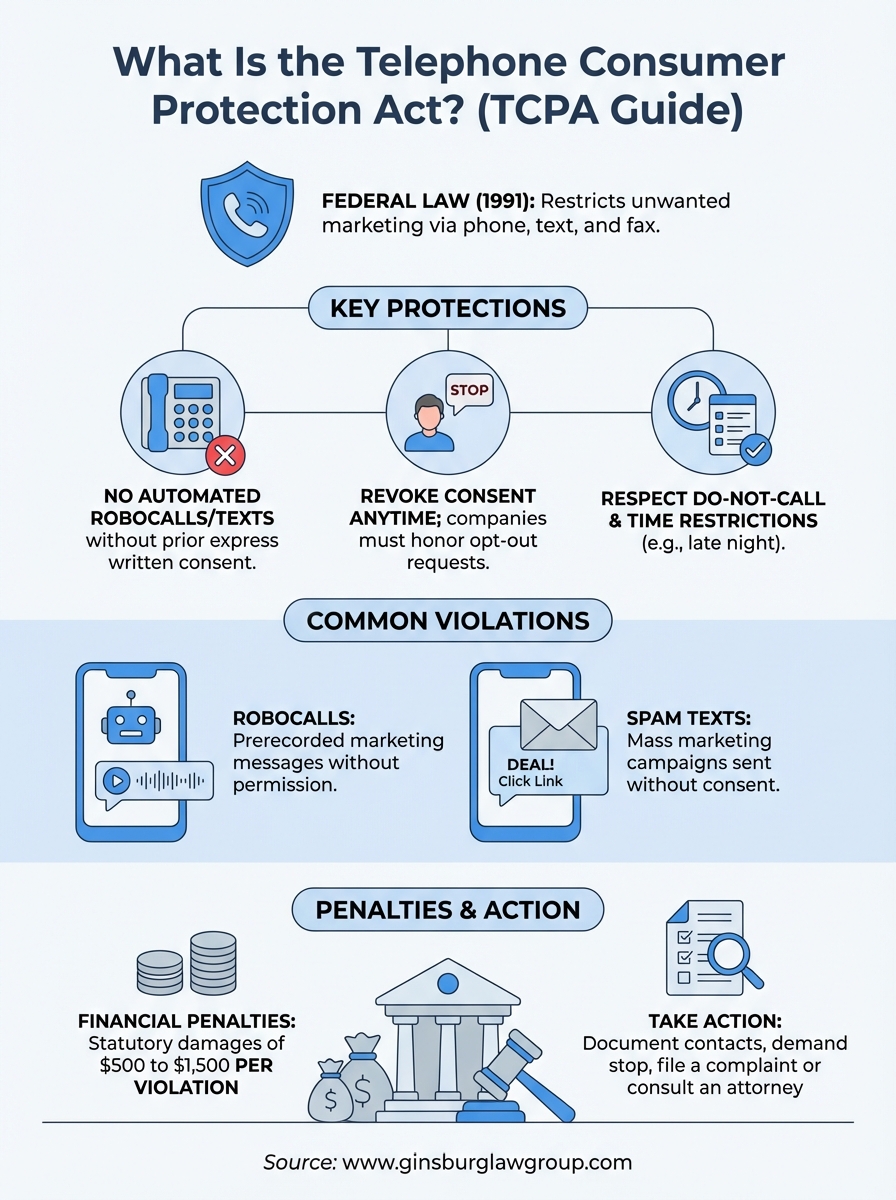
The TCPA gives you three fundamental shields against unwanted contact. First, companies must obtain your written consent before sending marketing texts or making robocalls to your cell phone. Second, you can revoke that consent at any time by telling the company to stop, and they must honor your request. Third, callers must respect do-not-call registries and time-of-day restrictions that prevent late-night or early-morning disturbances.
Your cell phone number receives stronger protections than your landline because you typically pay for incoming calls and messages. The law recognizes that your mobile device is personal property, not a business billboard. Telemarketers who ignore these protections face statutory damages of $500 to $1,500 per violation, creating a financial incentive for companies to follow the rules and respect your privacy.
How to identify a TCPA violation
You can spot a TCPA violation when a company contacts you without your prior written consent or ignores your direct request to stop calling. The law requires specific authorization before automated systems can dial your cell phone for marketing purposes, and violations occur the moment a business breaks these contact rules. Most people don’t realize they’ve experienced illegal communication until they understand what protects them under federal law.
The three clear signs of illegal contact
Companies violate the TCPA when they use automated dialing equipment or prerecorded messages to reach your cell phone without permission. You’ll recognize this through robocalls that play a recording immediately after you answer, or texts from numbers that send identical messages to thousands of recipients at once. The system doesn’t need a human to press buttons, it dials and delivers content automatically.
Knowing what is the telephone consumer protection act means recognizing that your written consent is mandatory before any automated marketing contact happens.
When consent doesn’t exist or was never valid
Your consent must be clear, specific, and documented in writing before it counts under TCPA rules. Buried checkboxes in online forms, vague terms of service agreements, or verbal permission during phone calls don’t meet the legal standard for authorization. Companies also violate the law when they continue contacting you after you’ve revoked consent, even if you initially agreed to receive messages.
Penalties companies face for breaking the law
Companies that violate the TCPA face financial penalties starting at $500 per illegal call or text, and courts can triple that amount to $1,500 per violation when they find willful misconduct. The Federal Communications Commission enforces these rules and can stack penalties when businesses make thousands of unauthorized contacts. You don’t need to prove actual harm or financial loss to collect these damages, the violation itself creates your right to compensation.
Statutory damages per violation
Courts award you between $500 and $1,500 for each individual TCPA violation, meaning every unwanted robocall or text message creates a separate penalty. Companies that send mass marketing campaigns to thousands of people can face millions in total damages when cases become class actions. The penalty amount depends on whether the court finds the company acted negligently ($500) or knowingly broke the law ($1,500).
Understanding what is the telephone consumer protection act includes knowing that you can recover money even when spam calls cause no financial damage beyond annoyance.
Additional consequences beyond fines
Businesses also face injunctions that force them to stop all unauthorized calling practices and implement compliance systems. Repeat offenders risk losing their telecommunications licenses, which effectively shuts down their ability to operate. Courts can order companies to pay your attorney fees and litigation costs, making it financially viable for lawyers to take TCPA cases on contingency without you paying upfront expenses.
Common examples of illegal communication
You experience TCPA violations most often through robocalls that pitch products or services without your written permission. These automated systems dial your cell phone and either play a prerecorded message or connect you to a live salesperson after you answer. Companies selling extended car warranties, health insurance, debt relief services, and vacation packages frequently break these rules by purchasing phone number lists and blasting calls to thousands of people who never agreed to be contacted.

Marketing robocalls to your cell phone
Telemarketers violate federal law when they use predictive dialers or automatic telephone dialing systems to reach your mobile device with sales pitches. You’ll recognize these calls when a recording starts playing immediately, or when you hear dead air for several seconds before a person speaks (the delay happens while the system connects your answer to an available agent). Political organizations and charities receive exemptions from some TCPA rules, but businesses selling commercial products have no such protection.
Learning what is the telephone consumer protection act helps you distinguish between legal informational calls and illegal marketing harassment that breaks federal rules.
Text message spam campaigns
Companies send illegal texts when they blast promotional offers, discount codes, or product announcements to cell phones without documented consent. You might receive messages about loan opportunities, cryptocurrency investments, or shopping deals from numbers you don’t recognize. Businesses often claim you consented by providing your number during an online purchase or contest entry, but TCPA compliance requires separate, explicit written authorization specifically for text message marketing.
Steps to take if your rights are violated
You can fight back against TCPA violations by following a clear three-step process that protects your legal claims while stopping the harassment. Companies bank on consumers not knowing their rights or feeling too overwhelmed to act, but documentation and decisive action give you leverage to either stop the calls immediately or build a strong case for compensation. Understanding what is the telephone consumer protection act means recognizing that federal law puts enforcement power directly in your hands.
Document every violation carefully
Start recording details immediately after you receive any unwanted call or text. Write down the date, time, phone number that contacted you, and the exact content of the message or conversation. Save voicemails, text messages, and screenshots as evidence because these records prove the frequency and nature of violations. Companies often claim they never contacted you or that you consented, so your documentation becomes the foundation of any legal claim.
Demand they stop contacting you
Send the company a written cease and desist letter stating clearly that you revoke any previous consent and demand no further contact. Keep a copy of this letter and proof of delivery because the law requires businesses to honor your request. Most legitimate companies will stop immediately to avoid mounting penalties for continued violations after receiving direct notice.
File a complaint or pursue damages
Contact a consumer protection attorney who handles TCPA cases on contingency, meaning you pay nothing unless you win. You can also file complaints with the Federal Communications Commission or your state attorney general’s office to trigger regulatory investigations.
Final thoughts on consumer protection
Understanding what is the telephone consumer protection act gives you real power to stop harassment and hold companies accountable when they break federal law. You don’t need to tolerate unwanted robocalls, spam texts, or aggressive telemarketing campaigns that invade your privacy and waste your time. The TCPA creates enforceable rights with significant financial penalties that motivate businesses to respect your choices about who contacts you and when they can reach your personal devices.
Taking action against violators serves a purpose beyond your individual case. Every complaint you file and every lawsuit you pursue helps establish legal precedents that protect all consumers from similar abuse. Companies only change their behavior when enforcement becomes more expensive than compliance, and your willingness to fight back makes the difference between a compliant marketplace and continued violations that affect millions of people daily across the country.
If you’re experiencing persistent TCPA violations and want to explore your legal options, Ginsburg Law Group offers free case evaluations to help you understand your rights and potential compensation under federal law.