A Telephone Consumer Protection Act violation happens when a company hits your phone with robocalls, autodialed texts, or prerecorded messages you never agreed to. It also covers calls to numbers on the National Do Not Call Registry.
These interruptions are more than just a nuisance—they’re often illegal. And consumer protection laws like the TCPA give you the power to seek financial compensation for every single violation. Knowing your consumer rights, which also include protections under the FDCPA and FCRA, is the first move in stopping harassment for good.
Understanding Your Rights Under the TCPA
If your phone is constantly buzzing with calls from unknown numbers or spammy texts from companies you’ve never dealt with, you’re definitely not alone. It can feel like an endless, overwhelming barrage.
Thankfully, a powerful federal law acts as your shield: the Telephone Consumer Protection Act (TCPA). Don’t think of it as some stuffy legal document. Instead, picture it as a clear set of rules that businesses must follow before they use automated tech to contact your cell phone.
When companies break those rules, they commit telephone consumer protection act violations. The law is designed to give you, the consumer, a way to fight back and demand payment for the constant disruptions and invasion of your privacy. It’s a key part of a broader network of consumer rights, including the Fair Debt Collection Practices Act (FDCPA) and the Fair Credit Reporting Act (FCRA), which all work together to protect you from corporate overreach.
Your Legal Shield Against Harassment
At its heart, the TCPA is all about protecting your right to privacy from aggressive and intrusive marketing. It lays down strict guidelines for how and when telemarketers, debt collectors, and other companies can use autodialers and prerecorded voice messages.
The law basically says your phone is a personal space, not a free-for-all billboard for unsolicited ads. For a deeper look at the details, you can learn more about the Telephone Consumer Protection Act and how it works for you.
This legal protection is so important because it flips the script and puts the power back in your hands. You’re no longer helpless against a flood of unwanted calls and texts; you can actually hold the violators accountable.
The TCPA allows for statutory damages, which means you could be awarded $500 to $1,500 for each illegal call or text. This ensures that even a single mistake has real financial consequences for the company responsible.
Common Violations at a Glance
Spotting a violation is the first step toward standing up for your rights. We’ll get into the weeds on these issues later, but it’s useful to have a quick overview of what to look out for.
The table below highlights some of the most common ways companies break the law, the potential money you could recover, and what you should do immediately. This isn’t just about frustration—it’s about recognizing that you have legal standing and there are clear actions you can take to stop the harassment.
Common TCPA Violations and Your First Steps
| Type of Violation | What It Looks Like | Potential Damages Per Violation | Your First Step |
|---|---|---|---|
| Robocalls to Your Cell Phone | You get a call with a prerecorded message from a business without your prior written consent. | $500 – $1,500 | Document the date, time, and the number that called you. |
| Autodialed Text Messages | You receive promotional texts you never signed up for, often from a short-code number. | $500 – $1,500 | Take a screenshot of the text, making sure to capture the sender’s number and the message content. |
| Calls to the DNC Registry | A telemarketer calls your number more than 31 days after you registered it on the National Do Not Call list. | $500 – $1,500 | Note the company’s name and the date they called. Keep a record of your DNC registration. |
| Ignoring Opt-Out Requests | You text “STOP” or tell a live agent to stop calling, but the calls or texts keep coming. | $500 – $1,500 | Save proof of your opt-out (like your “STOP” text) and log every single contact you receive after that. |
Think of this table as your initial action plan. Documenting these details is the crucial first step in building a case and putting an end to the unwanted contact.
What Counts as a TCPA Violation?
You don’t need a law degree to spot a TCPA violation. At its heart, the law is built on a few common-sense ideas about protecting you from annoying, automated calls and texts. Let’s break down the legalese into simple terms so you can see exactly when a company steps over the line.
The TCPA really comes down to rules about consent, technology, and your basic right to be left alone. A violation happens when a company breaks those rules. The two biggest red flags are automated calls to your cell phone without your permission and telemarketing calls to any number you’ve placed on the National Do Not Call Registry.
The Power of “Prior Express Written Consent”
Think of prior express written consent as a crystal-clear permission slip you give to a company. This isn’t some vague verbal “okay” you gave once, or a pre-checked box you might have missed on a form years ago. For a company to legally send you automated marketing messages, they need a specific, documented agreement from you.
This permission slip is you explicitly saying, “Yes, it’s okay for you to send me marketing messages using a robocaller or automated texts.” If they don’t have that specific, provable green light from you before they start contacting you, they’re almost certainly breaking the law.
Plain English Definition: Prior Express Written Consent is an unmistakable “yes” from you, in writing, that allows a specific company to send you marketing robocalls or automated texts. They have to get this permission before the first message is ever sent.
So, if you get an automated marketing text or a robocall on your cell phone from a company you know you never gave that kind of permission to, it’s very likely a TCPA violation.
What Exactly Is an “Autodialer”?
The TCPA takes direct aim at calls and texts made with an Automatic Telephone Dialing System (ATDS), which most people just call an “autodialer.” While lawyers and courts have debated the precise technical definition for years, the concept is pretty simple for the rest of us.
Picture a system that acts like a dialing machine. Instead of a person manually punching in your ten-digit number for every single call, this equipment can store or generate phone numbers and dial them automatically without a human involved in each individual action. It doesn’t have to be some sci-fi robot; any technology that can store and dial numbers automatically can fit the bill.
- Autodialers: These are systems that can either store lists of numbers to call or produce them using a random or sequential generator.
- Prerecorded Messages: You know these well. They’re the robotic-sounding voices that deliver a sales pitch without a live person on the line.
- Artificial Voices: This is a similar concept, covering any computer-generated voice used in a marketing call.
If a company hits your cell phone with any of this tech for marketing purposes and they don’t have your prior express written consent, they’ve probably just violated the TCPA.
Ignoring the National Do Not Call Registry
Another huge piece of the TCPA puzzle is the National Do Not Call (DNC) Registry. This is the official federal list where you can add your phone number to tell telemarketers, loud and clear, that you don’t want to hear from them.
Once your number has been on that list for 31 days, it’s illegal for most telemarketers to call you. There are a few exceptions—like charities, political groups, and companies you already have a relationship with—but for the vast majority of cold sales calls, the rule is simple: Don’t call.
If a telemarketer from a for-profit business calls your registered number after that 31-day grace period, it’s a textbook violation. And get this: every single unwanted call can be a separate violation, which means you could be entitled to statutory damages for each one. This protection covers both your cell phone and your landline, giving you a powerful shield against aggressive sales tactics.
Common Ways Companies Break TCPA Rules
So, we’ve covered the basics of consent and autodialers. Now, let’s get into the nitty-gritty of how telephone consumer protection act violations actually happen. These aren’t just abstract legal concepts; companies violate these rules every single day, and you’ve probably seen the evidence in your own call history.
Think about it. Have you ever gotten automated payment reminder texts from a debt collector, replied “STOP,” and then gotten another message a week later? Or how about those prerecorded voicemails from a mortgage company offering a great refinancing deal you never asked about? These aren’t just annoying sales tactics—they are often straight-up violations of federal law.

Unsolicited Robocalls and Autodialed Texts
By far, the most common violations involve automated technology. If a company uses an autodialer to blast marketing calls or texts to your cell phone without getting your express written permission first, they are breaking the law. It’s really that simple.
This covers everything from those spammy texts about a miracle weight loss product to the infamous robocalls about your car’s extended warranty. If you didn’t sign on the dotted line—electronically or otherwise—agreeing to get these specific automated marketing messages on your cell, every single one could be a violation worth $500 to $1,500. This protection is the bedrock of the TCPA.
This is also why TCPA class-action lawsuits have exploded. In the first quarter of the year alone, there were 507 filings, a staggering 112% increase from the same period the year before. Today, about 80% of all TCPA lawsuits are class actions, which turns up the financial heat on violators when a single bad robocall campaign can lead to astronomical penalties.
Ignoring Your Opt-Out Request
Another flagrant—and surprisingly common—violation happens when you tell a company to stop, and they just… don’t. You have an absolute right to revoke your consent at any time, using any reasonable method.
When you text back “STOP,” tell a live agent to add you to their do-not-call list, or send an email asking them to cease contact, they are legally obligated to honor that request immediately. Continuing to hit you with automated messages after you’ve opted out is a clear-cut violation.
Here’s what this can look like:
- You reply “STOP” to a marketing text, get a confirmation, but another promotional message from them pops up a week later.
- You tell a debt collector on the phone, “Don’t call this number again,” only to have their autodialer ring you the very next day.
- You click the “unsubscribe” link in a company’s promotional email, but their separate text message campaign keeps coming.
Always document your opt-out request. A simple screenshot of your “STOP” text can be incredibly powerful evidence if they ignore you. This is especially useful when dealing with aggressive debt collectors. For more on this, check out our guide on when it’s illegal for debt collectors to call you at work.
Vague Consent and Lead Generation Forms
A huge and growing source of TCPA violations comes from those online lead generation forms. You fill one out to get a quick insurance quote or enter a contest, and suddenly your phone is blowing up with calls and texts from a dozen companies you’ve never even heard of.
Thankfully, the FCC has started cracking down hard on this. That vague, fine-print language promising to share your info with “marketing partners” just doesn’t cut it anymore.
Under new rules, consent must be granted to one specific seller at a time. This one-to-one consent requirement means companies can no longer rely on a single form to generate leads for an entire network of undisclosed businesses.
This is a massive win for consumers. It gives you the power to fight back against calls and texts that come from these murky online forms, because the “consent” they claim to have is often completely invalid. The bottom line: if you didn’t clearly agree to get automated calls from a specific company, their contact might be illegal.
How to Prove a Violation and Claim Damages
Knowing a company is breaking the law is one thing, but proving it is how you actually enforce your rights and get the money you’re owed. To build a solid TCPA case, you essentially have to become a detail-oriented detective.
Every piece of evidence you gather—every screenshot, every saved voicemail—strengthens your position and makes it that much harder for the company to wiggle out of responsibility. It’s not complicated, but it does require being thorough.
Building Your Evidence Locker
A strong TCPA claim is built on a foundation of solid proof. Without it, it’s just your word against a corporation’s, and trust me, they’re banking on you not keeping good records.
Here’s a simple checklist of what you need to start saving right away:
- Screenshots of Texts: Don’t just save the message; capture the entire screen. You need the sender’s number, the date, the time, and the full message content to be clearly visible.
- Voicemail Recordings: Save every single prerecorded or artificial voicemail. These are smoking-gun evidence that a company is using automated systems.
- Phone Call Logs: Pop open your phone’s call history and start taking screenshots. Make sure you capture the incoming number, the date, and the time of the call.
- A Detailed Written Log: Keep it simple. A notebook or a spreadsheet works perfectly. For every unwanted call or text, jot down the date, time, the number that contacted you, and a quick note like “robocall about car insurance” or “unsolicited text from ShoeSale.com.”
This collection of evidence creates a powerful, undeniable timeline of the telephone consumer protection act violations. Keeping everything organized is absolutely crucial, especially if your case moves into the discovery phase. You can learn more about what that involves in our TCPA deposition preparation guide.
Understanding Your Right to Statutory Damages
One of the most powerful tools the TCPA gives consumers is something called statutory damages. This is just a legal term for a predetermined amount of money you can be awarded for each violation. The best part? You don’t have to prove you lost a specific amount of money.
The law is very clear on this. You are entitled to $500 for each illegal call or text. If you can show the company knew what they were doing was illegal and did it anyway—like continuing to text you after you replied “STOP”—the court can triple that amount to a staggering $1,500 per violation.
Think about how quickly that adds up. A single company sending you just two illegal texts a week for one month equals eight violations. At $500 a pop, that’s $4,000 in your pocket. This system was designed to hit violators where it hurts: their bottom line.
Individual Claims vs. Class Action Lawsuits
When you decide to take action, you can either go it alone or join forces with others who have been wronged by the same company.
An individual claim is exactly what it sounds like—you file a lawsuit based on the calls and texts you personally received. This is often the right move when the facts of your situation are unique.
A class action lawsuit, on the other hand, is when a company’s bad behavior has harmed a huge number of people in the same way. Let’s be real: if a telemarketer is blasting you with robocalls, they’re likely doing it to thousands of others. By banding together in a class action, consumers can level the playing field and take on massive corporations that would be impossible to fight alone.
These cases are exploding for a reason. In just the first four months of the year, an incredible 880 TCPA cases were filed in federal courts. That’s a 46% surge compared to the same time last year. And get this—class actions represented a massive 79% of all those filings. It’s a clear sign that consumers and their lawyers are fighting back, sending a message that widespread, systemic abuse won’t be tolerated.
How State Laws Strengthen Your Protections
While the federal TCPA is a powerful shield against unwanted calls and texts, it’s not the only law in your corner. Think of the TCPA as the national floor for consumer protection—a solid foundation. Many states, however, have built on top of that foundation, creating even stronger local rules.
These state-level statutes, often called “mini-TCPAs,” can offer you even more muscle when fighting back against harassing communications. This dual layer of federal and state law means a telephone consumer protection act violation can be tackled from multiple angles, reinforcing your rights.
The Rise of Mini-TCPAs and Stronger Safeguards
Over the years, many states have seen the federal TCPA and thought, “We can do better.” They’ve passed their own laws that often close loopholes, expand protections, or hit violators with steeper penalties.
For example, a state law might jack up the statutory damages well beyond the federal $500 to $1,500 per violation. This makes it a much bigger financial gamble for companies to ignore the rules. Some states also use a broader definition of what counts as an “autodialer” or clamp down on calling hours even more tightly, giving you more peace and quiet.
This process—from documenting the harassment to getting justice—is simpler than you might think.
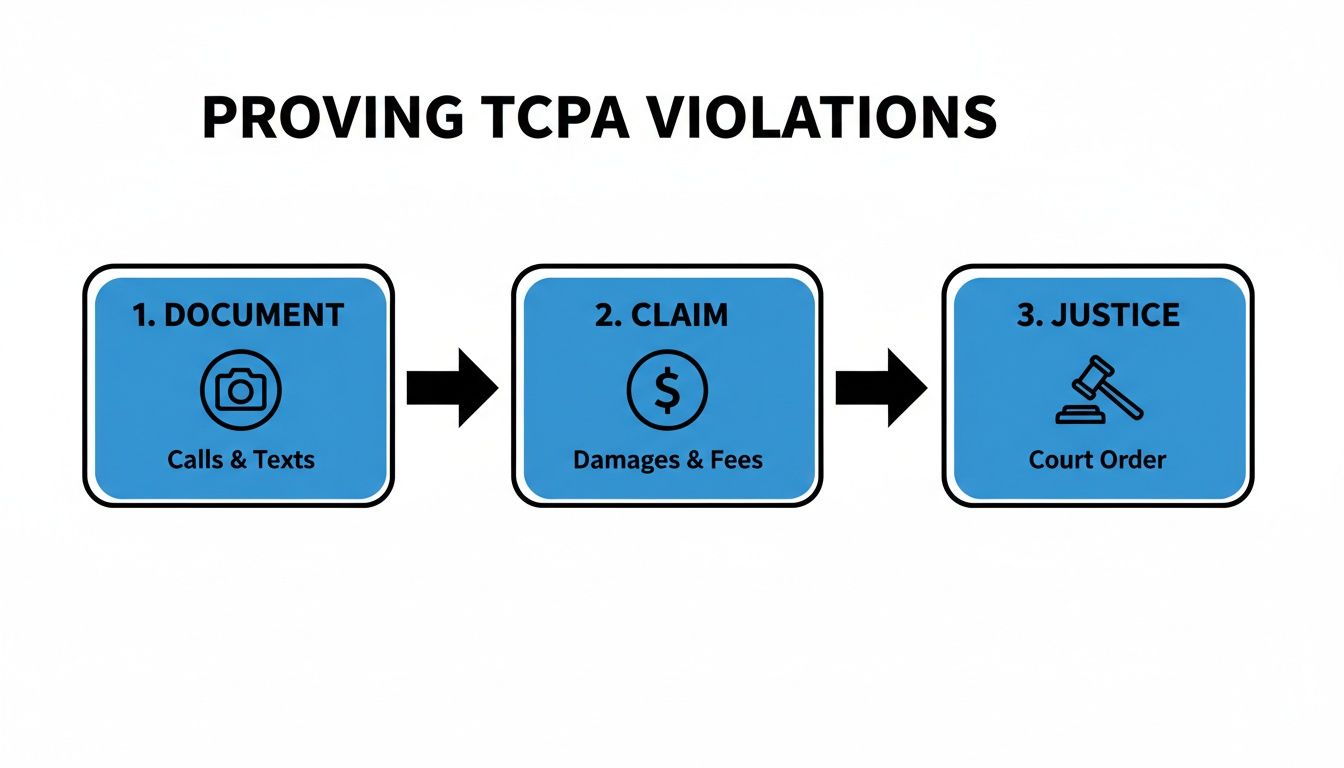
As you can see, it all starts with that first crucial step: keeping a record. That evidence is what empowers you to file a claim and hold them accountable.
State Attorneys General Are on the Offensive
It isn’t just about the laws on the books; it’s also about who is enforcing them. State Attorneys General (AGs) across the country have gone on the attack, actively hunting down and prosecuting illegal robocall operations. They aren’t just sitting back and waiting for consumers to sue.
When you pursue a claim, you are not alone. You are joining a nationwide fight backed by powerful government agencies dedicated to restoring consumer privacy and holding violators accountable for their actions.
This crackdown is serious. Ohio’s AG, for instance, has relentlessly pursued robocall rings, and a multi-state AG Task Force is putting immense pressure on the VoIP providers that enable these illegal calls. In fact, at least 15 states now have mini-TCPA laws that are even tougher than the federal version. You can discover more insights about these state AG enforcement trends to see just how hard they’re fighting.
The Impact of Government Crackdowns
This tag-team effort between state AGs and federal agencies like the Federal Communications Commission (FCC) has led to some staggering fines against companies that refuse to play by the rules. We’re not talking about small slaps on the wrist—these are often multi-million dollar penalties that send a shockwave through the industry.
These major enforcement actions prove that the government is firmly on your side. Their work helps dismantle the massive operations that flood our phones with junk calls, which in turn makes it easier for individual consumers like you to win your own legal battles. They’re clearing the path, making the legal landscape more favorable for holding every single violator accountable.
Your Next Steps to Stop the Harassment
Alright, you’ve got the background on what makes a call illegal and how to start collecting evidence. Now, let’s turn that knowledge into a concrete plan to stop the harassment and make these companies pay for ignoring your rights. It’s time to take back control of your phone and your peace of mind.
This isn’t just about feeling annoyed anymore; it’s about methodically building a case that proves a company broke the law. Each step you take strengthens your position.

Create Your Action Plan
Follow these steps in order to build an airtight case and put a permanent end to the unwanted calls and texts.
- Formally Revoke Consent in Writing: This is your first and most critical move. Send an email or a certified letter to the company with a clear, direct message: “I revoke any and all consent you believe you have to contact me via automated calls or text messages at [Your Phone Number].” This simple act creates a paper trail they can’t deny.
- Keep Documenting Everything: Once you’ve sent that letter, any call or text they send is a potential willful telephone consumer protection act violation. Don’t stop logging everything. Keep taking screenshots, saving call records, and jotting down notes. Evidence gathered after you’ve officially told them to stop is incredibly persuasive and can dramatically increase the damages you’re owed.
- Remember the Statute of Limitations: Generally, you have four years from the date of the violation to sue under the TCPA. That might sound like a lot of time, but don’t let it fool you. Phone records get deleted, and details get fuzzy. It’s best to act while the evidence is fresh and the abuse is well-documented.
Why Consulting a Consumer Protection Lawyer Is Crucial
You can absolutely file complaints with government agencies on your own, but when you’re dealing with a company that won’t take no for an answer, you need more leverage. Bringing in a lawyer who specializes in consumer protection law is often the game-changer.
Attorneys who specialize in TCPA cases have seen every trick in the book. They know how companies try to dodge responsibility and are experts at countering their arguments, forcing them to take your claim seriously.
Best of all, these law firms almost always work on a contingency fee basis. What does that mean for you? You pay absolutely nothing out of your own pocket. The lawyer’s fee is simply a percentage of the money they recover for you. If they don’t win your case, you owe them nothing. This levels the playing field, removing the financial risk and allowing anyone to stand up for their rights and finally stop the harassment for good.
Your TCPA Violation Questions, Answered
When you’re dealing with a flood of unwanted calls and texts, it’s easy to feel overwhelmed. You probably have a lot of questions about what your rights are and what you can actually do about it. Let’s break down some of the most common ones.
Can I Really Sue Over a Single Text or Call?
Yes, you absolutely can. Many people think you need to be buried in dozens of calls to have a case, but that’s not true. The law is designed to protect you from any unwanted contact, not just a pattern of it.
A single unsolicited robocall to your cell or one marketing text after you’ve unsubscribed is enough to have a valid claim. The TCPA enforces penalties for each and every violation, which means one illegal call can trigger $500 to $1,500 in damages.
What If I Originally Gave a Company My Number?
This is a huge point of confusion. Giving a company your number for one reason—say, on a shipping form or a warranty card—doesn’t give them a free pass to spam you with marketing forever. And crucially, you always hold the power to take back that permission.
The moment you tell a company to stop, they legally have to stop. It doesn’t matter if you gave them permission five years ago. Revoking your consent is your right, and it takes effect immediately.
On top of that, the rules for getting consent have become much stricter. Vague, fine-print agreements that companies used to rely on often don’t hold up in court anymore. Your power as a consumer is stronger than ever.
What Does It Cost to Hire a Lawyer for This?
For most people, it costs nothing upfront. This is probably the most surprising part for consumers who are worried about legal fees. Nearly all experienced consumer protection lawyers take TCPA cases on what’s called a contingency fee basis.
In plain English, this means the lawyer only gets paid if they win your case, and their fee is a percentage of the money they recover for you. They cover all the costs of the lawsuit themselves. If you don’t win, you don’t owe a dime. This system makes it possible for anyone to stand up to a big company, no matter their financial situation.
If you’re tired of illegal calls and texts, you don’t have to fight back alone. The team at Ginsburg Law Group PC is dedicated to defending consumer rights across a range of issues—from TCPA and FDCPA violations to Lemon Law and debt defense. We hold companies accountable for their actions. Contact us today for a free consultation to find out how we can help you stop the harassment and get the compensation you deserve.