It often starts with a period of silence. You’ve missed a few payments on a credit card or medical bill, and the original company you owed has stopped calling. Then, seemingly out of nowhere, you start getting letters and calls from a business you've never heard of. This is the classic sign that your debts have been sold to a collection agency. Your financial obligation now belongs to a new owner, one whose only business is getting you to pay up. Knowing your consumer rights is the first step in defending yourself.
The Journey of a Sold Debt

When an account goes unpaid for several months, the original creditor—whether it's a bank, a hospital, or a retailer—faces a business decision. Continuing to chase the debt costs them time and money. At some point, they cut their losses by performing a charge-off.
A charge-off is simply an accounting move. The company declares the debt a loss on their books, which can provide them with a tax benefit. But here’s the critical part: a charge-off doesn’t erase the debt. It just signals that the original creditor is done trying to collect it themselves. Their next move is usually to sell the account.
Why Creditors Sell Unpaid Debts
For a company, an overdue account is like a broken piece of equipment—it's a non-performing asset just sitting on their balance sheet, creating a financial drag. To clean up their books and recover at least a small portion of their money, creditors bundle these delinquent accounts into large portfolios.
These portfolios are then sold in what is essentially a debt auction. The buyers are typically debt-buying firms and collection agencies, and their entire business model is built on a simple profit motive.
A collection agency buys your debt for pennies on the dollar, but they gain the legal right to collect the full amount from you. This massive gap between their purchase price and the total debt balance is their potential profit margin, which fuels their aggressive collection tactics.
For example, after a credit card or medical bill has gone unpaid for 90-180 days, it’s often sold for as little as 4 to 10 cents per dollar owed. So, a $10,000 debt could be purchased for just $500. This creates a powerful financial incentive for the new owner to pursue you for the entire $10,000. To get a better sense of the scale, you can discover more insights about the debt collection market and its valuation.
The Lifecycle From Delinquency to Collection
The journey a debt takes from the original creditor to a collection agency is surprisingly predictable. To see how this all unfolds, let's walk through the typical stages.
The Journey of a Sold Debt
| Stage | Timeline | What Happens | Who Owns the Debt |
|---|---|---|---|
| Initial Delinquency | 30–90 Days | You miss payments. The creditor sends reminders and adds late fees. | Original Creditor |
| Serious Delinquency | 90–180 Days | Collection efforts intensify. The creditor decides the account is a loss. | Original Creditor |
| Charge-Off | Around 180 Days | The debt is written off as a loss for accounting and tax purposes. | Original Creditor |
| Debt Sale | After 180 Days | Your account is bundled with others and sold for a fraction of its value. | Original Creditor |
| New Ownership | After Sale | A collection agency now owns the debt and begins its own collection campaign. | Collection Agency |
This transfer of ownership is a pivotal moment. Your relationship is no longer with the company you originally did business with. Now, you’re dealing with a firm that specializes in one thing: collecting debt. Understanding this process is the first step in knowing how to respond and protect your rights.
Your Legal Shield Against Collector Harassment
When a debt gets sold to a collection agency, it can feel like you’ve been thrown into a whole new world with a different set of rules. And in a way, you have. But you’re not without protection. In fact, a powerful set of federal laws acts as your legal shield, protecting you from aggressive, unfair, and deceptive collection tactics.
Feeling cornered or harassed by a debt collector isn't just stressful—it’s very often illegal. These consumer rights are your primary form of debt defense.
The most important law on your side is the Fair Debt Collection Practices Act (FDCPA). Think of it as a strict rulebook that all third-party debt collectors must follow. Congress passed the FDCPA specifically to stop abusive behavior, and just knowing the basics can completely shift the power dynamic back in your favor.
What the FDCPA Prohibits
The FDCPA draws a very clear line in the sand, dictating how, when, and where a collector can contact you. It also makes it illegal for them to use lies or shady tactics to scare you into paying. Unfortunately, violations happen all the time.
Here are just a few of the hard-and-fast rules collectors are legally required to follow:
- Calling at Inconvenient Times: They are forbidden from calling you before 8 a.m. or after 9 p.m. in your local time zone, unless you've given them the green light to do so.
- Contacting You at Work: If you tell a collector you can't take their calls at your job (either verbally or in writing), they have to stop. Period.
- Using Threats or Profanity: Collectors can't use foul language or threaten you with things they can't legally do, like having you arrested. You absolutely cannot be jailed for an unpaid consumer debt like a medical bill or credit card.
- Misrepresenting Themselves or the Debt: It’s illegal for a collector to lie about who they are, how much you owe, or the legal status of the debt. For example, they can't pretend to be an attorney or threaten a lawsuit they have no real intention of filing.
The FDCPA isn't a list of polite suggestions; it's federal law. If a collector breaks these rules, you have the right to sue them. A single violation could mean you're entitled to $1,000 in statutory damages, plus compensation for any actual harm you suffered.
On top of these rules, the FDCPA gives you a powerful tool: the right to stop all communication. By sending a simple written "cease and desist" letter, you can force a collector to stop contacting you entirely. Their only exceptions are to tell you they're giving up or that they’re taking specific legal action, like filing a lawsuit. If you need guidance, there is a wealth of information detailing your rights against debt collectors that can help.
The TCPA: Your Defense Against Robocalls
These days, harassment is often automated. That’s where the Telephone Consumer Protection Act (TCPA) comes in. This law is another critical part of your legal shield, specifically designed to combat unwanted robocalls, auto-texts, and even faxes.
The TCPA demands that companies get your explicit permission before hitting you with calls from an autodialer or a prerecorded message. Here's the key: when an old debt is sold, the consent you might have given the original creditor doesn't just transfer over to the new debt collector.
So, if a collector is blowing up your cell phone with robocalls or a stream of automated texts, they are probably breaking the law. Each illegal call or text could cost them $500 to $1,500—payable directly to you. That adds up fast and gives collectors a strong financial reason to play by the rules.
The FCRA and Your Credit Report
Finally, let’s talk about your credit. The Fair Credit Reporting Act (FCRA) is the law that ensures the financial data on your credit report is accurate and handled properly. When a collection account pops up on your report, the FCRA is what keeps the reporting fair and honest.
The FCRA gives you some crucial rights:
- Dispute Inaccurate Information: If a collection agency reports something wrong—like an incorrect balance, a wrong date, or a debt that isn't yours to begin with—you have the right to dispute it with the credit bureaus (Experian, Equifax, and TransUnion).
- Have Outdated Information Removed: Most negative items, collections included, have a shelf life. They must be removed from your credit report after seven years. The FCRA sets this time limit so old financial stumbles don't haunt you forever.
- Know Who Is Viewing Your Report: The FCRA also puts tight restrictions on who can pull your credit file, which helps protect your financial privacy.
Together, the FDCPA, TCPA, and FCRA create a formidable defense for consumers. They ensure that even when a debt changes hands, you have clear rights and legal options to fight back against harassment, robocalls, and false credit reporting. Knowing these laws are on your side transforms you from a passive target into an empowered consumer.
Your Most Powerful First Move: Validating the Debt
The moment a debt collector first contacts you, a 30-day clock starts ticking. This isn't just some arbitrary deadline; it's your one and only window to make the most powerful move in your entire debt defense playbook: demanding they validate the debt.
Think of it this way: a stranger knocks on your door and says they bought the right to collect your mortgage from the bank. You wouldn't just write them a check, would you? Of course not. You'd ask to see the contract, the proof of sale, and who they are. A debt validation letter does exactly that. It's a formal, legally recognized request that forces the collector to prove they actually own the debt and have the right to collect a single penny from you.
This isn't just a simple request for paperwork—it's a legal shield. If the collector can't produce the specific proof required by law, they have to stop contacting you. It's your best defense against paying a debt that might be riddled with errors, past its expiration date, or not even yours to begin with.
The chart below shows how your rights under federal laws like the FDCPA, TCPA, and FCRA work together to protect you.
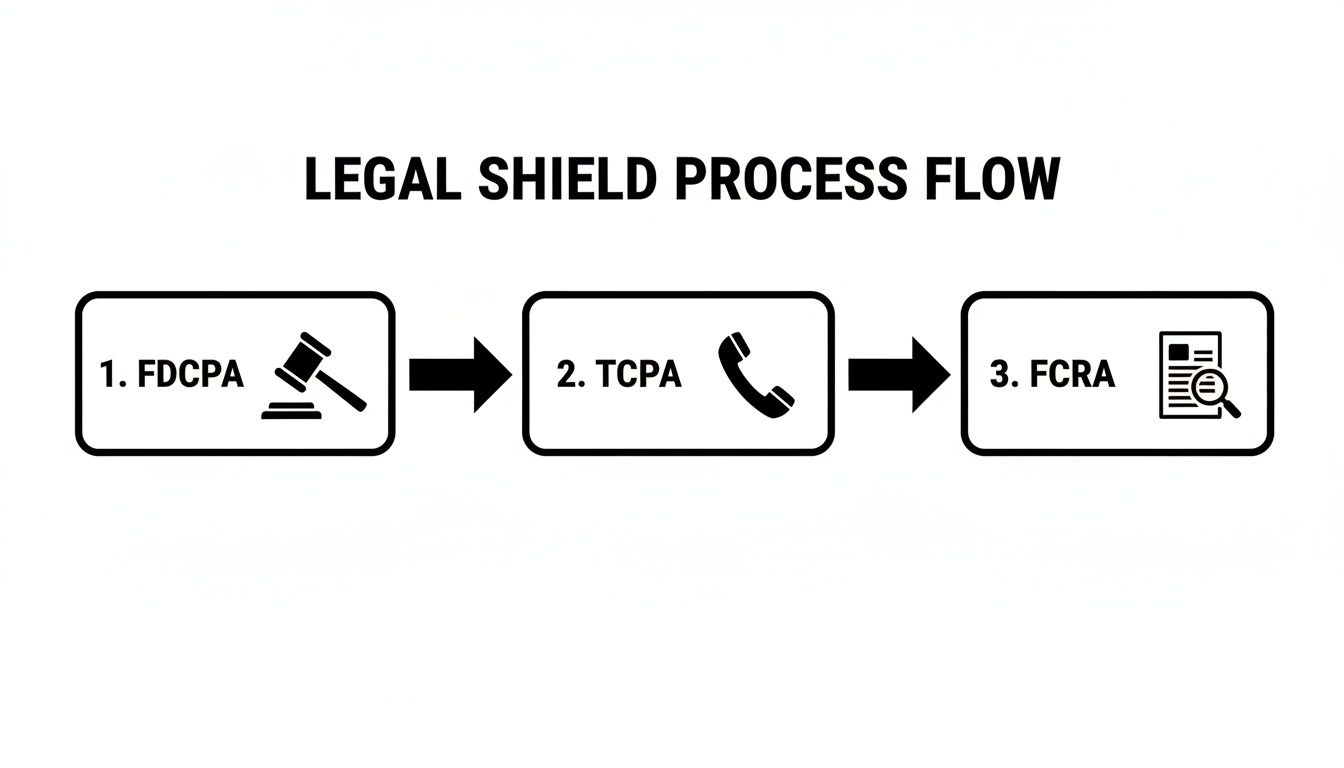
Each of these laws provides a different layer of defense, giving you a comprehensive toolkit to fight back against illegal or unfair collection tactics.
Why Debt Validation Is So Effective
Here’s an industry secret: when debts are sold, they’re often bundled into massive spreadsheets and sold for pennies on the dollar. In that chaotic transfer, crucial information gets garbled or lost entirely. It’s incredibly common for collection agencies to have the wrong balance, the wrong person, or be trying to collect a "zombie debt" that's too old to be legally enforced.
A debt validation letter flips the script. It shifts the burden of proof entirely onto the collector. They can't just say you owe money. They have to prove it.
By sending a validation letter, you are exercising your rights under the Fair Debt Collection Practices Act (FDCPA). The law requires the collector to halt collection activities until they send you verification of the debt. If they fail to provide it, any further attempt to collect is a violation.
This simple step can bring the harassment to an immediate halt. And the harassment is real—read the full research about these industry trends and you'll see just how widespread these issues are. For those being buried under constant texts and calls, a consumer protection attorney can enforce your rights under both the TCPA (which governs robocalls/texts) and the FDCPA.
Crafting and Sending Your Letter
To make this work, timing and method are everything. You must send your debt validation letter within 30 days of the collector’s first contact. Miss that window, and you lose some of your strongest legal protections.
Follow these steps to the letter to make sure your request is airtight:
- Act Fast: Don’t procrastinate. Get your letter written and in the mail as soon as you hear from the collector.
- Be Direct and Neutral: Your letter should clearly state that you dispute the debt and are requesting full validation. Critically, do not admit the debt is yours or talk about making payments.
- Request Specifics: Ask for the original creditor’s name and account number, the amount of the debt when the collector acquired it, and documentation proving they have the legal authority to collect from you.
- Use Certified Mail: This is the one step you cannot skip. Send the letter via certified mail with a return receipt. This gives you undeniable legal proof of when the collector received your demand.
Following this process forces the collector to play by the rules. We've made it even easier by creating a proven template to work from. You can check out our guide on how to use a debt validation letter template to make sure you've covered all your legal bases and given yourself the best possible defense.
Old Debts and Your Credit Report: The Two Timelines That Matter
When an old debt suddenly reappears, it can feel like a ghost from your financial past. A collection agency might start calling, sending letters, and making demands. This is what many people call zombie debt—an old debt that comes back to haunt you long after you thought it was gone.
To deal with it, you need to understand that two completely separate clocks are ticking. The first clock determines if they can sue you. The second clock determines how long it can damage your credit report. Knowing how both work is your best defense.
The Statute of Limitations: Can They Still Sue You?
Every state has a law called the statute of limitations. Think of it as a legal expiration date on a debt. It sets a firm deadline for how long a creditor or collector has to file a lawsuit against you. This timeframe is different depending on where you live and the type of debt (like a credit card versus a written contract).
Once that deadline passes, the debt becomes "time-barred." A collector can still call and ask you to pay, but they've lost their biggest weapon: they cannot legally sue you. If a collector threatens to sue you—or actually does—for a time-barred debt, they're breaking the Fair Debt Collection Practices Act (FDCPA).
Be incredibly careful here. A single wrong move can bring a zombie debt roaring back to life. Making a small payment, or even just agreeing in writing that you owe the money, can reset the statute of limitations entirely. This gives the collector a fresh chance to sue you.
Before you even think about engaging with a collector on an old debt, your first step is to find out your state's statute of limitations for that specific type of debt.
Credit Reporting: The Seven-Year Rule
While the statute of limitations is about lawsuits, a different federal law—the Fair Credit Reporting Act (FCRA)—governs your credit report. The FCRA has a very clear rule: most negative items, including collection accounts, must be removed after seven years.
This seven-year clock starts on the date of the original delinquency. That’s the date of the first payment you missed with the original creditor, which eventually led to the account being charged off and sold.
Here’s the critical part: that clock does not restart just because your debt was sold to a new collector. A common and illegal tactic is for a collector to report the debt with a newer date to keep it on your credit report longer. This is called "re-aging," and you can fight it.
Does Paying a Collection Actually Help Your Credit Score?
It’s a fair question, and the answer is complicated. When you pay a collection, the account on your credit report gets updated to show a zero balance and a "paid" status. This certainly looks better to a potential lender than an open, unpaid collection.
But the collection entry itself will likely stay on your report for the remainder of the seven-year period.
The good news is that modern credit scoring models are starting to see things differently:
- Newer FICO® Score models (like FICO 9 and 10) completely ignore collection accounts that have been paid off.
- All VantageScore® models do the same and disregard paid collections.
The catch? Many lenders, especially in the mortgage industry, still rely on older FICO score versions that penalize you for any collection account, paid or not. So, while paying is often the responsible thing to do, don't expect an immediate, magical boost to your score.
What to Do About an Incorrect Collection on Your Report
The FCRA guarantees your right to an accurate credit report. If you see a collection account with wrong information—maybe it's not your debt, the balance is off, or the dates are incorrect—you need to act.
You have the right to dispute the error directly with the credit bureaus (Experian, Equifax, and TransUnion). Once you file a dispute, they are required by law to investigate your claim, usually within 30 days. For a step-by-step guide, you can learn more about how to dispute late payments and other errors on your credit report.
The debt collection industry is a numbers game. Agencies buy massive portfolios of old debt for pennies on the dollar and then use high-volume, aggressive tactics to collect. This focus on quantity over quality means mistakes are common. But their business model can be your leverage. When you find credit reporting errors or get hit with illegal robocalls, the FCRA and TCPA give you powerful rights. As the debt collection market grows, so do the opportunities for consumers to push back—many of these cases result in settlements worth thousands of dollars.
Your Strategic Toolkit for Dealing With Collectors

Knowing your rights is one thing, but actually using them to turn the tables on a debt collector? That’s where you take back control. When an account lands with a collection agency, you need a game plan for every move they make. This isn't just about sending a single letter; it's about strategically managing every communication, negotiating from a position of strength, and sidestepping the common traps that can cost you dearly.
This strategic debt defense approach puts the legal burden squarely back on the collector. Every letter you mail, every call you take (or better yet, don't take) is a calculated move. This forces them to play by your rules, not the other way around.
Taking Control of Communications
The endless calls and flood of letters can be completely overwhelming. But here’s the good news: the FDCPA gives you the power to tell them how—and even if—they can contact you. You absolutely do not have to put up with calls at work or a phone that rings off the hook at home.
Instead of just ignoring the calls, which rarely solves anything, you can use specific written demands to manage the interaction. This does more than just give you some peace and quiet. It creates a paper trail, which is your best evidence if you ever need to prove harassment or other legal violations down the road.
A couple of powerful letters should be in your arsenal:
- Mail-Only Communication Letter: Send this to demand that all future contact be made through the mail. It immediately stops the phone calls and gives you a written record of every single claim they make.
- Cease and Desist Letter: This is the ultimate stop sign. Once a collector receives this letter, the FDCPA legally requires them to stop all contact. They have only two ways they can reach out again: to tell you they are ending collection efforts, or to notify you that they are taking a specific legal action, like filing a lawsuit.
Your Communication Toolkit With Debt Collectors
The letter you choose to send really depends on what you're trying to accomplish. Each one serves a distinct purpose, and picking the right tool for the job is essential to getting the outcome you want.
This table breaks down your main options.
| Letter Type | Purpose | When to Use It | Legal Impact |
|---|---|---|---|
| Debt Validation | To force the collector to prove they own the debt and have the right to collect. | Within 30 days of the first contact. | Halts collection efforts until they provide proof. |
| Mail-Only Request | To stop all phone calls and create a written record of all communications. | Any time you want to stop calls but remain in contact about the debt. | If they call after receiving it, it’s an FDCPA violation. |
| Cease and Desist | To demand the collector stop all contact with you permanently. | When you want to end all communication, often for time-barred debts. | Legally forces them to stop contact, with few exceptions. |
Think of these letters as your first line of defense, allowing you to set the ground rules for any future engagement.
Negotiating a Settlement and Pay-for-Delete
So, what happens if the debt is legitimate and still within the statute of limitations? Your best move might be to negotiate a settlement. Remember, the collection agency bought your debt for pennies on the dollar. This is their secret weakness. They have plenty of room to negotiate and will often gladly accept a payment for less than the full amount you originally owed.
One of the most effective strategies here is negotiating a pay-for-delete agreement. Here's a common misconception: simply paying off a collection account doesn't make it disappear from your credit report. It just gets updated to show a $0 balance, but the negative history stays for up to seven years. A pay-for-delete is different. It’s an agreement where you offer to pay an agreed-upon amount, and in return, the collector promises to completely remove the account from your credit reports with Equifax, Experian, and TransUnion.
CRITICAL: Do not, under any circumstances, agree to a settlement or pay-for-delete over the phone. Get the entire agreement in writing before a single penny leaves your hands. Once you pay, you lose all your leverage, and the collector has zero incentive to honor a verbal promise.
Critical Mistakes to Avoid at All Costs
How you interact with a collector is just as important as the letters you send. A few simple slip-ups can completely undermine your efforts and give the collector an advantage.
First and foremost, never give a debt collector your bank account or debit card information. If you've negotiated a settlement, pay with a cashier's check or a money order sent via certified mail. This prevents any "accidental" withdrawals of more than you agreed to. Along those same lines, don't make verbal promises or agreements of any kind. If it's not in writing, it might as well have never happened.
When to Call a Consumer Protection Attorney
Dealing with a debt collector on your own has its limits. While sending validation letters and negotiating a settlement are smart first steps, there are moments when the situation escalates beyond what you can—or should—handle yourself.
When a collector crosses a legal line, it's time to stop playing defense. This is your cue to bring in a professional who can not only stop the illegal behavior but also turn the tables and hold the collector accountable. This is the core of effective debt defense.
Red Flags That Mean It's Time for Legal Help
Some actions by a collector aren't just annoying; they're clear signals that you need professional legal backup. If you run into any of these scenarios, it’s a good idea to start looking for a consumer law firm immediately.
Think of these as triggers for taking legal action:
- You've Been Sued: This is the most urgent red flag. Once you receive a summons for a lawsuit, the clock starts ticking. If you ignore it, the collector can get a default judgment, which opens the door to wage garnishment or levying your bank account.
- Harassment Continues After You've Said Stop: You sent a cease and desist letter, but the calls and messages keep coming. This isn't just persistent; it's a clear violation of the FDCPA, and an attorney knows exactly how to make it stop.
- They Threaten You: Any talk of arrest, violence, or legal action they have no real intention of taking is completely illegal. These are classic scare tactics used by abusive collectors, and they are not to be tolerated.
- It's Not Your Debt: You've gone through the dispute process, provided proof that they have the wrong person, but they won't let it go. This is pure harassment and may also be an FCRA violation if they're reporting it on your credit.
How a Consumer Attorney Can Fight for You
Bringing in an attorney isn't just about getting someone to answer the phone for you. It's about shifting the power dynamic and potentially getting a financial recovery for the abuse you've endured.
Most consumer protection laws—like the FDCPA, TCPA, and FCRA—include what's known as a "fee-shifting" provision. This is a complete game-changer for consumers.
This provision means that if you win your case, the law forces the debt collector who broke the law to pay your attorney’s fees and costs. Because of this, many consumer law firms, including Ginsburg Law Group, will represent you with no out-of-pocket cost.
An attorney will immediately get to work stopping the harassment and defending you against a lawsuit. They'll also scrutinize your case for every single violation. Each illegal robocall could be worth $500 to $1,500 under the TCPA. A proven FDCPA violation can add another $1,000 in statutory damages, on top of any actual damages you suffered.
Don't let an aggressive collector who breaks the law have the last word. If you're facing a lawsuit or relentless harassment after a debt was sold, calling an attorney is the strongest move you can make.
Frequently Asked Questions About Sold Debts
When a debt is sold, a lot of new questions and worries pop up. It's a confusing and often stressful time. Let's clear up some of the most common concerns people have when a new collector starts calling.
Can a Debt Collector Contact My Family or Employer?
This is a big one, and the FDCPA rules here are very clear. A collector is allowed to call third parties, like your relatives or your boss, for one specific reason: to get your current address and phone number. That's it.
They are strictly forbidden from discussing your debt with anyone else. Once they have your location information, those calls to other people must stop immediately.
What Happens to My Debt if I Die?
It's a difficult topic, but it's important to know what happens to debt when someone passes away. This is where estate planning becomes critical. The debt doesn't just disappear; it becomes part of the deceased's estate. The estate's executor will use available assets (like cash or property) to pay off creditors before any inheritance is passed to heirs.
What’s most important to understand is that your family is not personally responsible for your individual debts. If you were the only one on the loan, they don’t inherit your debt. If the estate has no assets, the debt typically goes unpaid. Collectors cannot legally pursue your relatives for payment. Proper estate planning can help protect assets and ensure this process is handled smoothly.
Will Paying a Collection Remove It From My Credit Report?
Unfortunately, no, it won't happen automatically. When you pay off a collection account, its status on your credit report is updated to show a zero balance. While that's much better than having an open, unpaid collection, the negative mark itself can stick around for up to seven years.
The only surefire way to get it removed completely is by negotiating a "pay-for-delete" agreement. Make sure you get this promise in writing from the collector before sending any money.
Can I Be Arrested for an Unpaid Consumer Debt?
Absolutely not. In the United States, you cannot be thrown in jail for failing to pay a consumer debt like a credit card balance, medical bill, or personal loan.
Any debt collector who threatens you with arrest is breaking the law in a serious way. This is a major violation of the FDCPA and a huge red flag that you should talk to an attorney right away.
Are you facing a lawsuit, endless harassment, or credit reporting errors related to a debt that was sold? You don’t have to fight alone. The team at Ginsburg Law Group specializes in holding collectors accountable under the FDCPA, TCPA, and FCRA, often at no out-of-pocket cost to you. Contact us today for a free consultation to protect your rights.