


Summary
Former property owners in Travis County may be entitled to unclaimed surplus funds when their properties sell at auction for more than the total debt owed. These excess proceeds rightfully belong to the original owner rather than the government or lenders, but recovery requires proactive effort and adherence to strict legal deadlines. The process depends on whether the sale was a tax foreclosure, managed by the Travis County Tax Office, or a mortgage foreclosure, handled through the district court system. To begin recovery, individuals should search the Texas Comptroller’s unclaimed property database, the County Tax Office, and the District Clerk’s records. While general unclaimed property can be claimed online, foreclosure proceeds often necessitate court filings, notarized affidavits, and proof of ownership. Claimants must be wary of common mistakes such as missing the two-year statutory deadline for tax sales or falling victim to predatory scams that demand high upfront fees. Because competing claims from lienholders or complex title issues can arise, securing legal representation from firms like Ginsburg Law Group can ensure rightful owners successfully navigate the recovery process before their rights to the funds expire.
Every year, thousands of dollars in excess foreclosure proceeds go unclaimed in Travis County. If you’re searching for surplus funds Austin resources, you’re likely a former property owner wondering whether there’s money waiting to be claimed. When a property sells at auction for more than what’s owed, that difference, the surplus, belongs to the former owner, not the government or the lender.
Recovering these funds isn’t automatic. You’ll need to identify whether surplus funds exist, file a claim with the correct entity, and meet strict deadlines. The process differs depending on whether your property was sold through a tax foreclosure or a mortgage foreclosure, and mistakes can cost you your rightful payout.
At Ginsburg Law Group, we help consumers navigate foreclosure-related legal issues and financial recovery throughout Texas. This guide breaks down how to check for surplus funds in Travis County, what documents you’ll need to file your claim, and when it makes sense to get legal help to secure money that’s rightfully yours.
What surplus funds mean in Austin and Travis County
Surplus funds represent the leftover money after a property sells at auction for more than the total debt owed. In Travis County, this happens in two main scenarios: tax foreclosure sales conducted by the county or mortgage foreclosure sales initiated by lenders. When you lose property through foreclosure, you don’t automatically forfeit your right to these excess proceeds. The law recognizes that any amount beyond what’s needed to satisfy the debt and sale costs belongs to you as the former owner.
The confusion around surplus funds Austin claims often stems from the fact that different entities handle different types of foreclosures. Tax sales fall under Travis County’s jurisdiction, while mortgage foreclosures typically involve the district court system. Both processes generate surplus funds, but the claim procedures and deadlines differ significantly. You’ll need to identify which type of foreclosure occurred before filing your claim.
If your property sold for $250,000 but only $180,000 was owed (including fees and interest), you’re entitled to claim the $70,000 difference.
Tax foreclosure surplus funds
When Travis County forecloses on a property for unpaid property taxes, the county tax office auctions the home to recover the debt. If the winning bid exceeds the taxes owed plus administrative costs, the county holds these excess proceeds for a specific period. You have the right to claim this money, but you must act within the statutory deadline or risk losing it permanently to the taxing entities involved.
Mortgage foreclosure excess proceeds
Mortgage lenders initiate foreclosure when you default on loan payments, and the property sells through a trustee’s sale. After the lender recovers what you owed on the mortgage, plus foreclosure costs and attorney fees, any remaining funds become surplus. Texas law requires the trustee or court to hold these proceeds for eligible claimants, which typically include the former homeowner, junior lienholders, or other parties with recorded interests in the property.
Where to search for surplus funds in Travis County
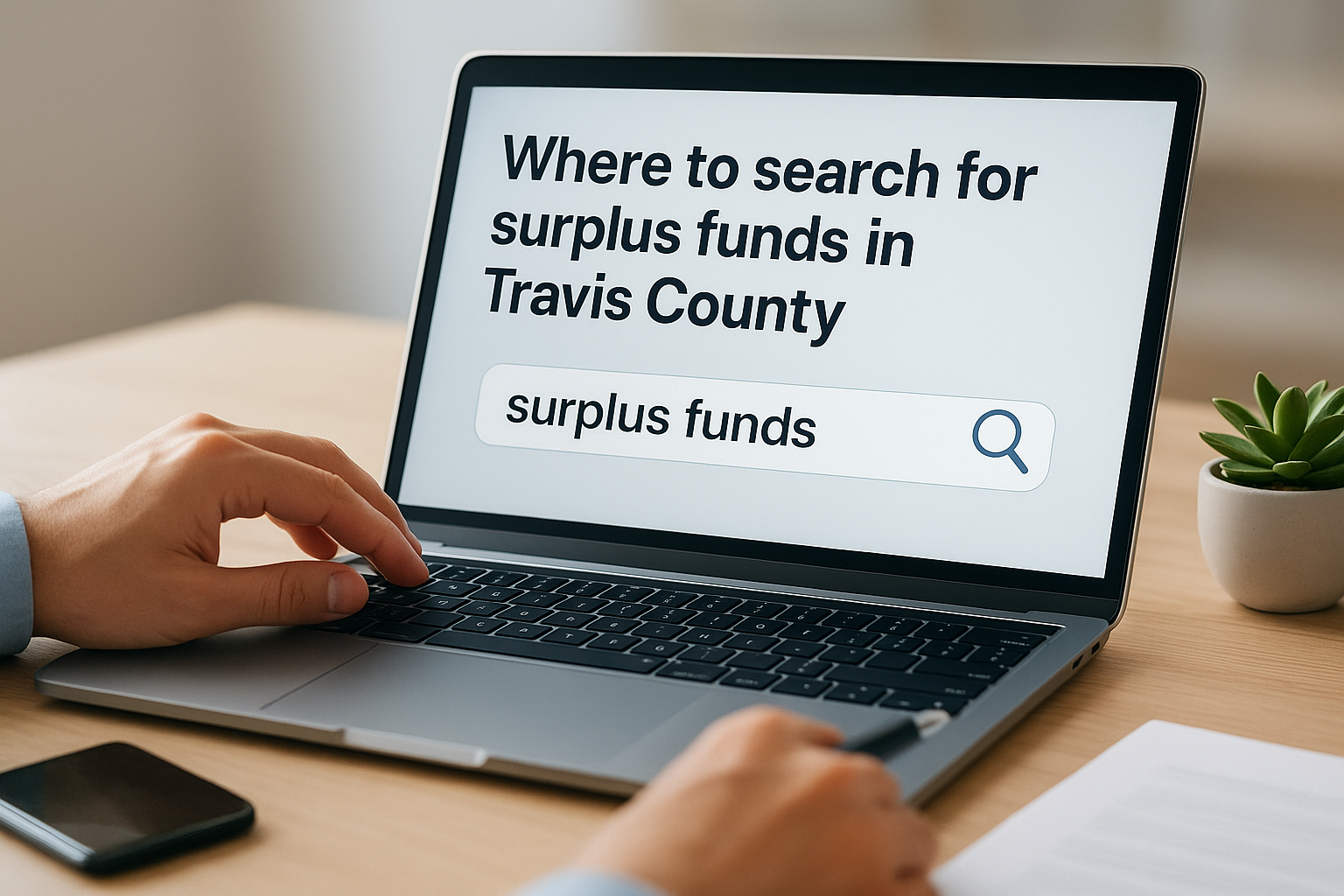
Your search for surplus funds Austin starts with identifying which government entity or court holds the money. You’ll need to check multiple databases because no single repository tracks all types of surplus funds. The process requires separate searches depending on whether your property went through a tax sale or mortgage foreclosure, and you may also discover unrelated unclaimed property in your name.
Texas Comptroller’s unclaimed property database
Start by searching the Texas Comptroller’s Unclaimed Property Division at ClaimItTexas.gov. This state database holds billions in unclaimed funds, including dormant bank accounts, utility deposits, insurance proceeds, and other financial assets. While this won’t show foreclosure surplus specifically, you might find money you didn’t know existed. Type your name exactly as it appeared on documents, then try variations with middle initials or previous addresses.
Travis County Tax Office and district court
Contact the Travis County Tax Office directly at 512-854-9473 to inquire about tax sale surplus. For mortgage foreclosure excess proceeds, you’ll need to check with the district court that handled your foreclosure case. Call the Travis County District Clerk’s office at 512-854-9457 and provide your case number or property address. Court staff can confirm whether surplus funds exist and guide you through the claim process.
You can’t assume someone will notify you about surplus funds automatically. You must take the initiative to search and file your claim.
How to claim state and city unclaimed property
The Texas Comptroller’s Unclaimed Property Division manages a straightforward online claim system that takes most people under 15 minutes to complete. If your search on ClaimItTexas.gov reveals money in your name, you can file your claim electronically without paying fees or hiring a representative. The state verifies your identity and ownership, then issues payment directly to you, typically within 30 to 90 days of approval.
Step-by-step claim filing process
Your claim submission requires proof of identity and ownership documentation. You’ll need to create an account on ClaimItTexas.gov, select the property you’re claiming, and upload supporting documents. The system guides you through each requirement based on the type of property and claim amount.
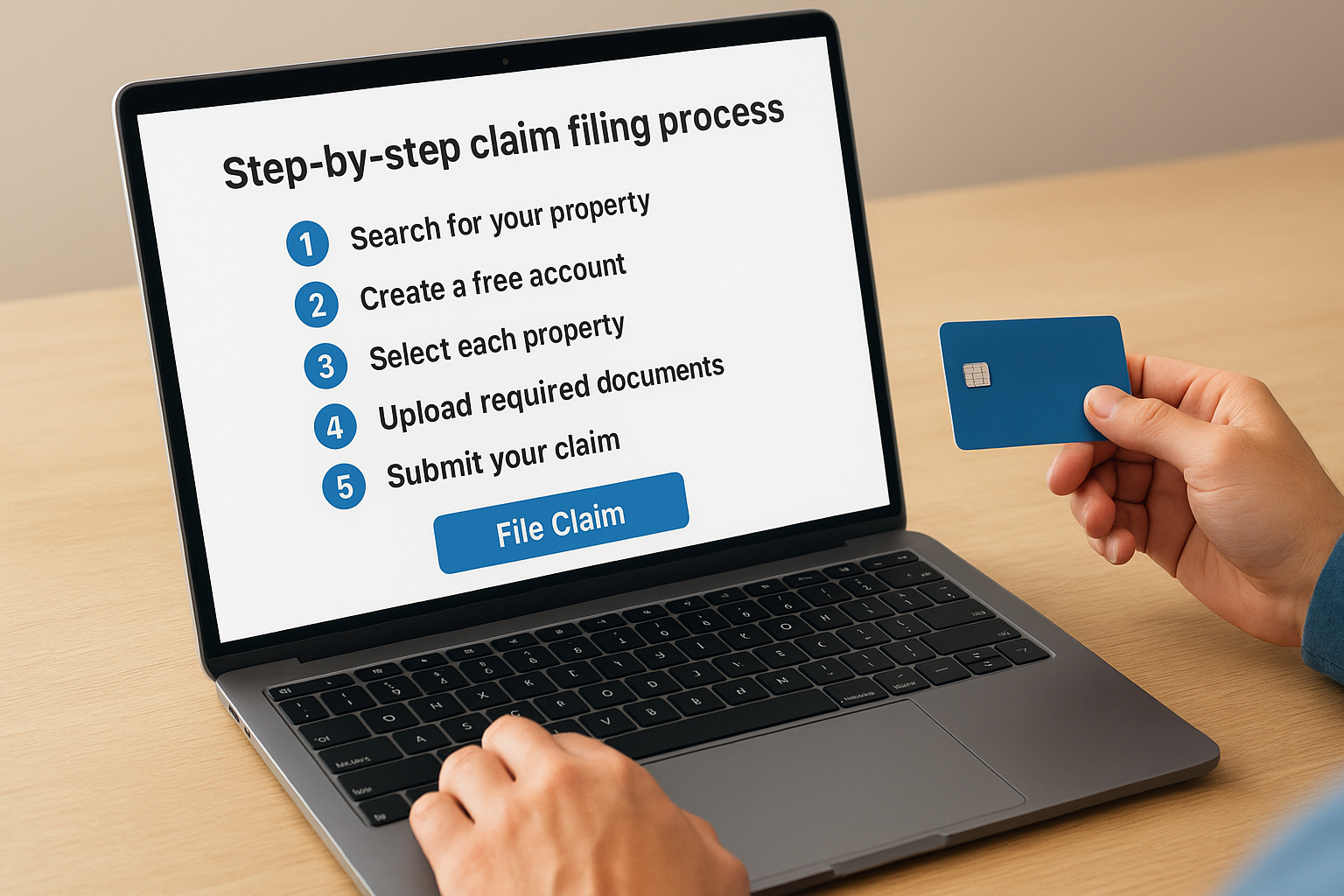
- Search for your property using your full name and previous addresses
- Create a free account with your current email and phone number
- Select each property you want to claim and click “File Claim”
- Upload required documents: driver’s license, Social Security card, and proof of address
- Add ownership proof if the property is under a business name or old address
- Submit your claim and save the confirmation number for tracking
Claims under $500 typically process faster because they require less documentation verification.
The Comptroller’s office may request additional proof if your name doesn’t match exactly or if multiple people claim the same property. Respond quickly to any requests to avoid delays in receiving your money.
How to claim foreclosure and tax sale excess proceeds
Claiming foreclosure excess proceeds requires different procedures depending on whether your property sold through a tax sale or mortgage foreclosure. Unlike the straightforward online system for general unclaimed property, surplus funds Austin claims from foreclosure sales typically involve court filings and notarized documentation. You’ll face strict deadlines, and you must prove your ownership interest in the foreclosed property before receiving payment.
Filing a claim for tax sale surplus
You must file your claim with the Travis County Tax Office within two years from the date of the tax sale. Contact the office at 512-854-9473 to request a claim form and ask which documents they require for verification.
Your tax sale surplus claim needs these documents:
- Completed claim form from the Travis County Tax Office
- Copy of your driver’s license or state-issued ID
- Deed or title showing you owned the property before the sale
- Notarized affidavit confirming your identity and ownership
- Lien releases if you paid off any judgments before the foreclosure
Tax sale surplus claims that miss the two-year deadline become property of the taxing entities that initiated the foreclosure.
Filing a claim for mortgage foreclosure proceeds
For mortgage foreclosure excess proceeds, you file through the district court that handled your foreclosure case. The trustee holds these funds temporarily and must deposit them with the court if no one claims them within specific timeframes.
Avoid delays, denials, and scams
Filing errors and fraudulent companies represent the two biggest threats to recovering your money. Travis County and Texas courts reject claims daily because applicants miss deadlines, submit incomplete paperwork, or fail to prove ownership properly. Meanwhile, scam companies prey on former homeowners who don’t understand the claim process, charging upfront fees or taking excessive percentages for services you can handle yourself.
Common mistakes that block your claim
Your claim gets denied when you miss filing deadlines, which vary by foreclosure type and can be as short as two years. Courts also reject applications with insufficient ownership documentation, such as unsigned affidavits or photocopies instead of certified deeds. Always verify which specific documents the county or court requires before you submit your claim. File copies of everything you send and get tracking confirmation if you mail physical documents.
Never pay anyone upfront to help you claim surplus funds, because legitimate attorneys only charge contingency fees or represent you on a case-by-case basis.
Red flags for surplus fund scams
Watch out for companies that contact you unsolicated claiming they’ve “found your money” and demand 30% to 50% of the surplus as their fee. These operations often require you to sign away rights before explaining the actual claim process. You can file surplus funds Austin claims yourself for free through official government channels, or hire a vetted attorney who charges reasonable contingency fees only after you receive payment.
Next steps
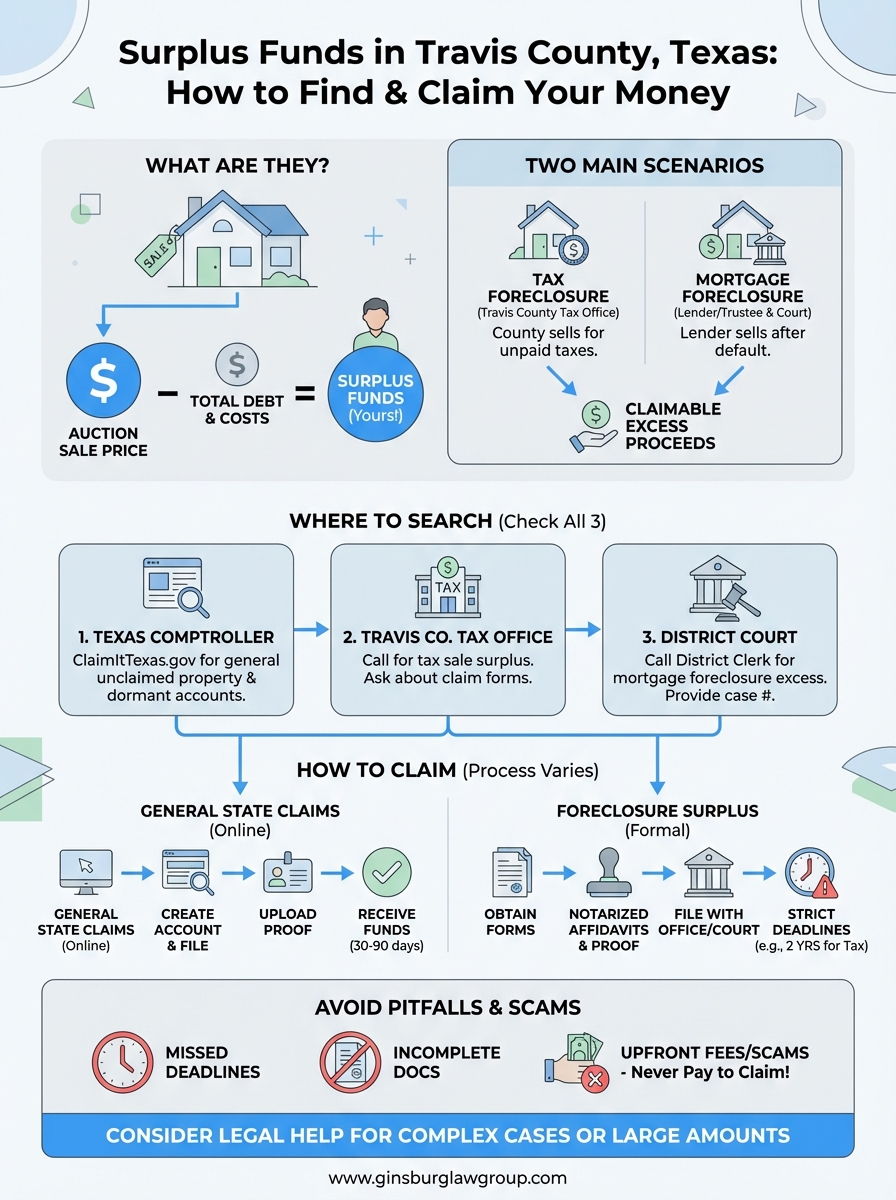
Recovering surplus funds Austin starts with checking all three databases: Texas Comptroller’s unclaimed property, Travis County Tax Office for tax sale proceeds, and the district court for mortgage foreclosure excess. You should begin your search immediately because filing deadlines can expire in as little as two years from the sale date. Document every communication and keep copies of all forms you submit.
If your claim involves complex ownership issues, competing claimants, or significant amounts of money, getting legal representation protects your interests. You might face challenges proving ownership if your deed has discrepancies or if junior lienholders also filed claims. Ginsburg Law Group helps consumers throughout Texas navigate foreclosure-related financial recovery and can evaluate whether your situation requires attorney assistance. Take action now before statutory deadlines eliminate your right to recover money that belongs to you.
Leave your feedback
Are you happy with the article?


