Your phone rings, and instead of a human voice, you hear a robotic message selling you an extended car warranty or threatening legal action over a debt you don’t recognize. Prerecorded voice calls have become one of the most common, and most complained about, forms of unwanted communication in the United States. What many people don’t realize is that federal law provides strong protections against these calls, and violations can result in significant financial penalties for the companies making them.
The Telephone Consumer Protection Act (TCPA) sets strict rules about when businesses can use prerecorded messages to contact consumers. These rules cover everything from telemarketing pitches to debt collection attempts, and they’ve become even more relevant as companies experiment with AI-generated voices that blur the line between human and machine. Understanding your rights under the TCPA is the first step toward stopping unwanted calls and potentially recovering damages.
At Ginsburg Law Group, we represent consumers who’ve been bombarded by illegal robocalls and prerecorded messages. This article breaks down the TCPA’s consent requirements, explains how the law applies to emerging AI voice technology, and outlines what you can do if your rights have been violated.
Why prerecorded voice calls matter
Robocalls represent the single largest source of consumer complaints to the Federal Communications Commission and Federal Trade Commission. In recent years, Americans have received billions of prerecorded voice calls annually, ranging from legitimate appointment reminders to outright scams. These calls don’t just interrupt your day; they consume your time, invade your privacy, and in many cases, attempt to deceive you into sharing personal information or making payments you don’t owe. The sheer volume of unwanted automated calls has fundamentally changed how people interact with their phones, with many consumers now avoiding calls from unfamiliar numbers entirely.
The real cost of unwanted automation
Prerecorded calls cost you more than just a few seconds of annoyance. When you answer a robocall during work, you lose productivity. When you’re bombarded with five calls per day from debt collectors using automated systems, the stress affects your mental health. Research shows that constant unwanted calls lead to anxiety, sleep disruption, and a sense of powerlessness. Scammers have weaponized this technology to target vulnerable populations, including elderly consumers who may not recognize sophisticated voice impersonation tactics.
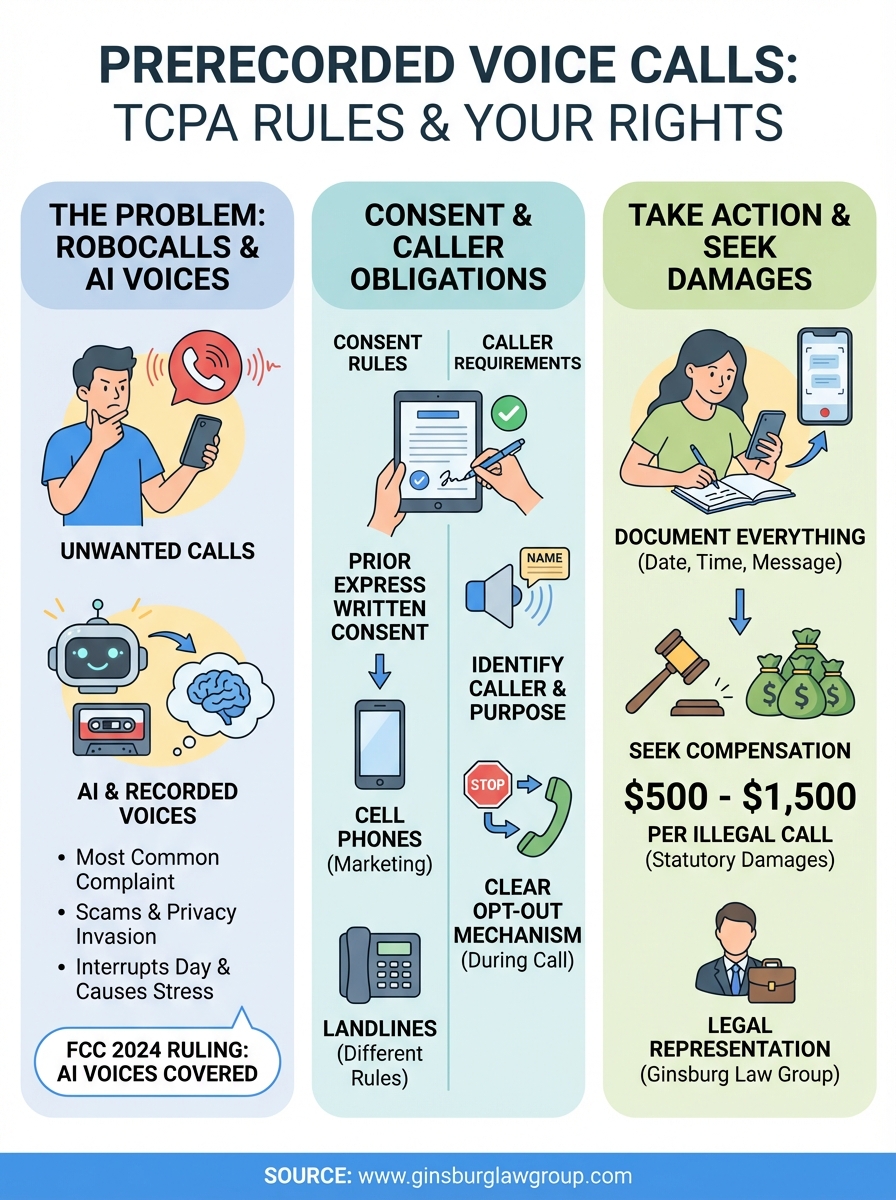
Companies that violate TCPA rules can face penalties of $500 to $1,500 per illegal call, creating a powerful financial incentive for compliance.
Why understanding your rights matters
You have legal protections that most companies hope you’ll never learn about. The TCPA gives you the right to stop unwanted calls, demand compliance with disclosure rules, and seek compensation when businesses break the law. Many consumers don’t realize that each illegal robocall represents a potential statutory damage award. Companies count on your lack of knowledge to continue their practices unchecked, which is exactly why understanding these rules matters for protecting yourself and holding violators accountable.
What counts as a prerecorded or artificial voice call
The TCPA defines prerecorded voice calls as any telephone message that uses a recorded or artificial voice to deliver content. This definition covers traditional robocalls where you hear a static recording, but it also includes more sophisticated systems that piece together pre-recorded words and phrases to create the illusion of a live conversation. If the voice you hear wasn’t spoken by a human at the exact moment you picked up the phone, it falls under TCPA regulation.
The legal definition
Artificial voice technology includes any voice that’s been recorded in advance or generated by computer systems. The FCC has clarified that this applies whether the recording is a simple static message or a complex system that responds to your spoken answers using pre-recorded segments. You don’t need to prove that advanced technology was used. If the company stored any portion of the voice before transmitting it to your phone, the call meets the definition.
The TCPA applies regardless of whether you can tell the voice is artificial or believe you’re speaking with a live person.
Common examples you’ll encounter
Your rights apply to marketing calls offering products, political campaign messages, debt collection attempts, and charity solicitations using recorded voices. Even calls that start with a live person but transfer you to a recorded message can trigger TCPA protections once that recording plays.
When consent is required under the TCPA
The TCPA requires prior express written consent before companies can make prerecorded voice calls to your cell phone for marketing purposes. This means businesses must obtain your written permission, usually through a signature or electronic agreement, before they can use automated systems to pitch products or services. The consent requirement doesn’t apply to all calls, though. Emergency notifications, calls from healthcare providers about appointments, and messages from schools or charities you’ve supported may proceed without written permission under certain circumstances.
Calls that require written consent
Telemarketing robocalls to your cell phone need your explicit written agreement before the first call. You must have signed a document or clicked through an online form that clearly disclosed you’d receive automated calls. Companies cannot hide this consent in fine print or assume that providing your phone number equals permission to robocall you.
Written consent must clearly state that you agree to receive calls using an automatic telephone dialing system or artificial or prerecorded voice.
Calls to landlines
Residential landlines receive stronger protections for marketing calls. Companies need your consent even before they can place prerecorded voice calls to these numbers, though the consent requirements differ slightly from cell phone rules.
What callers must include: disclosures and opt-out
Companies making prerecorded voice calls must follow strict disclosure rules designed to protect your rights. The TCPA requires callers to identify themselves at the beginning of each message and provide you with a clear way to stop future calls. These requirements apply whether the call is a marketing pitch, debt collection attempt, or political message. Businesses that skip these disclosures face penalties for each violation, though many still take shortcuts hoping consumers won’t report them.
Required identification information
Every prerecorded message must begin with the identity of the caller and, for commercial solicitations, the business’s phone number or address. You shouldn’t need to listen through a sales pitch to learn who’s calling. The identification must happen within the first few seconds of the message, giving you immediate context about whether the call deserves your attention or should be reported.
Callers cannot hide their identity behind vague company names or delay disclosures until after their pitch.
The opt-out mechanism
The TCPA requires an automated opt-out system that lets you stop future calls during the message itself. You must have access to a clear method, typically pressing a specific number, that immediately removes your number from the caller’s list. Companies have five seconds at the start and during the message to explain how you can opt out, and they must honor your request within a reasonable timeframe.
AI-generated and cloned voices: what changed in 2024
The Federal Communications Commission issued a landmark ruling in February 2024 that explicitly brought AI-generated voices under TCPA protection. This decision responded to growing concerns about companies using sophisticated voice cloning technology to make prerecorded voice calls sound more human. The FCC clarified that artificial intelligence systems generating speech fall under the same rules as traditional recorded messages, meaning companies need your written consent before using AI voices to call your cell phone for marketing purposes.
The FCC’s AI voice ruling
The 2024 ruling confirmed that any artificially generated voice counts as an artificial voice under the TCPA, regardless of how realistic it sounds. Companies cannot avoid consent requirements by arguing that their AI technology differs from traditional recordings. The FCC specifically addressed voice cloning, where systems replicate a specific person’s voice patterns, stating these calls receive the same regulatory treatment as robocalls.
AI-generated voices must follow identical consent and disclosure requirements as traditional prerecorded messages.
What this means for your protection
You now have clear legal grounds to challenge calls using AI voices that sound like real people but lack proper consent. Companies experimenting with voice synthesis technology cannot use novelty as an excuse for TCPA violations.
If you think a call broke the rules
Start documenting every suspicious call you receive. Write down the date, time, phone number displayed, and what the recorded message said. Note whether the caller identified themselves clearly, provided an opt-out mechanism, or obtained your consent before contacting you. Save voicemails and take screenshots of your call log. These records become crucial evidence if you decide to pursue legal action against companies making illegal prerecorded voice calls to your number.
You have legal rights under the TCPA that allow you to seek compensation for violations. Companies that break these rules face penalties between $500 and $1,500 per illegal call, money that goes directly to you as the consumer. You don’t need to prove actual financial harm. The statute provides damages simply because the violation occurred.
Ginsburg Law Group represents consumers nationwide in TCPA cases against companies that ignore robocall regulations. Our firm handles these cases on contingency, meaning you pay nothing unless we recover money for you. Contact us for a free case evaluation if you’ve received multiple illegal prerecorded calls.