At its heart, a Telephone Consumer Protection Act attorney is your advocate against the daily barrage of unwanted robocalls, junk texts, and aggressive telemarketing. They use a powerful federal law—the Telephone Consumer Protection Act (TCPA)—to hold offending companies accountable and can help you secure $500 to $1,500 for every single illegal call or text. This protection is part of a broader set of consumer rights designed to shield you from corporate overreach and harassment, alongside laws like the FDCPA and FCRA.
What Are Your Rights Under the TCPA

Think of the TCPA as a federally enforced ‘Do Not Disturb’ sign for your phone. Passed way back in 1991, this law was specifically designed to protect you from the growing problem of intrusive and unsolicited marketing. It draws a clear line in the sand, dictating exactly how and when businesses can contact you using automated technology. The TCPA is a key piece of consumer protection, similar to how the Fair Debt Collection Practices Act (FDCPA) governs how debt collectors can behave.
The whole point of the TCPA is to put you back in control of your phone. It acknowledges that your cell phone is a personal space, not a public billboard for any company that wants your attention. This is why the penalties are so steep—the law is meant to stop these disruptions before they take over your life.
The Cornerstone of TCPA: Your Express Consent
If you remember only one thing about the TCPA, make it this: express consent. A company needs your clear and direct permission before it can legally hit your phone with autodialed marketing calls or prerecorded messages. A vague “maybe” or an old relationship isn’t good enough; they need a definite “yes.”
When it comes to marketing calls and texts, the bar is set even higher. The law demands prior express written consent. This means you had to have physically or digitally signed something, checked a box on a form, or given another clear, written green light for them to send you promotional content.
A company can’t just assume you want their marketing texts because you bought something from them two years ago. The responsibility is on them to prove they have your explicit, written permission for every automated marketing message.
Understanding this one concept is the key to spotting a potential violation. If you’re getting texts from a business you never explicitly agreed to hear from, they are probably breaking the law. A good telephone consumer protection act attorney can dig into the details and determine if the “consent” a company claims to have is actually legitimate.
Key Protections the TCPA Provides
Beyond just consent, the TCPA lays out several other ground rules to protect your peace and privacy. These regulations create a framework that every telemarketer must follow—or risk facing major financial consequences.
Here’s a quick rundown of some of the most important TCPA rules.
Key TCPA Protections at a Glance
The TCPA provides a comprehensive set of rules to govern how companies can contact consumers. This table summarizes the main protections that put you in control.
| Protection Area | What It Means for You |
|---|---|
| Consent Requirements | Companies need your express written consent for automated marketing calls/texts. |
| Calling Time Restrictions | Telemarketers cannot call before 8 a.m. or after 9 p.m. in your local time zone. |
| National Do-Not-Call Registry | Once on the list, most telemarketers must stop calling you within 31 days. |
| Internal Do-Not-Call Lists | You can tell any company to stop calling, and they must legally honor that request. |
| Required Identification | Callers must identify themselves, the company they represent, and provide contact info. |
These protections work together to build a strong defense against telemarketing harassment.
When a company ignores these fundamental rules, they expose themselves to legal action. This is more than just a matter of being annoyed; it’s about enforcing your consumer rights. If you want to take a closer look at the law itself, you can learn more about what the Telephone Consumer Protection Act is in our detailed guide. Knowing these rights is the first step toward recognizing when a company has crossed the line and it’s time to get help from a TCPA lawyer.
Recognizing Common TCPA Violations
Knowing your rights is one thing, but spotting a violation in the wild is another. It’s how you can actually fight back. So many people just assume an unwanted call or text is annoying when, in reality, it’s flat-out illegal. The first step is learning to recognize the common tactics that aggressive marketers and debt collectors use. This is how you turn that frustration into a solid legal claim.
The violations I see most often boil down to one thing: a lack of proper consent. If you’re getting automated marketing texts you never signed up for or relentless robocalls from a company you’ve told to stop, those are huge red flags. Each one of those messages or calls could be a separate violation, and they can add up quickly.
Autodialers and Prerecorded Messages
One of the biggest targets of the TCPA is a piece of technology called an autodialer. Just think of it as a system that can automatically dial numbers from a list or just generate them randomly. If a company uses one to call or text your cell phone for marketing reasons without your clear, written permission, they’ve likely broken the law.
The same goes for prerecorded or artificial voice messages. We’ve all gotten them. You pick up the phone and a robotic voice starts its sales pitch. That’s a classic TCPA violation if you never agreed to receive those calls. And yes, this includes those prerecorded voicemails—they count just like a direct call.
Here’s the most important part: the burden of proof is on the company, not you. They have to prove they got your consent. You don’t have to prove you didn’t give it.
These rules are so strict for a reason. Automated systems can blast out thousands of calls an hour, making them a powerful tool for harassment. A good telephone consumer protection act attorney knows how to use a company’s reliance on this technology to build a strong case against them.
Ignoring Your Right to Say Stop
Even if you did give a company permission to contact you at some point, that permission doesn’t last forever. You have the absolute right to take it back whenever you want, and they have to respect your decision. This goes for both calls and texts.
When you reply “STOP” to a marketing text, that’s a legally binding command. If they send you even one more promotional message after that, they’ve violated the TCPA. The same is true for phone calls. If you tell a live agent, “Put me on your do-not-call list,” they are required by law to do it immediately.
Some of the most common examples I see from clients include:
- Persistent Texts After “STOP”: You text “STOP,” get a confirmation message, and then a week later, another promotional text from them pops up.
- Ongoing Calls After a Verbal Request: You clearly tell a telemarketer to stop calling, but they keep coming, sometimes from different phone numbers.
- Ignoring the National Do-Not-Call Registry: Your number has been on the registry for more than 31 days, but you’re still getting calls from companies you’ve never done business with.
It’s critical to document every single text and call you get after you’ve told them to stop. Each one can add $500 to $1,500 to the compensation you’re owed. For a closer look at these scenarios, take a look at our overview of Telephone Consumer Protection Act violations. By keeping a careful record, you’re handing your attorney the exact evidence they need to demand justice on your behalf.
How a TCPA Attorney Fights for You
Trying to stop a wave of illegal calls and texts from a big company can feel impossible, like you’re shouting into the wind. This is exactly where a skilled TCPA attorney steps in. Think of them as your personal advocate, armed with the legal know-how to take on corporate legal teams and win. They handle the entire process, turning your daily frustration into a solid legal claim. An attorney specializing in consumer rights, whether it’s TCPA violations, FDCPA harassment, or Lemon Law disputes, understands how to level the playing field.
The first thing your attorney does is put up a shield. As soon as you hire them, they formally notify the company to stop contacting you immediately. All future communication has to go through their office, which means your phone finally stops buzzing. That alone is a huge relief.
Building Your Case from the Ground Up
Once the harassment stops, your lawyer switches into investigator mode. They’ll start with the evidence you’ve gathered—your call logs, screenshots of texts, and any notes you took—and begin piecing together a clear timeline of the violations.
But their investigation goes much deeper than just what’s on your phone. An experienced TCPA lawyer knows exactly what to dig for. They’ll scrutinize the company’s calling technology and internal procedures to prove the core elements of your case:
- Was an Autodialer Used? Through legal discovery, they can find out if the company used an automated telephone dialing system (ATDS) to blast out calls or texts, which is a major red flag under the TCPA.
- Did You Actually Give Consent? They put the burden of proof on the company to produce clear, undeniable evidence that you gave them express written consent to be contacted for marketing.
- Did They Ignore You? Your attorney will use your “STOP” texts or records of you telling them to stop calling as proof that the company knowingly broke the law after you revoked consent.
This is how your personal experience gets transformed from a simple complaint into a powerful legal argument that can stand up in court.
Making Them Pay (Without Costing You a Dime)
With a rock-solid case built, your attorney shifts from investigation to direct action. They’ll file a lawsuit on your behalf, officially starting the process to hold the company financially accountable. Armed with a deep understanding of TCPA case law, they’ll push for a settlement that reflects the true value of your claim—which can range from $500 to $1,500 per illegal call or text.
Best of all, you don’t need a pile of cash to get this kind of expert legal help. Nearly all TCPA attorneys work on a contingency fee basis.
What does this mean? It means you pay zero upfront fees. Your lawyer only gets paid if they successfully win your case, taking a percentage of the final settlement or court award. This approach opens the door to justice for everyone, not just those who can afford to pay a lawyer by the hour.
You are definitely not alone in this. TCPA lawsuits are on the rise as more and more people learn about their rights and fight back. In fact, TCPA complaints recently shot up by 66.6% in just one year, and class action lawsuits jumped by over 39%. This surge shows that people are successfully using the law to stop harassment. You can read more about the latest trends in TCPA litigation to see how things are changing. By getting an attorney, you’re joining a growing movement of people who are using the law to get the peace—and the compensation—they deserve.
Building a Strong TCPA Claim
Winning a TCPA lawsuit boils down to having solid proof. While a TCPA attorney will navigate the legal minefield for you, the evidence you gather beforehand can make all the difference. Think of yourself as the lead detective on your own case.
The steps you take right now can put you in a powerful position to win. It all starts with documenting everything.
Your Actionable Evidence Checklist
The best cases are built on a foundation of clear, undeniable proof. It’s easy to get frustrated and just delete the illegal calls and texts, but you need to resist that urge. Instead, start documenting them. Every piece of evidence you save is another building block for your claim.
Here’s a practical checklist of what to start gathering immediately:
- Screenshot Your Call Logs: Grab clear screenshots of your phone’s call history. Make sure each image shows the full phone number, the date, and the time of the call.
- Save Every Text Message: Don’t delete a single illegal text. Screenshot the entire conversation, especially your requests to “STOP” and any messages they sent after that.
- Preserve Voicemails: If they leave prerecorded voicemails, save them. These are often slam-dunk evidence of a TCPA violation and can be incredibly powerful.
- Keep Detailed Notes: Start a simple log or a note on your phone. For every call or text, jot down the date, time, the number that contacted you, and a quick summary (e.g., “robocall for auto warranty,” “text ad for pizza after I replied STOP”).
This kind of detailed record-keeping transforms your frustration into a concrete timeline of illegal harassment that an attorney can use to build a powerful case.
The Power of Revoking Consent Correctly
One of the most critical pieces of evidence is proof that you clearly told the company to stop contacting you. This is what we call revoking consent. While telling a live agent to “put me on your do-not-call list” is a good start, a written record is far more compelling in court.
Replying “STOP” to a marketing text is the gold standard. The law requires them to honor that request immediately. When they ignore it and text you again, they are willfully breaking the law, which can boost your potential compensation from $500 to a hefty $1,500 per violation.
A written record of you revoking consent—like a “STOP” text—is a powerful tool. It removes any doubt and shows a clear disregard for your rights, making it much harder for the company to argue they made an innocent mistake.
Once you have this evidence organized, you’re not just a victim—you’re a plaintiff with a strong case. A good TCPA attorney can take your documentation and hit the ground running. If you’re getting ready for the legal journey, it helps to know what to expect during questioning. You can learn more by checking out our TCPA deposition preparation guide to feel fully prepared.
This visual breaks down the straightforward process your attorney will follow to turn your evidence into a successful outcome.
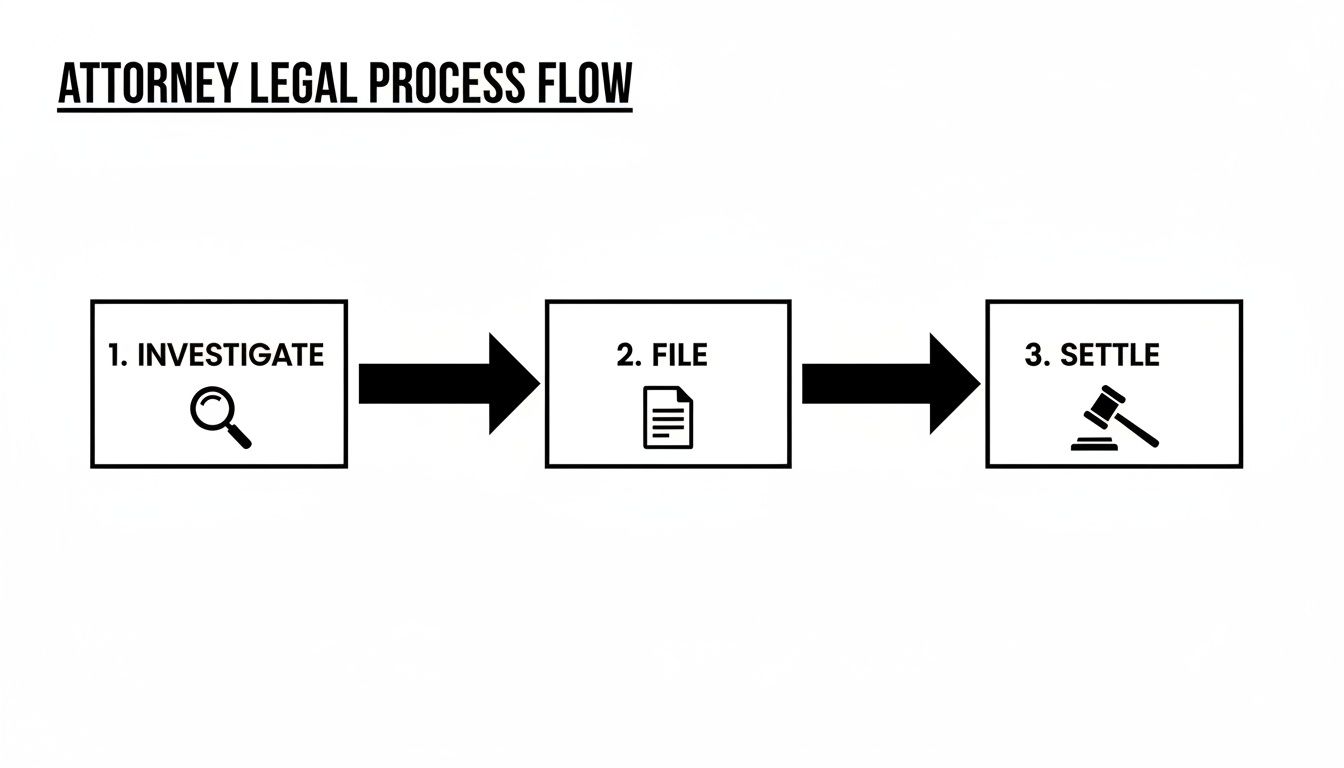
The process is simple: your lawyer investigates the facts, files the necessary legal paperwork, and works to secure a settlement that compensates you for the harassment.
What’s Your Claim Really Worth?
Taking a stand against illegal calls isn’t just about stopping the constant buzzing in your pocket. It’s also your chance to hold companies financially accountable for breaking the law. Congress put serious teeth into the TCPA, and the penalties for each violation can add up much faster than you might think.
The law is very clear about the penalties. It’s not a fine the company pays to the government; it’s statutory damages paid directly to you. A TCPA attorney can look at the evidence you have and give you a realistic idea of what your claim could be worth based on these fixed amounts.
How TCPA Damages Are Calculated
The TCPA has a two-tiered system for compensation. There’s a base penalty for any violation, and a much higher penalty for companies that knew they were breaking the rules and did it anyway.
Here’s how it breaks down:
- $500 Per Violation: You’re entitled to $500 for every single illegal call, text, or robocall voicemail. Every. Single. One.
- Up to $1,500 Per Willful Violation: If you can prove the company acted knowingly—for example, they kept texting you after you replied “STOP”—a judge can triple the damages to $1,500 per violation.
These penalties are not a one-time thing. They apply to each individual infraction. An unwanted text is one violation. A robocall that hits your voicemail is another. This is how a minor annoyance can quickly become a significant claim for damages.
Let’s look at a quick example: A company has been spamming you with marketing texts, and you have proof of 20 of them. At the base rate of $500 each, that’s already a $10,000 claim. If they sent those texts after you told them to stop, that amount could jump to $30,000.
This “per-violation” structure is the muscle behind the TCPA. It makes it financially painful for companies to ignore the law, forcing them to weigh the risk of every single message they send.
The Force of a Class Action Lawsuit
Sometimes, your bad experience is just the tip of the iceberg. When a company is blasting out illegal robocalls or texts to thousands of people, a class action lawsuit becomes the most powerful way to fight back. In a class action, one or a few people sue on behalf of a much larger group that has been harmed in the same way.
Class actions are incredibly effective in TCPA cases because they bundle thousands of smaller claims into one massive legal fight. This creates the kind of leverage needed to get the attention of huge corporations and hold them accountable. The result is often multi-million dollar settlements that no single person could ever hope to achieve on their own.
Because the TCPA has no cap on total damages, the financial risk for companies is enormous. Remember, private citizens can seek $500 per violation, which can be tripled to $1,500 for willful violations. When a company makes thousands of illegal calls, that liability multiplies into the millions. This uncapped penalty structure, as detailed by platforms like LoanPro, gives consumer attorneys a very strong hand when negotiating settlements. Your individual claim gains immense power when joined with others in a class action.
How State Telemarketing Laws Strengthen Your Rights
While the federal TCPA is a powerful shield, it’s not the only weapon in your arsenal against unwanted calls and texts. Many states have their own consumer protection laws, often called “mini-TCPAs,” that can provide even stronger protections and, in some cases, lead to significantly higher damages. This is similar to how state-specific Lemon Laws offer protections for defective vehicles that go beyond federal warranty acts.
Think of it like this: the federal TCPA sets the floor for consumer rights—the minimum standard of protection that applies to everyone in the United States. But many states have decided to build on that foundation, creating stricter rules that close loopholes and hold aggressive telemarketers more accountable. Where you live can make a huge difference in the strength of your case.
This complex web of state and federal regulations is exactly why having a seasoned TCPA attorney is so critical. They know how to examine the unique details of your situation and figure out which laws—state, federal, or a combination of both—give you the most powerful leverage.
The Advantage of Stronger State Laws
The differences between federal and state laws aren’t just minor details; they can be game-changers for your claim. A violation that might net you $500 under the federal TCPA could be worth much more under a state statute.
Here are a few ways state laws often give you an edge:
- Broader Definitions: Some states use a much wider definition of an “autodialer,” making it far easier to prove a company broke the law.
- Stricter Consent Rules: Your state might demand explicit written consent for calls or texts in situations where federal law is a bit murkier.
- Higher Penalties: Some states have put real teeth into their laws, with penalties that can dwarf the federal maximum of $1,500 per violation.
- Longer Statutes of Limitations: You may have more time to file a lawsuit under your state’s law than the four years allowed by the federal TCPA.
Leveraging Both Federal and State Statutes
A smart attorney doesn’t just choose one law and stick with it. They strategically weave together federal and state statutes to build the strongest case possible. In recent years, at least 15 states have passed their own robust telemarketing laws.
Some of these “mini-TCPAs” expand the definition of “telephone solicitation” to explicitly include text and image messages, while others link violations to deceptive trade practice acts, which can sometimes allow for triple damages. A few states have even set penalties as high as $20,000 per violation. An attorney who knows this landscape can use it to your advantage, fighting to get you every dollar you deserve. You can find more details about the complex state-level enforcement landscape on parkerpoe.com.
The existence of these state laws is a game-changer. It means your claim could be far more valuable than you initially realize, and it gives your attorney multiple legal avenues to pursue justice on your behalf.
Ultimately, this dual layer of protection highlights why getting expert legal advice is so important. A qualified lawyer can navigate the intricacies of both federal and local laws, ensuring that companies are held accountable under every single applicable statute. This dramatically increases your chances of a successful outcome.
Frequently Asked Questions About TCPA Lawsuits
Deciding whether to take legal action against a company is a big step, and it’s natural to have questions. Most people feel a little intimidated at the thought of squaring off against a big corporation, but knowing what to expect can make the whole process feel much more manageable.
Let’s walk through some of the most common concerns people have before they even think about calling an attorney.
One of the first things on everyone’s mind is cost. The good news? You don’t need a pile of cash to get top-tier legal help. Almost every telephone consumer protection act attorney takes these cases on a contingency fee basis.
What does that mean for you? It’s a “no win, no fee” arrangement. You pay absolutely nothing upfront. Your lawyer’s fee is simply a percentage of the money they recover for you, whether it’s from a settlement or a court verdict. If they don’t win, you don’t owe them a dime.
How Long Does a TCPA Lawsuit Take?
Honestly, it varies quite a bit. Some cases wrap up surprisingly fast, sometimes in just a few months. This usually happens when the proof of a violation is crystal clear, and the company decides it’s better to settle quickly than drag things out.
On the other hand, more complicated cases can take longer, especially if they grow into a class action lawsuit. These can stretch out for a year or more as they move through investigation, legal motions, and negotiations. Once an attorney reviews the specifics of your situation, they can give you a much better estimate of the timeline.
Is One Unwanted Text or Call Enough to Sue?
Yes, absolutely. A single illegal text or robocall is a violation of the TCPA, full stop. The law was designed to protect you from each and every unwanted contact. That one text you got from a company you never gave your number to? That’s a violation worth $500.
If that text arrived after you had already told them to stop contacting you, the violation is considered willful, and the penalty jumps to $1,500. While it might not always make sense to file a lawsuit over a single text, that one message is still proof that the company broke the law. A good lawyer will look at that single violation and see if it’s part of a bigger pattern of behavior, which could lead to a much larger case. Never assume a violation is too small to matter.
Ready to stop the harassment and get the compensation you deserve? The team at Ginsburg Law Group PC is here to help you understand your rights and fight back. We offer free consultations to evaluate your case and explain your options with no obligation. Contact us today to get started.